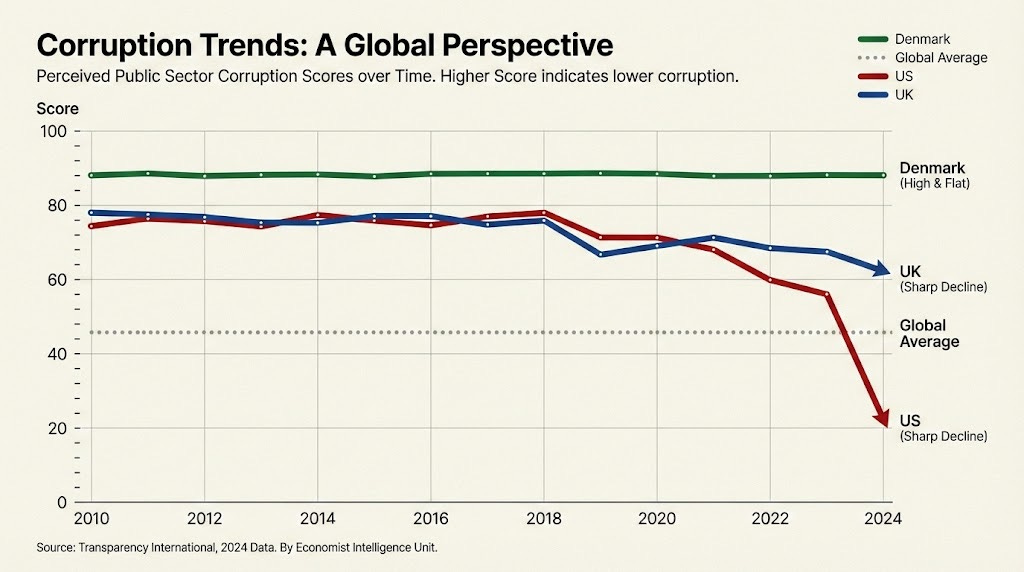
US, UK plunge to historic lows in 2025 global corruption index
Transparency International report warns of ‘leadership gap’ as Western democracies slide; global average hits record low.

The global fight against public sector corruption has hit a critical impasse, with established democracies including the United States and the United Kingdom plunging to historic lows in the 2025 Corruption Perceptions Index (CPI).
Released Tuesday by Transparency International, the report paints a stark picture of a “leadership gap” that has allowed graft to metastasize even in nations once considered paragons of integrity. The global average score fell to 42 out of 100 — a new low — while more than two-thirds of the 182 countries and territories surveyed scored below 50.
”We’re seeing a concerning picture of long-term decline in leadership to tackle corruption,” said Maíra Martini, CEO of Transparency International. “The absence of bold leadership is leading to weaker standards and enforcement, lowering ambition on anti-corruption efforts around the world.”
The West crumbles
The most alarming findings in the 2025 index center on the continued erosion of anti-corruption standards in the West. The United States fell to a score of 64, ranking 29th globally — its lowest position in the history of the index. This marks a significant drop from previous years and places the world’s largest economy behind countries such as Barbados, Bhutan, and the United Arab Emirates.
Transparency International attributes the U.S. decline to a “perfect storm” of institutional weakening. The report explicitly cites the degradation of the Foreign Corrupt Practices Act (FCPA), a landmark law prohibiting the bribery of foreign officials, which has seen enforcement freezes and regulatory rollbacks. Additionally, the report points to increasing attacks on judicial independence and a reduction in funding for global civil society programs that monitor government overreach.
”The United States government’s decision to temporarily freeze and then degrade enforcement of its Foreign Corrupt Practices Act sends a dangerous signal that bribery and other corrupt practices are acceptable,” the report states.
Across the Atlantic, the United Kingdom also hit a record low with a score of 70, ranking 20th. The slide follows a series of domestic scandals involving political donations and “cash for access” allegations that have plagued Westminster. The report highlights that “political finance loopholes” and the “targeting of campaigners” have damaged public trust in British institutions.
”This persistent decline is not a temporary blip – it risks becoming a defining feature of our political culture,” said Daniel Bruce, chief executive of Transparency International UK, in a statement. “The UK government must demonstrate that it is serious about restoring integrity.”
Global crisis of leadership
The 2025 CPI reveals that the rot is not confined to any single region. While Denmark (89), Finland (88), and Singapore (84) continue to top the rankings, even the highest-performing region — Western Europe — is showing signs of stagnation. The region’s average score is dropping faster than any other, a trend the report describes as a wake-up call for European leaders.
”Western European nations make up nine of the top ten countries globally... However, anti-corruption efforts have largely stalled in recent years,” the report notes.
The “leadership gap” identified by the watchdog refers to a widespread failure by heads of state to enforce existing laws and protect the independence of institutions. In many cases, leaders are actively dismantling the checks and balances designed to hold them accountable.
This retreat from accountability has serious real-world consequences. The report draws a direct line between corruption and the failure to deliver basic services. “Corruption leads to under-funded hospitals, unbuilt flood defenses, and blights the hopes and dreams of young people,” Martini said.
Regional breakdowns
The Americas: Organized Crime and Impunity
In the Americas region, the report describes a landscape besieged by organized crime and weak democratic institutions. With the U.S. faltering, the regional anchor for anti-corruption enforcement is drifting. Countries like Venezuela (10), Haiti (16), and Nicaragua (14) remain at the bottom, paralyzed by state capture and criminal networks.
However, the report notes that “years of inaction by governments... has weakened democracy and allowed the growth of organized crime.” This is particularly evident in the struggle to combat environmental crimes, where corruption facilitates illegal logging and mining across the Amazon basin.
Asia Pacific: Stagnation and Elite Influence
The Asia Pacific region shows a pattern of “stalling anti-corruption progress.” While 31 countries globally have improved since 2012, most in this region have not. The report cites “well-connected elites often buying political influence” as a primary driver of stagnation.
China scored 43, ranking 76th, reflecting an ongoing struggle to root out corruption despite high-profile crackdowns. Meanwhile, democracies in the region like South Korea (63) and Taiwan (68) perform relatively well but face pressure to maintain transparency in increasingly polarized political environments.
Eastern Europe and Central Asia: Authoritarianism Rising
This region remains one of the lowest-performing, with a score of 34 out of 100. The report condemns “widespread impunity for corruption being driven by the vested interests that dominate most governments.”
Russia’s score of 22 (ranking 157th) reflects the utter collapse of independent oversight, while countries like Georgia (50) and Bosnia and Herzegovina (34) struggle with democratic backsliding. The concentration of power in the executive branch and the suppression of NGOs are recurring themes in the region’s analysis.
Sub-Saharan Africa: Conflict and Corruption
Sub-Saharan Africa continues to face the highest levels of perceived corruption, with a regional average that lags behind the rest of the world. The connection between corruption and conflict is stark: South Sudan (9) and Somalia (9) occupy the very bottom of the index.
”Weak democracy... sometimes paired with armed conflicts, insecurity and escalated civil unrest – continues to undermine governance,” the report finds. However, there are glimmers of hope; the report notes that anti-government protests in countries like Madagascar (25) show a populace increasingly unwilling to accept the status quo.
Gen Z
A unique highlight of the 2025 report is the role of young people in demanding accountability. Transparency International points to a surge in “Gen Z-led protests” in countries scoring poorly on the index.
In Nepal (34) and Madagascar (25), young demonstrators have taken to the streets to criticize leaders for abusing power. The report characterizes these movements as a vital counter-force to the “leadership gap,” proving that while institutions may be failing, public demand for integrity remains robust.
”Anti-government protests in many parts of the world show that people are fed up with unaccountable leadership and are demanding reform,” the report states.
Skepticism
The CPI ranks 182 countries and territories by their perceived levels of public sector corruption, using a scale of 0 (highly corrupt) to 100 (very clean). The index relies on 13 external data sources from independent institutions, including the World Bank and the World Economic Forum.
Critics of the index often point out that “perception” does not always align with reality, and that the index can be biased toward Western definitions of governance. Transparency International acknowledges that nations with “clean” public sectors can still enable global corruption by facilitating money laundering—a “cross-border corruption” that the CPI’s domestic focus does not fully capture.
”Nations with the least corrupt public sectors can still have serious integrity issues... many enable corruption in other countries by facilitating the transfer of proceeds of corruption across borders,” the report clarifies.
Moving forward
Despite the grim statistics, Transparency International insists that corruption is not inevitable. The report outlines a “clear blueprint” for reversing the trend: strengthening justice systems, enhancing oversight of public spending, and closing loopholes for secret money in elections.
But the window for action is closing. With the global average score sliding and major powers retreating from their anti-corruption commitments, the burden is increasingly falling on civil society and independent media to hold power to account.
”At a time of climate crisis, instability and polarization, the world needs accountable leaders and independent institutions to protect the public interest more than ever,” Martini concluded. “Yet, too often, they are falling short.”