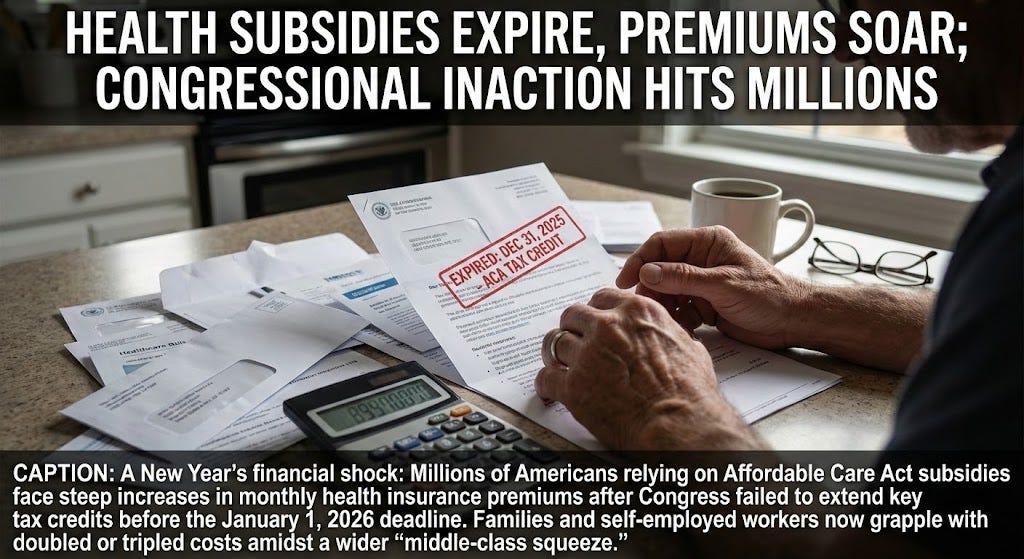
The ball dropped and so did your safety net: ACA subsidies expire in silence
Congress did not need a vote to double your premiums — they just needed a calendar. Inside the strategy of weaponized inertia that quietly delivered a massive New Year's tax hike.
The ball has dropped, the confetti is being swept from Times Square — and in living rooms across America, the financial hangover of 2026 is setting in before the champagne even wears off.
Congress didn’t need a roll call vote to execute the largest tax hike on the middle class in recent history this New Year’s Day. They simply needed a calendar.
As of this morning, the enhanced tax credits that have kept health insurance affordable for millions of Americans are dead, victims of a legislative strategy that political analysts are calling “weaponized inertia.” By allowing the clock to run out following a bruising 43-day government shutdown, lawmakers effectively enacted a massive financial penalty on the self-employed, the working class and the gig economy — all without ever having to put their names to a “yea” or “nay” vote.
The result is a silent but violent collision between Washington procedure and household budgets. For the vast majority of the 20 million enrollees in the Affordable Care Act (ACA) marketplace, premiums are not just creeping up; they are doubling or tripling overnight.
The “middle-class squeeze,” a favorite buzzword of the campaign trail, has officially been replaced by legislative neglect. Welcome to the era of suffocation.
Math of ‘Inaction’
While Washington treats the subsidy expiration as a procedural stalemate, for Americans like Katelin Provost, the cost of congressional silence is a precise and devastating figure: $665 a month.
That is the difference between the $85 premium the 37-year-old single mother paid last year and the nearly $750 bill she faces today, according to reporting by The Associated Press.
”It really bothers me that the middle class has moved from a squeeze to a full suffocation, and they continue to just pile on and leave it up to us,” Provost told AP political reporter Ali Swenson.
Provost is a social worker, a professional accustomed to navigating the frayed edges of America’s safety net. But as the AP notes, the expiration of these subsidies pushes her into a demographic that policymakers frequently overlook: the “too rich for Medicaid, too poor for the market” gap. If Congress fails to revive the subsidies in a Hail Mary vote later this month, Provost says she will drop her own coverage to keep her 4-year-old daughter insured.
She is effectively becoming a casualty of the legislative calendar.
Stan Clawson represents another demographic the strategy of inertia relies on: the captive customer. As detailed in Swenson’s coverage, Clawson is a 49-year-old freelance filmmaker and adjunct professor in Salt Lake City who lives with paralysis from a spinal cord injury. He cannot afford to play chicken with his health coverage.
When his premiums jumped from $350 to nearly $500 overnight — an “inaction tax” of $150 a month — he didn’t have the luxury of walking away. He told the AP he absorbed the expense because the alternative is physical peril.
Pocket Veto by Attrition
How did we get here? The expiration is the culmination of a high-stakes game of legislative chicken that began late last year.
The subsidies, originally passed as a temporary pandemic measure in 2021 and extended by Democrats, were set to sunset on Dec. 31, 2025. Democrats forced a shutdown in a desperate bid to attach the extension to must-pass spending bills. Moderate Republicans, eyeing their 2026 reelection prospects, signaled willingness to cut a deal. Even President Donald Trump floated a potential compromise, only to retreat following intense conservative backlash against “permanent entitlements.”
In the end, the path of least resistance won.
This is “inaction as policy.” By letting the deadline pass, fiscal conservatives achieved a long-standing goal — reducing federal outlays — without the messy optics of voting to strip healthcare from constituents. It is a pocket veto by attrition.
But the economic fallout is immediate. According to an analysis by the Urban Institute and the Commonwealth Fund, the surging prices are expected to prompt some 4.8 million Americans to drop coverage entirely in 2026.
This triggers a secondary crisis known to actuaries as the “death spiral.” As younger, healthier Americans like freelance creatives and gig workers flee the market because they can’t justify the new $600 monthly price tag, the insurance pool becomes older and sicker. This, in turn, drives premiums even higher for those who remain, creating a feedback loop of unaffordability.
Political Boomerang
If “weaponized inertia” was the strategy in D.C., the battlefield is about to shift to the districts that decide the House majority. The political irony of 2026 is that the ACA enrollee is no longer just a blue-state trope; they are the statistical backbone of the Republican majority.
The geography of pain does not favor the GOP. Recent data indicates that nearly 57% of all ACA marketplace enrollees live in districts represented by Republicans.
The epicenter is Florida. Key Republican incumbents like Rep. Maria Elvira Salazar and Rep. Carlos Giménez represent districts where over a third of the population relies on these now-expired credits. In Miami-Dade, the expiration looks less like a policy shift and more like a 100% markup on the cost of living.
For members in these swing districts, the “inaction” defense — claiming they didn’t vote to raise costs — crumbles when constituents open their January statements. The “tangible loss” doctrine in political science suggests that voters punish the removal of an existing benefit far more severely than they reward the creation of a new one.
Furthermore, the expiration disproportionately targets the entrepreneurial class — the very demographic both parties claim to champion.
The modern ACA market is heavily populated by small business owners, ranchers, consultants and independent contractors who lack employer-sponsored plans. In states like Texas and Florida, which boast the highest rates of incorporated self-employed workers, these voters are fiscally conservative but uniquely vulnerable to market shocks.
By letting subsidies expire, Congress has effectively levied a targeted tax on entrepreneurship. Come November, the “party of business” may find that the business owners are the ones holding the pitchforks.
A Narrow Window Remains
Is this permanent? Technically, no.
The window to select and change plans remains open until Jan. 15 in most states (see HealthCare.gov). This offers a sliver of time for a legislative fix, though the odds are long.
In the House, a group of four centrist Republicans has broken with GOP leadership, joining forces with Democrats to force a discharge petition that could bring a three-year extension vote to the floor as soon as mid-January.
”We need a solution, not a stalemate,” one of the moderate Republicans told reporters off the record, citing fears of a “blood bath” in the midterms.
But even if the House passes a fix, it faces a wall in the Senate, which already rejected two partisan health care bills in December — a Democratic pitch for extension and a Republican alternative focused on Health Savings Accounts.
Meanwhile, Americans whose premiums are skyrocketing say lawmakers don’t understand what it’s really like to struggle to get by as health costs ratchet up with no relief.
”Both Republicans and Democrats have been saying for years, ‘Oh, we need to fix it.’ Then do it,” says Chad Bruns, a 58-year-old enrollee in Wisconsin, a key battleground state. “They need to get to the root cause, and no political party ever does that.”
For now, millions of Americans are starting 2026 with a lighter wallet and a heavier sense of cynicism. The system worked exactly as designed: The deadline hit, the lights stayed on in the Capitol and the bill was forwarded directly to the kitchen tables of the middle class.
Editor’s Note on Original Reporting
This analysis is based on factual reporting, interviews and data originally gathered and published by The Associated Press.
Original Story: “Health subsidies expire, launching millions of Americans into 2026 with steep insurance hikes”
Reporter: Ali Swenson
Source: The Associated Press
We acknowledge the vital work of the AP in documenting the specific financial impacts on individuals like Katelin Provost and Stan Clawson, whose testimonies provide the human foundation for this political analysis.


Trumps greed and his need for cruelty, they go hand in hand, likewise his stinking party of yes men suck ups
Trump and GOP, F!-🤬America good