

Rubio’s oil quarantine on Venezuela is a logistical siege on Havana
Secretary of State redefines U.S. intervention in Latin America using a naval blockade to sever the energy lifeline between Cuba in a high-stakes bid for dual regime change without a declared war.

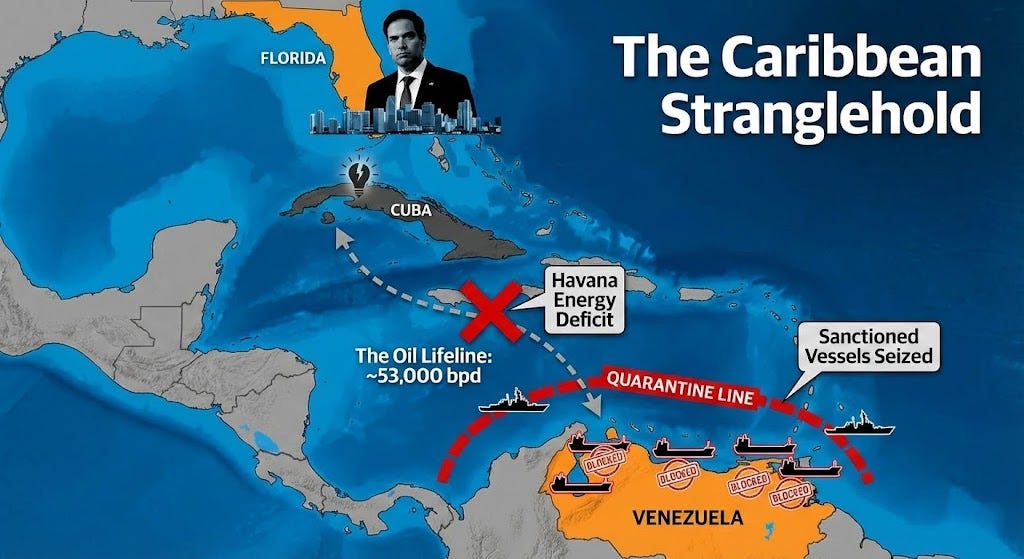
When Secretary of State Marco Rubio appeared on the Sunday talk shows this week, he wasn’t just defending a military operation. He was outlining a new American doctrine for the Western Hemisphere — one that replaces the soft power of diplomacy with the hard leverage of logistics.
In the wake of the U.S. military’s extraction of Venezuelan President Nicolás Maduro, Rubio has moved quickly to define the mission not as nation-building, but as a quarantine.
By enforcing a naval blockade on Venezuelan oil, the administration is executing a dual-track strategy: physically choking the remnants of the Maduro regime while simultaneously severing the economic lifeline of its patron in Havana.
For Rubio, the first Cuban American to serve as America’s top diplomat, the operation represents the convergence of a lifelong ideological crusade and the America First mandate of President Donald Trump. While the White House frames the move as a counter-narcotics victory, analysts see a broader geopolitical play — a logistical siege designed to starve two adversaries with a single chokehold.
Quarantine as a weapon
The centerpiece of this strategy is what Rubio calls an oil quarantine. Unlike a traditional wartime blockade, which requires congressional approval, Rubio characterizes this as a law enforcement action. The U.S. Navy and Coast Guard are intercepting vessels not as enemy combatants, but as carriers of “sanctioned property,” operating under U.S. court orders.
“There’s a quarantine right now in which sanctioned oil shipments — there’s a boat, and that boat is under U.S. sanctions, we go get a court order — we will seize it,” Rubio explained on CBS’s “Face the Nation”.
This distinction is critical. By treating Venezuela’s oil exports as the proceeds of crime, the U.S. has effectively shut down the country’s primary revenue stream without technically declaring war. The strategy relies on American naval superiority to control the logistics of the Caribbean, forcing the new leadership in Caracas to choose between economic strangulation or compliance with U.S. demands.
Warning to Havana
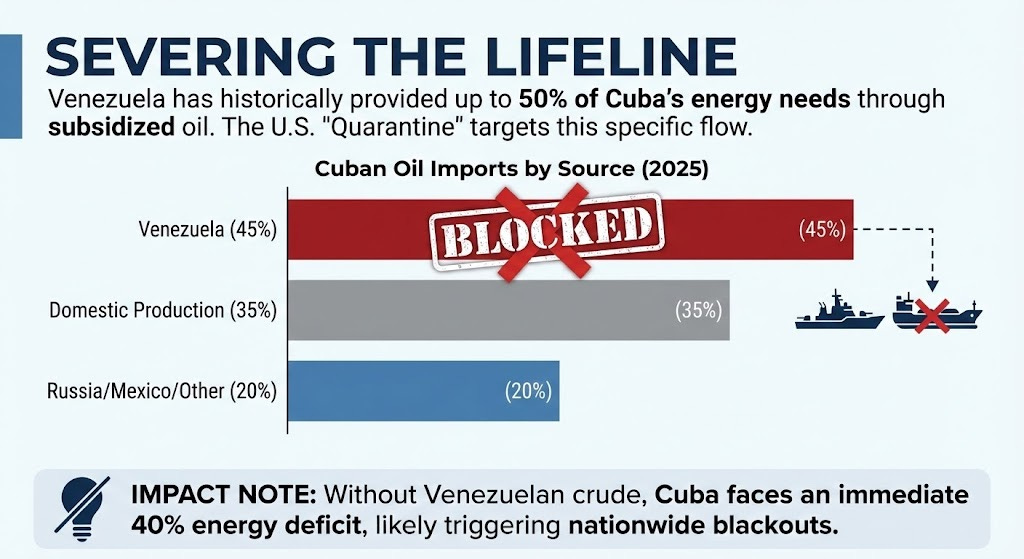
While the operation is centered on Venezuela, the target is equally the communist government in Cuba. For decades, Havana has relied on subsidized Venezuelan oil to keep its power grid functional. By cutting this supply line, Rubio is striking at the foundation of the Cuban state’s stability.
Rubio was explicit in his warning to the island’s leadership, noting that with their key ally gone, they should be worried.
“If I lived in Havana, and I was in the government, I’d be concerned – at least a little bit,” Rubio said Sunday.
This domino theory of logistics suggests that the administration believes it can induce regime change in Cuba not through invasion, but through energy deprivation.
The loss of Venezuelan crude, combined with existing U.S. sanctions, could plunge the island into a permanent blackout, potentially triggering the kind of internal unrest that Rubio has long predicted would be the regime’s undoing.
‘Viceroy’ and president
The operation also highlights Rubio’s unique role within the Trump administration. While President Trump grabbed headlines by declaring that the U.S. would “run” Venezuela during the transition, it was Rubio who walked back the rhetoric, clarifying that the U.S. is running policy, not the day-to-day government.
This dynamic has cemented Rubio’s status as a viceroy for Latin America, granted broad latitude to reshape the region. He has successfully rebranded the Monroe Doctrine — the 19th-century policy opposing external influence in the Americas — for the 21st century.
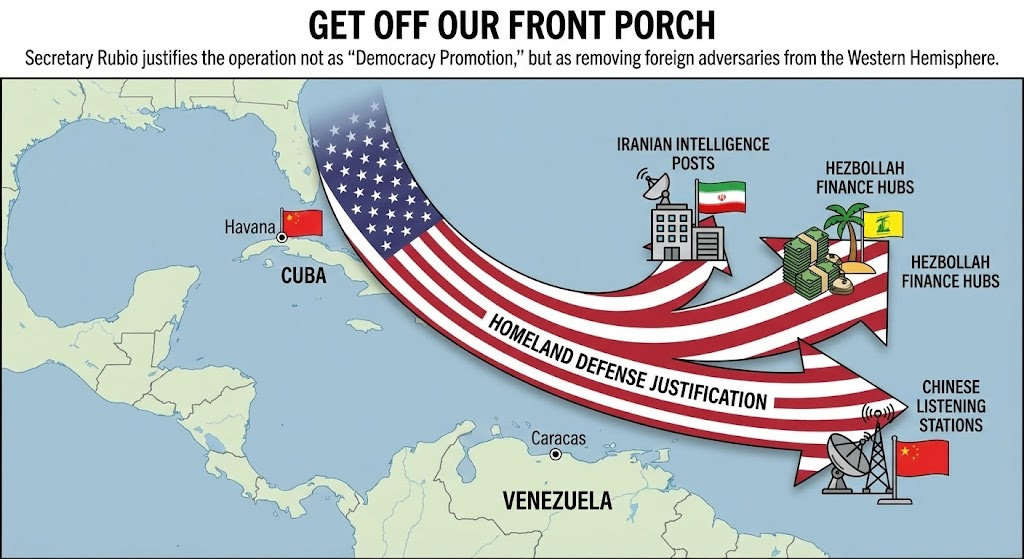
The new Rubio Doctrine treats the presence of foreign adversaries like Iran, Russia and China in the Western Hemisphere not just as diplomatic irritants, but as direct threats to the U.S. homeland that justify military intervention.
“We will no longer have... a Venezuela that’s the crossroads for many of our adversaries around the world, including Iran and Hezbollah,” Rubio told ABC’s “This Week”.
Many risks to siege
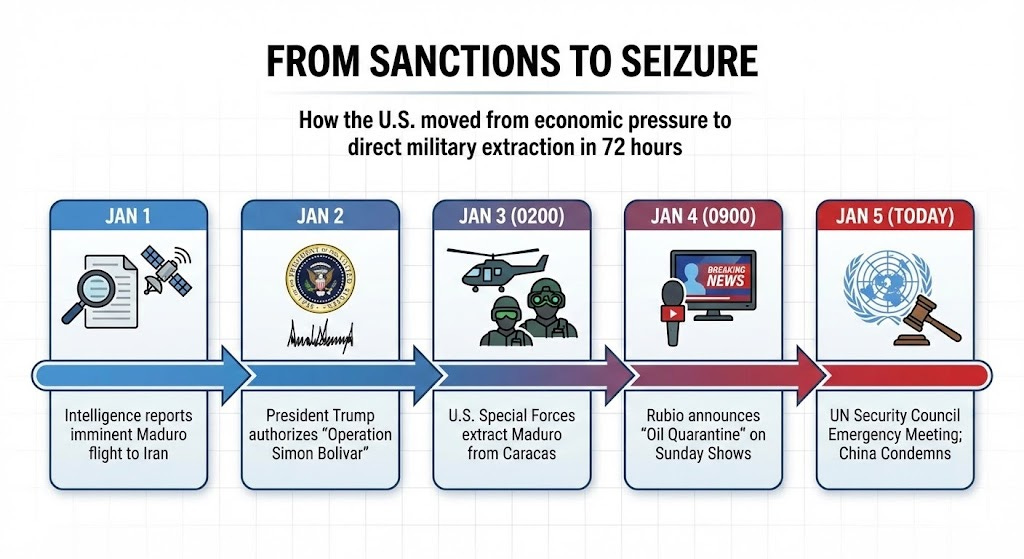
The strategy is not without significant risk. By relying on a quarantine rather than a diplomatic coalition, the U.S. has alienated global powers. China, a major purchaser of Venezuelan oil, has condemned the move as “gangsterism,” and Russia has warned of destabilizing consequences.
Furthermore, if the pressure campaign fails to produce a quick transition in Caracas, the U.S. risks owning the humanitarian fallout.
A prolonged blockade could starve the Venezuelan population, leading to a new migration crisis that would directly impact the U.S. southern border — undermining the very America First goals the administration claims to serve.
For now, however, the ships are stopped and the flow of oil has ceased. Rubio has bet his tenure — and potentially his political future — on the belief that logistics can achieve what decades of diplomacy could not: the simultaneous collapse of two anti-American regimes in the Caribbean.