The End of Birthright? Inside the Constitutional Brinkmanship Over American Identity
As the Supreme Court weighs arguments in Trump v. United States, the 14th Amendment faces a status-based challenge that could render millions stateless and redefine the social contract.
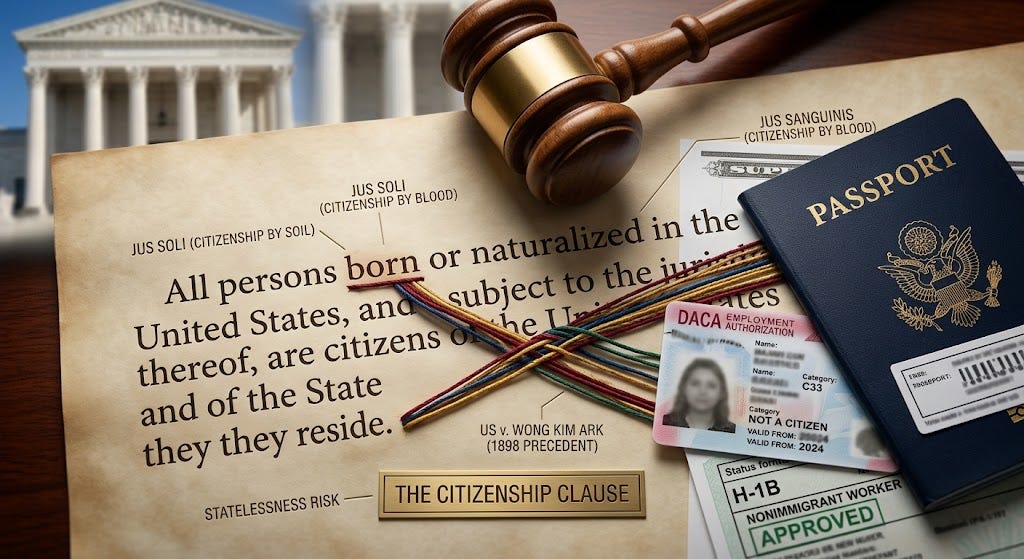
In the shadow of a marble-columned sanctuary that has, for over a century, stood as the final arbiter of American identity, the Supreme Court is poised to weigh an executive challenge that threatens to bifurcate the definition of citizenship. The oral arguments in Trump v. United States represent more than a procedural dispute over executive overreach; they signal a fundamental attempt to deconstruct the 14th Amendment’s Citizenship Clause, potentially ushering in a legal framework where the accident of birth is secondary to the status of the parent.
The case hinges on a transformative executive order that denies automatic citizenship to children born on U.S. soil unless at least one parent maintains legal residency. While the administration frames the move as a restoration of “original public meaning,” the practical implications are tectonic. If upheld, the ruling would effectively disenfranchise millions, barring a burgeoning generation from Social Security, federal employment, and the ballot box. It is a gamble that risks the creation of a permanent, stateless underclass, testing whether a 158-year-old constitutional guarantee can survive the pressures of 21st-century nativist policy.
The Architecture of Exclusion
For 128 years, the legal bedrock of American belonging has rested upon United States v. Wong Kim Ark. That 1898 decision codified a simple truth: if you are born here, you are of here. By challenging this precedent, the administration is attempting to re-engineer the American social contract.

The UCLA Latino Policy and Politics Institute notes that the demographic weight of this shift falls almost entirely on non-white populations. By decoupling citizenship from the soil (jus soli) and tethering it to bloodline (jus sanguinis), the order creates a jurisdictional “gray zone.” Children born to DACA recipients or H-1B visa holders—individuals deeply integrated into the American economy—could find their offspring rendered “legal ghosts,” born in a U.S. hospital but possessing no claim to the protection of the flag.
A Return to the Pre-Civil War Paradigm
The administration’s “originalist” defense ignores why the 14th Amendment was ratified in 1868. It was the Union’s definitive answer to the Dred Scott decision, which had ruled that Black Americans could not be citizens.
The current legal challenge seeks to revive the “subject to the jurisdiction thereof” clause as a restrictive gatekeeper. The White House argues that those in the country without legal permission do not owe “true” allegiance to the U.S., and thus their children are not fully under its jurisdiction. This interpretation would represent the most significant narrowing of American civil rights since the Jim Crow era.
The Specter of Statelessness
Beyond the domestic political fray lies a looming humanitarian crisis: statelessness. International law generally abhors a vacuum of citizenship, yet the administration’s order could force parents to seek documentation from countries they have long since fled—countries that may refuse to recognize children born in the United States.
The result is a “caste system” by another name. A child born in a U.S. hospital to an undocumented mother would grow up alongside a child of citizens, attending the same schools and speaking the same language, yet find themselves barred from every milestone of adulthood: a driver’s license, professional certification, or the right to vote.
The Path Forward
As the justices take the bench, the nation faces a choice between two competing visions of identity. One is an expansive, geographic definition that has served as the engine of integration for over a century. The other is a restrictive, status-based definition that views citizenship as a prize to be guarded rather than a right to be recognized.
While the ACLU expresses optimism that the Court will uphold the status quo, the mere existence of the case has already shifted the boundaries of the permissible. Regardless of the ruling, the assault on birthright citizenship has moved from the fringes of talk radio to the highest court in the land, signaling that the question of “who is an American” is no longer settled law.
Key Takeaways: What Happens if Birthright Citizenship is Repealed?
Legal Standing: Children of non-citizens would lack automatic U.S. passports and Social Security numbers.
Economic Impact: Millions would be ineligible for federal work authorization, Medicaid, and SNAP benefits.
Political Shift: A significant portion of the future population would be permanently barred from voting, creating a non-voting resident class.
International Conflict: Increased risk of statelessness if parents’ home countries do not grant citizenship by descent.
Analysis by Jay Keller — Flingjore.com