
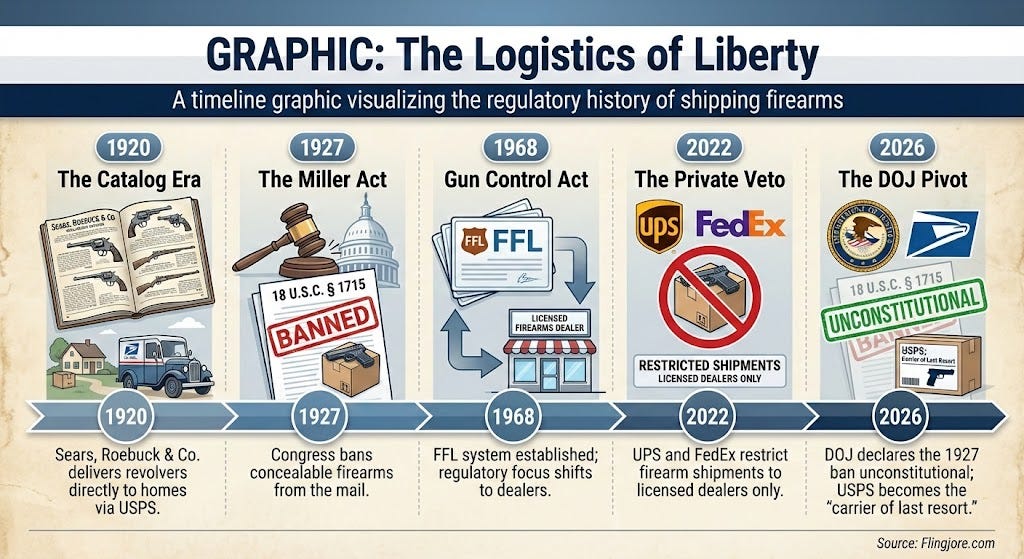
UPS and FedEx restrict handgun shipments, so Justice Department reopens the U.S. mail to save Second Amendment
Trump administration argues that when the private market blocks a constitutional right, the Post Office serves as the carrier of last resort.
Note from the Editor:
This headline reads like a typo. For 99 years, mailing a handgun has been illegal. But this isn’t just a gun story; it is a logistics story. We analyze how the decision by UPS and FedEx to restrict shipments inadvertently forces the DOJ’s hand, turning the Post Office into the unlikely safety net for the Second Amendment.
In a quiet but seismic shift in federal policy, the Department of Justice asserts that the 99-year-old ban on mailing handguns through the U.S. Postal Service is unconstitutional.
The opinion, released Thursday by the Office of Legal Counsel, does more than just open the mail stream to revolvers; it fundamentally redefines the government’s obligation to facilitate the logistics of gun ownership when the private sector refuses to do so.
The 15-page opinion, authored by Assistant Attorney General T. Elliot Gaiser, concludes that 18 U.S.C. § 1715, a statute rooted in the 1927 Miller Act, infringes on the Second Amendment rights of citizens by prohibiting the most efficient means of transporting firearms.
New ‘public utility’ of Second Amendment
The Department of Justice’s argument hinges on a collision between constitutional rights and modern commerce. The opinion notes that private carriers, specifically UPS and FedEx, have voluntarily restricted firearm shipments to licensed manufacturers and dealers. This corporate policy shift has effectively removed the “private option” for unlicensed individuals wishing to ship handguns for lawful purposes, such as repair, relocation, or hunting.
“Consequently, so long as Congress chooses to run a parcel service, the Second Amendment precludes it from refusing to ship constitutionally protected firearms to and from law-abiding citizens,” the opinion states.
This finding suggests a new legal framework: When the free market restricts the logistics of a constitutional right, the government’s public utility (the USPS) becomes the “carrier of last resort.” The opinion argues that the inability to mail a firearm imposes “significant barriers” that interfere with the “incidental rights to acquire and maintain arms.”
Historical context: Miller Act of 1927
To understand the dismantling of this law, one must examine its origins. The ban on mailing concealable firearms was not a product of modern political polarization, but a specific response to the crime waves of the 1920s.
In the early 20th century, the Sears, Roebuck & Co. catalog allowed Americans to order firearms by mail without background checks or restrictions. A rural customer could purchase a revolver and have it delivered to their doorstep.
By 1927, concerns regarding organized crime and the “motorized bandit” led Congress to pass the Miller Act (44 Stat. 1059). The legislative intent, as recorded in the Congressional Record of the 69th Congress, was to eliminate the anonymity of mail-order gun purchases. Proponents argued that by forcing purchasers to buy from local dealers, they would be subject to local police regulations.
The law specifically targeted “pistols, revolvers, and other firearms capable of being concealed on a person,” while leaving rifles and shotguns mailable under certain conditions. This distinction reflected the specific focus on concealed carry used by criminals of that era.
For nearly a century, this statute remained the baseline for federal postal policy, reinforced later by the Gun Control Act of 1968, which established the Federal Firearms License (FFL) system.
Gap in modern logistics
The DOJ’s 2026 opinion argues that the landscape has shifted. While the 1927 law intended to regulate sales, the modern effect is a blockade on transport.
In recent years, major private carriers updated their service guides to restrict firearm shipments.
UPS: Requires shippers to hold a valid FFL to ship firearms.
FedEx: Similarly restricts shipments to licensed customers.
The DOJ opinion cites these private restrictions as a key factor. It notes that for an unlicensed citizen, there is no longer a viable “common carrier” to transport a handgun. The opinion posits that the government cannot ban the use of the mails if the mail is the only remaining option for exercising a constitutional right.
Distinction of dangerous items
The opinion is careful to separate “arms” from “ammunition.” It upholds the ban on mailing ammunition and explosives, citing USPS Publication 52, which regulates hazardous materials.
The Department of Justice determines that while handguns are “arms” protected by Second Amendment, gunpowder and ammunition pose a physical safety risk to postal employees and equipment.
This distinction (severability) aims to protect the core constitutional right (the firearm) without compromising the operational safety of the mail service.
Implications: Federal supremacy vs. State law
The ruling creates immediate friction between federal postal operations and state firearm laws. The U.S. Postal Service is a federal entity; however, packages eventually enter local jurisdictions.
Legal analysts point to a potential conflict under the Supremacy Clause of the Constitution. If a citizen mails a handgun from a state with permissive laws to a state with strict possession laws (e.g., New York or California), the act of mailing is now federally protected, according to the DOJ.
The recipient, however, may still be subject to state prosecution upon receipt.
The opinion states that the USPS cannot be used to enforce the unconstitutional ban, but it does not grant immunity from state laws regarding possession or transfer requirements (such as background checks required by the Brady Handgun Violence Prevention Act).
Pivot from restriction to facilitation
Justice department opinion represents a significant reversal of 20th-century gun control philosophy, pivoting from a focus on restricting access to a focus on facilitating logistics.
In declaring the 1927 ban unconstitutional, the administration mandates that the U.S. Postal Service modernize its role to accommodate the Second Amendment, ensuring that the right to bear arms includes the right to ship them.


