
'Very real possibility' U.S. businesses take financial stake in Venezuelan oil, energy secretary says
Following Trump’s emergency order to block creditors, the path is now clear for U.S. majors to acquire equity in Venezuela without inheriting the nation’s debt.
Big picture
Equity Stakes Possible: Wright confirms U.S. firms may take direct stakes in Venezuelan oil.
Legal Shield Created: Trump’s order blocks creditor lawsuits, clearing the path for new investment.
Total Control: The U.S. now manages all crude sales via an "oil quarantine."
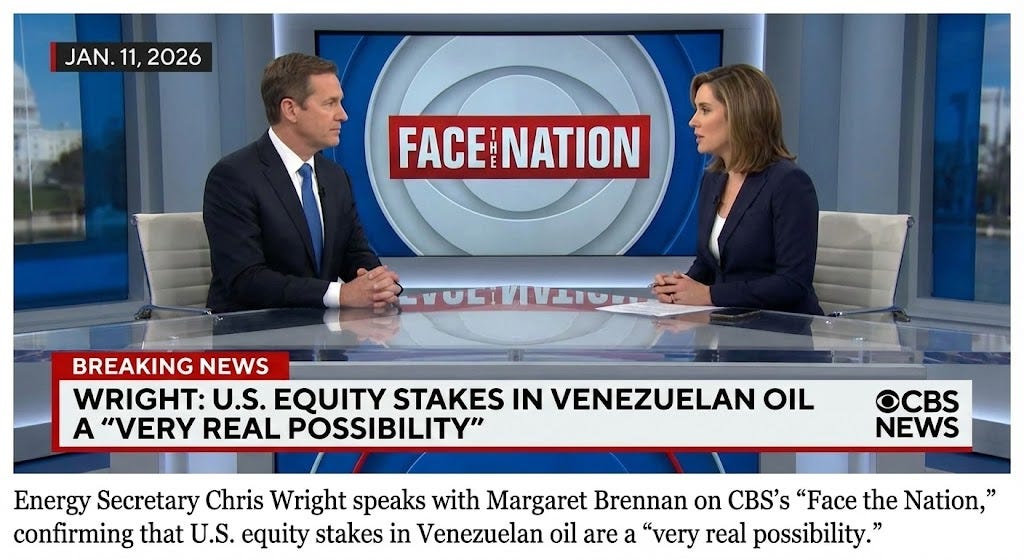
Energy Secretary Chris Wright said Sunday that it is a “very real possibility” American businesses will take a direct financial stake in Venezuelan oil, confirming that the Trump administration intends to move beyond simple sanctions and oversee a wholesale restructuring of the nation’s energy sector.
Speaking on CBS’s Face the Nation, Wright indicated that the U.S. strategy involves more than just holding funds in escrow; it aims to physically rehabilitate and potentially privatize elements of Petróleos de Venezuela, S.A. (PDVSA) under U.S. corporate guidance.
”That’s going to be up to American businesses. That’s certainly a very real possibility,” Wright told host Margaret Brennan when asked if U.S. companies would take equity positions in the state-run oil giant.
The admission provides the missing context for the aggressive Executive Order signed by President Trump on Friday.
While initially read as a defensive move to freeze assets, legal analysts now view the order as an offensive “clearing of the deck” — a necessary legal maneuver to allow U.S. investment to flow without being instantly seized by creditors.
How the executive order enables the ‘stake’
For years, U.S. oil majors like ExxonMobil and ConocoPhillips have been hesitant to re-enter Venezuela not just because of physical security, but because of successor liability.
If a U.S. company were to buy a stake in PDVSA under normal circumstances, they could theoretically be sued by Venezuela’s legions of unpaid creditors — bondholders, arbitration winners, and suppliers — who would claim that the new assets should be used to satisfy old debts.
President Trump’s order effectively nullifies that risk.
By designating the assets as Foreign Government Deposit Funds held in U.S. custody and explicitly declaring all judicial processes against them null and void, the President has created a sovereign shield.
Legal experts, including sovereign debt restructuring veteran Lee Buchheit, have long argued that any successful restructuring of Venezuela would require neutralizing the legal risk posed by holdout creditors.
The new executive order accomplishes that by unilaterally stripping federal and state courts (often in creditor-friendly jurisdictions like New York and Delaware) of their ability to attach these assets.
A clean slate is created for companies like Chevron or Exxon to step in, invest capital and extract oil without fearing that a judge will garnish their revenue to pay bondholders from 2017.
Friction with Big Oil
The legal maneuver comes just 48 hours after President Trump hosted top executives from Chevron, ExxonMobil and ConocoPhillips at the White House to discuss ramping up Venezuelan production.
While the President promised security and direct U.S. government backing, the response from the energy sector was cautious.
According to sources briefed on the meeting, executives expressed skepticism about the speed of the proposed ramp-up given the dilapidated state of PDVSA’s infrastructure.
ExxonMobil CEO Darren Woods reportedly described the current environment in Venezuela as “uninvestable” without more robust legal guarantees — guarantees that this new executive order attempts to provide.
Woods has consistently maintained that any return to the country would require significant changes to the legal framework given that Exxon has had its assets seized by Venezuela twice before.
ConocoPhillips CEO Ryan Lance, whose company is the largest non-sovereign creditor, has similarly stressed that any new arrangement must address the billions owed to his shareholders.
ConocoPhillips recently secured a $8.5 billion judgment against Venezuela for past expropriations, a claim that this new Executive Order ostensibly blocks from being collected.
Oil quarantine
The administration is already implementing what Secretary of State Marco Rubio has termed an “oil quarantine.”
”No, today we are running the sale of their crudes,” Wright explained on Face the Nation. “You know, we have a quarantine around their ability to ship oil outside of Venezuela. All of that goes through American crude marketers. And then that crude goes out into the market.”
Wright confirmed that the revenue from these sales is not going to Caracas but is being collected and held by the United States to “better the lives of Americans and Venezuelans.”
This mechanism turns the U.S. Treasury into a trustee.
Under the authority of the President Trump's executive order, Treasury Secretary Scott Bessent manages these funds “solely in a custodial and governmental capacity.”
This prevents the Maduro regime remnants from accessing cash, but crucially, it also prevents the funds from being drained by litigation in U.S. courts.
Bottom line
The executive order was not just a defensive measure to stop money from flowing to the regime; it was a market-making tool.
By voiding the legal claims of creditors, the Trump administration paves the way for U.S. energy companies to treat Venezuela not as a sovereign debtor, but as a distressed asset under new management — protected by the full force of the U.S. Treasury.


