

DOJ misses deadline for Epstein files, sets up clash with Congress
Attorney General Pam Bondi cites privacy reviews for 5.2 million documents; Massie and Khanna blast slow roll as new target date shifts to Jan. 21.

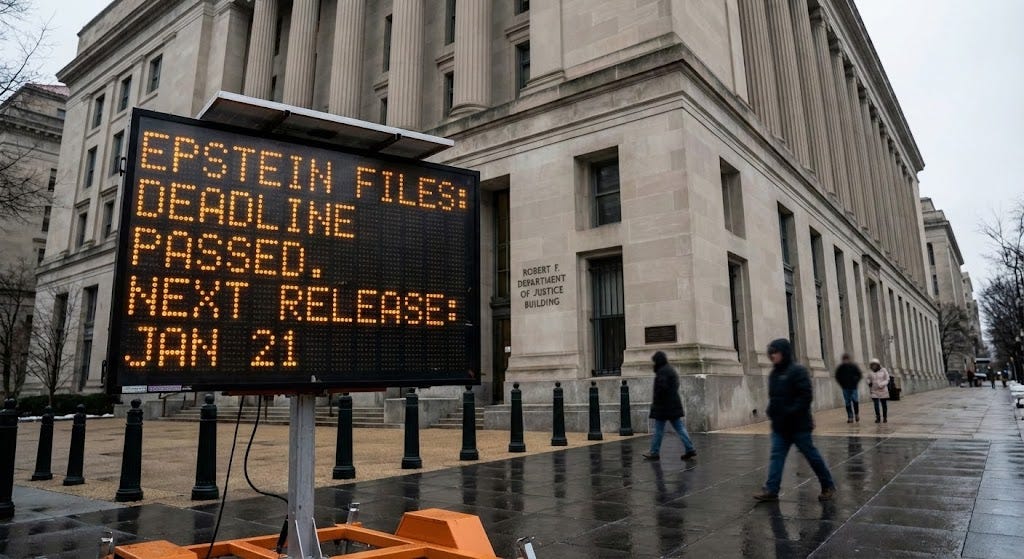
The legal deadline for the Department of Justice to release additional files on Jeffrey Epstein passes without the full disclosure mandated by Congress, setting up a confrontation between lawmakers and federal investigators over the pace of transparency.
Attorney General Pam Bondi faces bipartisan criticism after the DOJ fails to meet the Dec. 19 deadline set by the Epstein Files Transparency Act. The department now signals it targets Jan. 20 or 21 for the next significant release of documents.
At the center of the delay sits a cache of roughly 5.2 million documents. Justice Department officials cite the sheer volume of material and the legal necessity of redaction to protect the privacy of victims who remain private citizens. Over 400 attorneys are currently reviewing the files, according to DOJ statements to Congress.
The delay frustrates lawmakers who view the “slow roll” as a defiance of the legislative will. The standoff highlights a deeper tension in Washington: the friction between legislative mandates for transparency and the executive branch’s procedural machinery.
While the DOJ points to logistical hurdles—reviewing millions of pages requires immense manpower—critics see a familiar pattern of bureaucratic inertia designed to dilute the impact of the release.
Unlikely alliance
The push for total transparency creates strange bedfellows in the House, uniting the populist left and the libertarian right against the centrist establishment. Reps. Ro Khanna, D-Calif., and Thomas Massie, R-Ky., lead the charge, forming a “horseshoe” coalition that views the intelligence and justice communities with shared skepticism.
For Khanna, the issue centers on accountability for the powerful and the protection of vulnerable victims who were ignored by the system. For Massie, it is about checking the surveillance state and exposing government complicity in shielding a federal asset. Despite their ideological distance, both argue that the specific timeline in the legislation was a binding command, not a suggestion.
”The law was clear,” Massie says. “Thirty days means thirty days.”
This alignment signals a shift in how Washington handles scandal. Where previous investigations often devolved into partisan finger-pointing, the Epstein files represent a rare “anti-establishment” consensus. Both sides fear that a prolonged review process allows for the “sanitization” of politically damaging connections before the public sees them.
Transparency mandate
The current standoff stems from the Epstein Files Transparency Act, passed in November 2025. The legislation swept through Congress on a wave of public pressure to finally close the book on the saga that began with a controversial non-prosecution agreement in 2006.
That original deal, brokered by federal prosecutors in Florida, allowed Epstein to plead guilty to state charges and avoid federal prosecution, sealing the names of his accomplices and high-profile associates. The 2025 Act was designed specifically to pierce that legal veil.
While a federal judge ordered the release of specific grand jury transcripts on Dec. 5—providing a narrow window into the 2006-2007 investigation—the bulk of the federal files remains processing. These documents, which include FBI interview summaries and flight manifests, are expected to map the full extent of Epstein’s network.
Until the January release, the deadline remains a technicality, and the narrative remains controlled by the redactor’s pen.