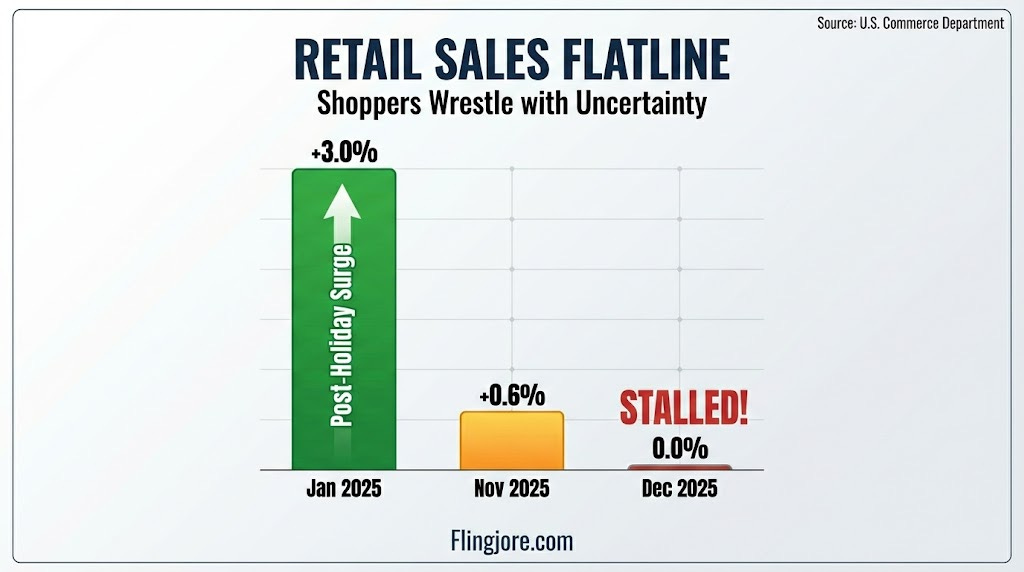
0.0%: The consumer hits a wall
Why the ‘optimism spike’ of 2025 collapsed into stagnation on tariff anxieties and credit exhaustion to kill holiday spending spree
Retail sales flatlined in December, closing out the year with a sudden deceleration as American consumers grappled with mounting economic uncertainty, according to Commerce Department data released Tuesday. The stall marks a sharp reversal from the spending resilience seen earlier in the year and stands in stark contrast to the holiday surges of the recent past.
The report from the Census Bureau shows retail and food services sales were virtually unchanged in December from November, holding steady at $735 billion. The flat reading missed economists’ expectations for a 0.4% increase and suggests the momentum that powered the economy through the post-pandemic recovery may be fracturing under the weight of accumulated inflation, tariff anxieties and the lingering effects of the recent 43-day government shutdown.
This 0.0% growth represents a significant cooling from the robust activity that defined the retail landscape just twelve months ago. To understand the severity of this shift, the current stagnation must be measured against the optimism of late 2024. According to revised data, total sales for the three-month period ending in January 2025 were up significantly, with year-over-year gains nearing 3%. Data from early 2025 showed robust growth in non-store retailers and food services, which jumped 5.3% and 4.7% respectively.
Today, that narrative has flipped. Excluding the volatile auto sector, sales fell across key discretionary categories, signaling that the lower-to-middle-income consumer has hit a financial wall. The details of the Commerce Department report underscore a widespread pulling back. Furniture and home furnishings plunged 0.9%, a clear indicator that the housing market freeze is curbing demand for big-ticket items. Clothing and accessories fell 0.7%, a disappointing result for the crucial holiday gifting season.
Even the tech sector was not immune, as electronics and appliances dipped 0.4%, reversing the tech-heavy spending of the previous year. Perhaps most telling, spending at restaurants—often a proxy for consumer confidence—slipped 0.1%, suggesting households are returning to home-cooked meals to save cash. The only clear winners were necessities and maintenance, as building materials and garden supply stores posted a slight increase.
Market analysts point to a “perfect storm” of factors paralyzing the American shopper, led by the “uncertainty tax” of potential trade conflicts. With uncertainty around President Donald Trump’s tariffs looming, businesses and consumers appear to be entering a defensive crouch. Unlike the inflation of 2023—which was a known quantity—the current landscape is defined by policy ambiguity.
The economic outlook is further clouded by a cooling labor market. With employers adding just 28,000 jobs last month, wage gains may no longer be sufficient to offset rising prices and tariff-induced inflation. For now, the data describes a new normal: a cautious, price-sensitive electorate that has traded the spikes of yesterday for the safety of savings.