

GOP splits over tariff-for-health plan to fund subsidies
Johnson faces revolt from hardliners who fear a rushed, second reconciliation bill will not solve the coming cost-of-living crisis.

House Republican leadership is actively debating a controversial legislative maneuver to fund expiring health care subsidies using revenue from aggressive trade tariffs, a proposal that has ignited a fierce factional battle over the party’s economic identity ahead of the 2026 midterm elections.
The internal deliberations, confirmed by multiple senior GOP lawmakers and aides, center on the potential use of a second budget reconciliation package—a fast-track parliamentary procedure that allows legislation to bypass the Senate filibuster with a simple majority. While Speaker Mike Johnson has publicly signaled openness to the strategy, the proposal faces stiff resistance from fiscal hawks and vulnerable moderates who fear the political fallout of a rushed, party-line vote on health care.
At the heart of the dispute is a rapidly approaching fiscal cliff: enhanced subsidies for the Affordable Care Act (ACA) are set to expire on Dec. 31, threatening to spike premiums for millions of voters just as the midterm campaign season intensifies.
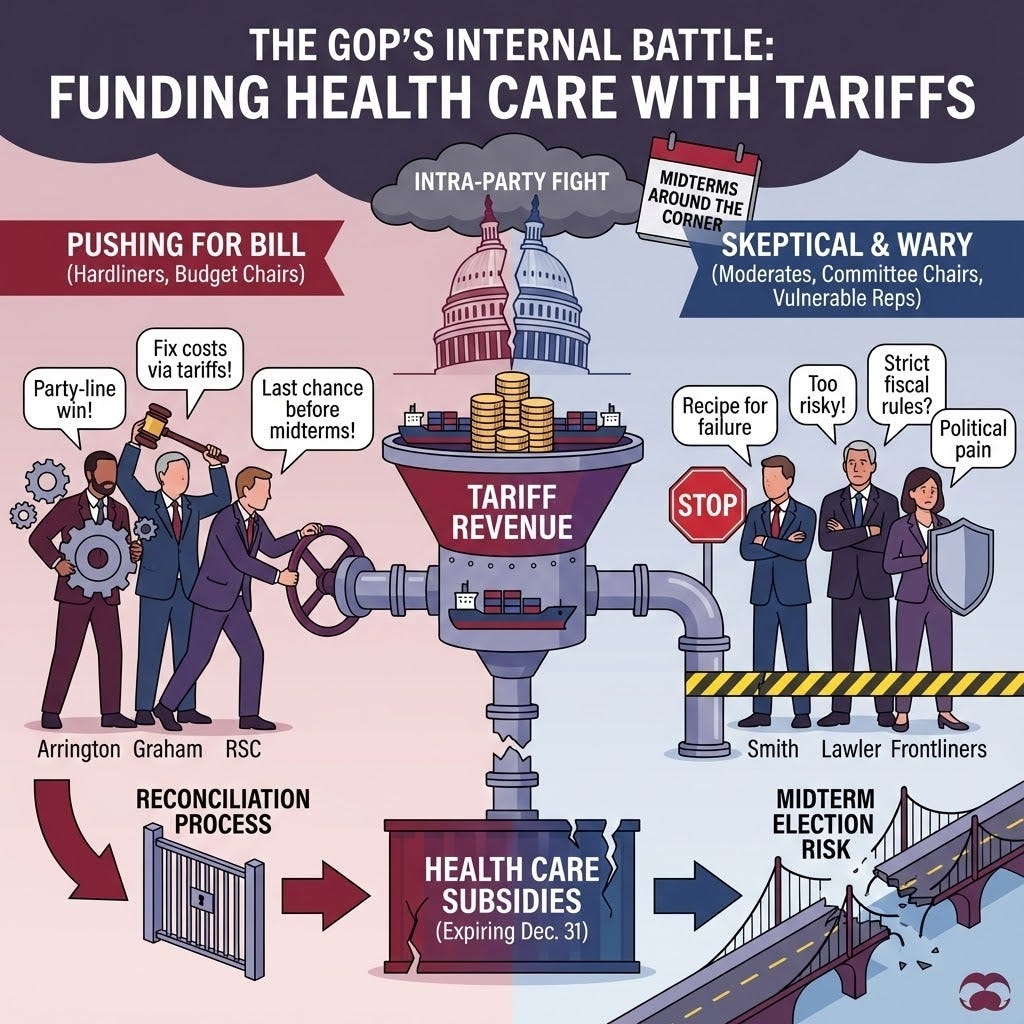
The Proposal: Tariffs for Entitlements
The emerging plan, championed by key figures including House Budget Chair Jodey Arrington (R-Texas) and members of the Republican Study Committee (RSC), represents a significant departure from traditional conservative orthodoxy. Rather than offsetting spending through entitlement cuts, proponents are suggesting the use of federal tariff revenue to finance a direct expansion of the social safety net.
“We need to actually follow through on the policies we’ve been popping off about for years that we believe will actually help everybody,” Arrington said, indicating that there is a “critical mass” of support to initiate the reconciliation process in January.
The strategy aims to solve two political problems simultaneously: it addresses the populist demand for protectionist trade barriers while mitigating the cost-of-living crisis for voters facing higher insurance premiums. Supporters argue this approach puts a conservative stamp on health care reform by linking it to “America First” trade policies rather than traditional tax hikes.
Rep. August Pfluger (R-Texas), chair of the RSC, confirmed that conservatives have discussed a “checklist” of affordability measures during closed-door meetings. Pfluger argued the package need not be divisive, suggesting a focus on expanding Health Savings Accounts (HSAs)—a long-standing GOP priority that was excluded from previous legislation.
“The trick,” Pfluger noted, is aligning the legislative agenda with the priorities of President Donald Trump, whose administration has signaled openness to using reconciliation for affordability issues.
Deepening Factions and Fiscal Skepticism
Despite the push from budget gatekeepers, the proposal has encountered profound skepticism from powerful committee chairs and rank-and-file members who view a second reconciliation attempt as a political liability.
The opposition is led notably by Rep. Jason Smith (R-Mo.), chair of the Ways and Means Committee, which holds jurisdiction over tax and health policy. Smith offered a blunt assessment of the plan’s viability: “I don’t see a path of a second reconciliation ever passing.”
Smith’s skepticism is rooted in the procedural and political realities of the reconciliation process. To succeed, any bill must strictly adhere to the “Byrd Rule,” which prevents extraneous policy changes that do not have a direct budgetary impact. Senior Republicans privately warn that many of the health care reforms sought by conservatives—such as deregulation or interstate insurance competition—would likely be stripped out by the Senate parliamentarian, leaving only the spending provisions.
Furthermore, the mechanism of funding subsidies via tariffs has raised alarms among traditional free-market conservatives. Critics within the conference argue that tariffs function effectively as consumption taxes on American families. Using that revenue to subsidize health insurance creates a circular economy where voters pay higher prices for goods to fund their own government benefits—a structure more akin to European-style social democracy than American fiscal conservatism.
The Moderate Revolt
The resistance is most acute among “frontline” Republicans—lawmakers representing swing districts that will decide control of the House in 2026. Having already taken difficult votes on a major tax-and-spending bill earlier in the session, which included controversial cuts to Medicaid, these members are wary of re-opening the health care debate.
In a heated closed-door meeting this month, Rep. Mike Lawler (R-N.Y.), a vulnerable incumbent, reportedly dismissed the idea of another party-line bill, stating it would “never” happen. Another House Republican compared the arduous process to “having a baby,” citing the immense political capital required to whip votes for a partisan package.
This hesitance reflects a broader strategic anxiety. With a slim majority, Speaker Johnson cannot afford more than a handful of defections. A failed vote on a major health care bill months before an election would be a gift to Democrats, allowing them to campaign on GOP disarray and the threat to insurance protections.
Senate Hurdles and “The Manchin Precedent”
Across the Capitol, the appetite for a second reconciliation bill is mixed. Senate Budget Chair Lindsey Graham (R-S.C.) has been bullish, advocating for a blueprint that includes health care, military funding, and immigration enforcement. However, Senate Majority Leader John Thune has remained noncommittal, emphasizing the difficulty of the process.
“You don’t just do reconciliation for the heck of it, you’ve got to have, you know, a specific purpose,” Thune told reporters.
Proponents point to the precedent set by Democrats in 2022, when they successfully passed the Inflation Reduction Act (IRA) just months before the midterms. That legislation, which also addressed health care subsidies, was the product of torturous negotiations that nearly collapsed multiple times before securing the vote of Sen. Joe Manchin (I-W.Va.).
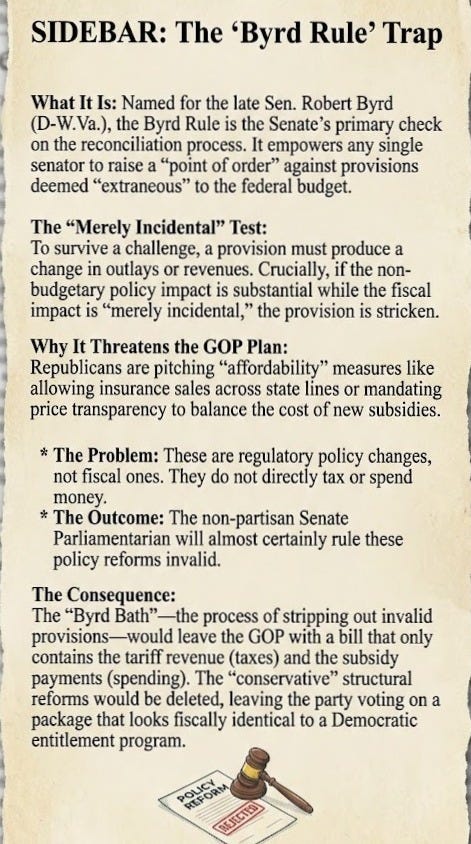
Republicans hoping to replicate that success face a similar dynamic, where a single senator or a small bloc of House members can effectively veto the entire agenda. Without a unified consensus on the underlying policy—specifically the mechanism of using tariffs to fund subsidies—leadership risks a public legislative failure.
Implications for the 2026 Agenda
The outcome of this internal fight will define the Republican platform entering the midterm cycle. If the effort collapses, the GOP risks facing voters with no solution for rising health care costs, potentially allowing ACA subsidies to expire under their watch. Conversely, pushing a “tariff-for-health” bill risks alienating the party’s donor base and free-market wing while handing Democrats ammunition regarding rising consumer prices.
House Majority Leader Steve Scalise indicated that while the agenda for January is full, reconciliation remains a key objective. “We’re trying to see if there’s consensus,” Scalise said. “We obviously would like to get one.”
As the Dec. 31 deadline for subsidies looms, the GOP is caught between its ideological commitment to small government and the practical political necessity of shielding voters from cost increases. The resolution of this debate will signal whether the party is fully transitioning away from the fiscal conservatism of the past two decades toward a new, populist economic model centered on state-managed trade and spending.
Jay Keller Independent from Jay Keller Independent⬇️
Johnson faces revolt from hardliners who fear a rushed, second reconciliation bill will not solve the coming cost-of-living crisis.
House Republican leadership is actively debating a controversial legislative maneuver to fund expiring health care subsidies using revenue from aggressive trade tariffs, a proposal that has ignited a fierce factional battle over the party’s economic identity ahead of the 2026 midterm elections.
The internal deliberations, confirmed by multiple senior GOP lawmakers and aides, center on the potential use of a second budget reconciliation package—a fast-track parliamentary procedure that allows legislation to bypass the Senate filibuster with a simple majority. While Speaker Mike Johnson has publicly signaled openness to the strategy, the proposal faces stiff resistance from fiscal hawks and vulnerable moderates who fear the political fallout of a rushed, party-line vote on health care.
At the heart of the dispute is a rapidly approaching fiscal cliff: enhanced subsidies for the Affordable Care Act (ACA) are set to expire on Dec. 31, threatening to spike premiums for millions of voters just as the midterm campaign season intensifies.
The Proposal: Tariffs for Entitlements
The emerging plan, championed by key figures including House Budget Chair Jodey Arrington (R-Texas) and members of the Republican Study Committee (RSC), represents a significant departure from traditional conservative orthodoxy. Rather than offsetting spending through entitlement cuts, proponents are suggesting the use of federal tariff revenue to finance a direct expansion of the social safety net.
“We need to actually follow through on the policies we’ve been popping off about for years that we believe will actually help everybody,” Arrington said, indicating that there is a “critical mass” of support to initiate the reconciliation process in January.
The strategy aims to solve two political problems simultaneously: it addresses the populist demand for protectionist trade barriers while mitigating the cost-of-living crisis for voters facing higher insurance premiums. Supporters argue this approach puts a conservative stamp on health care reform by linking it to “America First” trade policies rather than traditional tax hikes.
Rep. August Pfluger (R-Texas), chair of the RSC, confirmed that conservatives have discussed a “checklist” of affordability measures during closed-door meetings. Pfluger argued the package need not be divisive, suggesting a focus on expanding Health Savings Accounts (HSAs)—a long-standing GOP priority that was excluded from previous legislation.
“The trick,” Pfluger noted, is aligning the legislative agenda with the priorities of President Donald Trump, whose administration has signaled openness to using reconciliation for affordability issues.
Deepening Factions and Fiscal Skepticism
Despite the push from budget gatekeepers, the proposal has encountered profound skepticism from powerful committee chairs and rank-and-file members who view a second reconciliation attempt as a political liability.
The opposition is led notably by Rep. Jason Smith (R-Mo.), chair of the Ways and Means Committee, which holds jurisdiction over tax and health policy. Smith offered a blunt assessment of the plan’s viability: “I don’t see a path of a second reconciliation ever passing.”
Smith’s skepticism is rooted in the procedural and political realities of the reconciliation process. To succeed, any bill must strictly adhere to the “Byrd Rule,” which prevents extraneous policy changes that do not have a direct budgetary impact. Senior Republicans privately warn that many of the health care reforms sought by conservatives—such as deregulation or interstate insurance competition—would likely be stripped out by the Senate parliamentarian, leaving only the spending provisions.
Furthermore, the mechanism of funding subsidies via tariffs has raised alarms among traditional free-market conservatives. Critics within the conference argue that tariffs function effectively as consumption taxes on American families. Using that revenue to subsidize health insurance creates a circular economy where voters pay higher prices for goods to fund their own government benefits—a structure more akin to European-style social democracy than American fiscal conservatism.
The Moderate Revolt
The resistance is most acute among “frontline” Republicans—lawmakers representing swing districts that will decide control of the House in 2026. Having already taken difficult votes on a major tax-and-spending bill earlier in the session, which included controversial cuts to Medicaid, these members are wary of re-opening the health care debate.
In a heated closed-door meeting this month, Rep. Mike Lawler (R-N.Y.), a vulnerable incumbent, reportedly dismissed the idea of another party-line bill, stating it would “never” happen. Another House Republican compared the arduous process to “having a baby,” citing the immense political capital required to whip votes for a partisan package.
This hesitance reflects a broader strategic anxiety. With a slim majority, Speaker Johnson cannot afford more than a handful of defections. A failed vote on a major health care bill months before an election would be a gift to Democrats, allowing them to campaign on GOP disarray and the threat to insurance protections.
Senate Hurdles and “The Manchin Precedent”
Across the Capitol, the appetite for a second reconciliation bill is mixed. Senate Budget Chair Lindsey Graham (R-S.C.) has been bullish, advocating for a blueprint that includes health care, military funding, and immigration enforcement. However, Senate Majority Leader John Thune has remained noncommittal, emphasizing the difficulty of the process.
“You don’t just do reconciliation for the heck of it, you’ve got to have, you know, a specific purpose,” Thune told reporters.
Proponents point to the precedent set by Democrats in 2022, when they successfully passed the Inflation Reduction Act (IRA) just months before the midterms. That legislation, which also addressed health care subsidies, was the product of torturous negotiations that nearly collapsed multiple times before securing the vote of Sen. Joe Manchin (I-W.Va.).
Republicans hoping to replicate that success face a similar dynamic, where a single senator or a small bloc of House members can effectively veto the entire agenda. Without a unified consensus on the underlying policy—specifically the mechanism of using tariffs to fund subsidies—leadership risks a public legislative failure.
Implications for the 2026 Agenda
The outcome of this internal fight will define the Republican platform entering the midterm cycle. If the effort collapses, the GOP risks facing voters with no solution for rising health care costs, potentially allowing ACA subsidies to expire under their watch. Conversely, pushing a “tariff-for-health” bill risks alienating the party’s donor base and free-market wing while handing Democrats ammunition regarding rising consumer prices.
House Majority Leader Steve Scalise indicated that while the agenda for January is full, reconciliation remains a key objective. “We’re trying to see if there’s consensus,” Scalise said. “We obviously would like to get one.”
As the Dec. 31 deadline for subsidies looms, the GOP is caught between its ideological commitment to small government and the practical political necessity of shielding voters from cost increases. The resolution of this debate will signal whether the party is fully transitioning away from the fiscal conservatism of the past two decades toward a new, populist economic model centered on state-managed trade and spending.