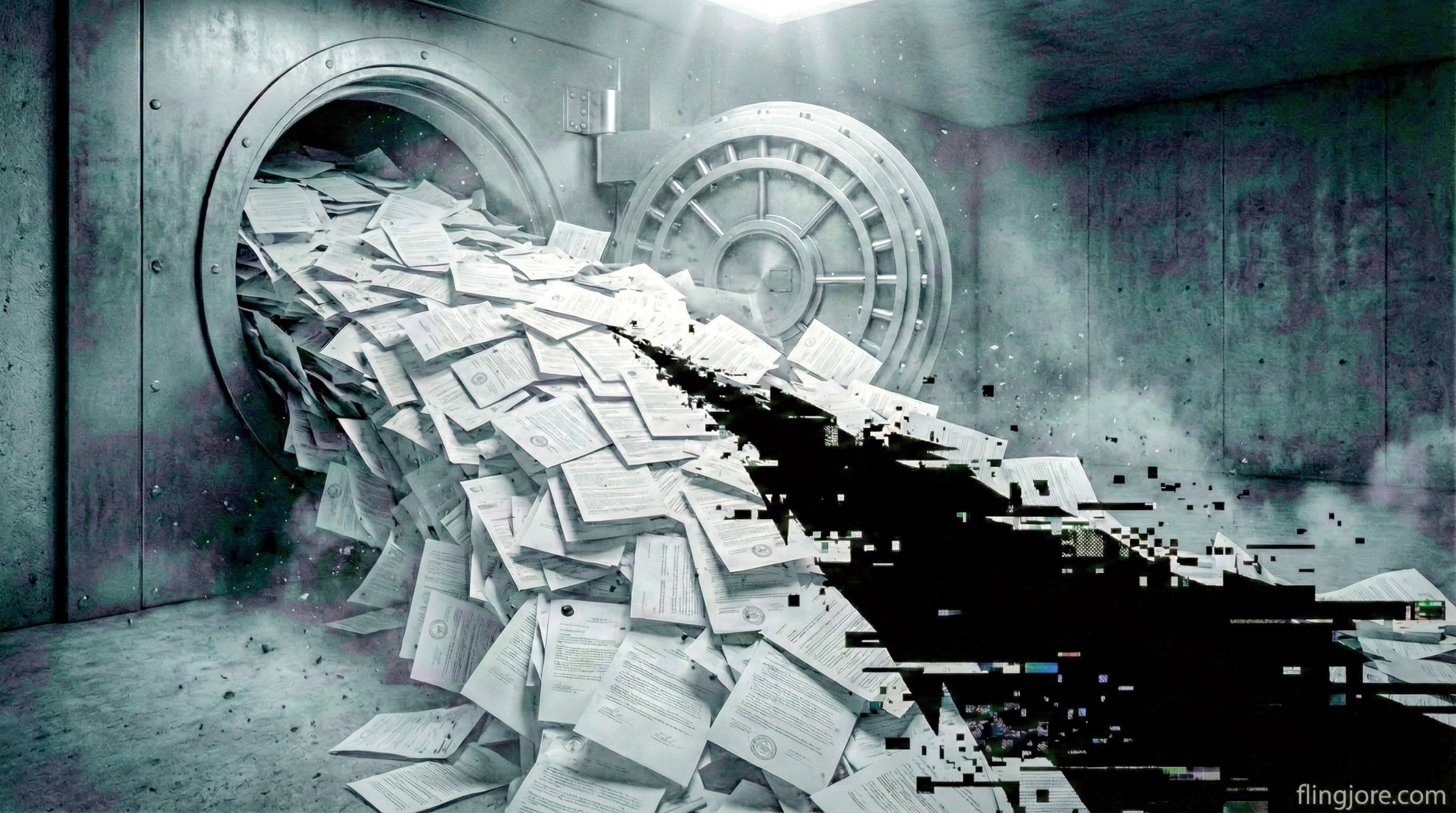
How data flooding by Department of Justice obscured 2.5 million Epstein files
When the Department of Justice released 3.5 million pages of documents related to Jeffrey Epstein on Friday, Jan. 30, 2026, the media predictably lunged for the names.
For three days, headlines have been dominated by client lists and celebrity gossip, a chaotic feedback loop that serves the exact purpose of modern malinformation: distraction by volume.
But for investigative observers, the most critical data point isn’t who is in the files — it’s what isn’t there.
Analysis: The missing 40%
According to the Department of Justice officials’ own admissions, the government identified more than 6 million pages of “potentially responsive” material.
Only 3.5 million pages were produced.
That leaves a gap of roughly 2.5 million files — nearly 40% of the total cache — that have vanished into the bureaucratic ether, dismissed by Deputy Attorney General Todd Blanche as mere duplicates or over-collected data.
This is not transparency. It is tactical flooding. By overwhelming the public with a deluge of unorganized raw data, the government has successfully hidden a massive procedural failure behind a wall of noise.
Sovereign shield vs. naked truth
The stated purpose of the delay in releasing these files was to protect the privacy of victims. On this front, the DOJ’s failure was total.
The Jan. 30 release included unredacted nude photographs and videos of survivors, exposing their faces and bodies to the world without their consent. Justice blamed “technical or human error” for this violation, sparking outrage from victims’ lawyers and prompting a quiet removal of thousands of files days later.
This incompetence, however, appears selective.
While the government “accidentally” released sensitive victim data, it made no such errors regarding national security. Despite the Epstein Files Transparency Act allowing for national security exemptions, the DOJ claims no files were withheld on those grounds.
We are asked to believe that a rushed review process, which failed to redact a victim’s face, was simultaneously perfect in filtering out state secrets.
A more skeptical analysis suggests the “missing” 2.5 million files likely contain the material that actually threatens the “sovereignty of the United States” — intelligence assets, diplomatic cables and state-level complicity — conveniently swept under the “duplicate” label to avoid the scrutiny of an official exemption log.
The distraction of Bill and Hillary Clinton
The media fixation on celebrity names has also conveniently buried a high-stakes procedural war involving former President Bill Clinton and former Secretary of State Hillary Clinton.
While pundits debated flight logs, the files confirm that the Clintons were engaged in a standoff with the House Oversight Committee throughout late 2025. It was only after a credible threat of contempt of Congress that the Clintons agreed to provide testimony and sworn declarations in early 2026.
The timing of the “flood” effectively neutralized this story.
By releasing millions of pages at once, the DOJ ensured that the Clintons’ legal maneuvering would be a footnote rather than a headline.
The narrative became “they were on the island,” distracting from the more relevant question: Why did a former President fight a subpoena for months if there was nothing to hide?
Timeline of failure
The logistics of the release betray the government’s intent. It took the DOJ nearly three years to release the first tranche of just 12,000 documents in December 2025.
Yet, under political pressure, the entire Justice Department managed to process and release 3.5 million files in just three months.
This acceleration came at the cost of accuracy, dignity and truth.
By declaring the review “complete” and shutting down the inquiry, the DOJ has signaled that this is not a criminal investigation. There will be no prosecutions derived from this data dump.
Congressional challenge
The discrepancy in the numbers has not gone unnoticed by lawmakers. Rep. Ro Khanna, D-Calif., has publicly challenged the Department of Justice, explicitly calling out the missing millions in the file count.
Khanna notes that the DOJ identified over 6 million responsive pages yet only released roughly half that amount, without providing a breakdown of where the remaining files went or why they were excluded.
Khanna’s statement pierces the “duplicate” defense. If 40% of a federal investigation’s file cache is truly “duplicate” or “non-responsive,” it points to a catastrophic failure in data management.
If it is not, it points to a cover-up.
By refusing to categorize these missing files under the official exemption list, the DOJ has created a black box that no FOIA request can easily penetrate.
The result is a victory for the federal government. The public is exhausted by the volume, the victims are re-traumatized by the leaks and the missing math — the 2.5 million files that never saw the light of day — remains unexamined.