

How math, water and code delete the middle class
Ideas: Your binary enclosure and why the system can't see you.

If you want to understand why the American middle class feels like it is collapsing, forget macroeconomics 101. Instead, watch a fictional teenage math prodigy flip a row of playing cards.
In a pivotal scene from the film X+Y, a young mathematician named Nathan stands before a row of face-down cards. He explains a game where every move consists of flipping a card and its neighbor.
Nathan’s conclusion is brutal in its finality: the sequence is strictly decreasing.
No matter what moves you make, the value of the binary string eventually hits zero. The game must terminate.
For years, economists have debated the wealth gap as if it were a linear problem — a matter of simply dealing more cards to the bottom of the deck.
But Nathan’s logic suggests we have been looking at the wrong equation.
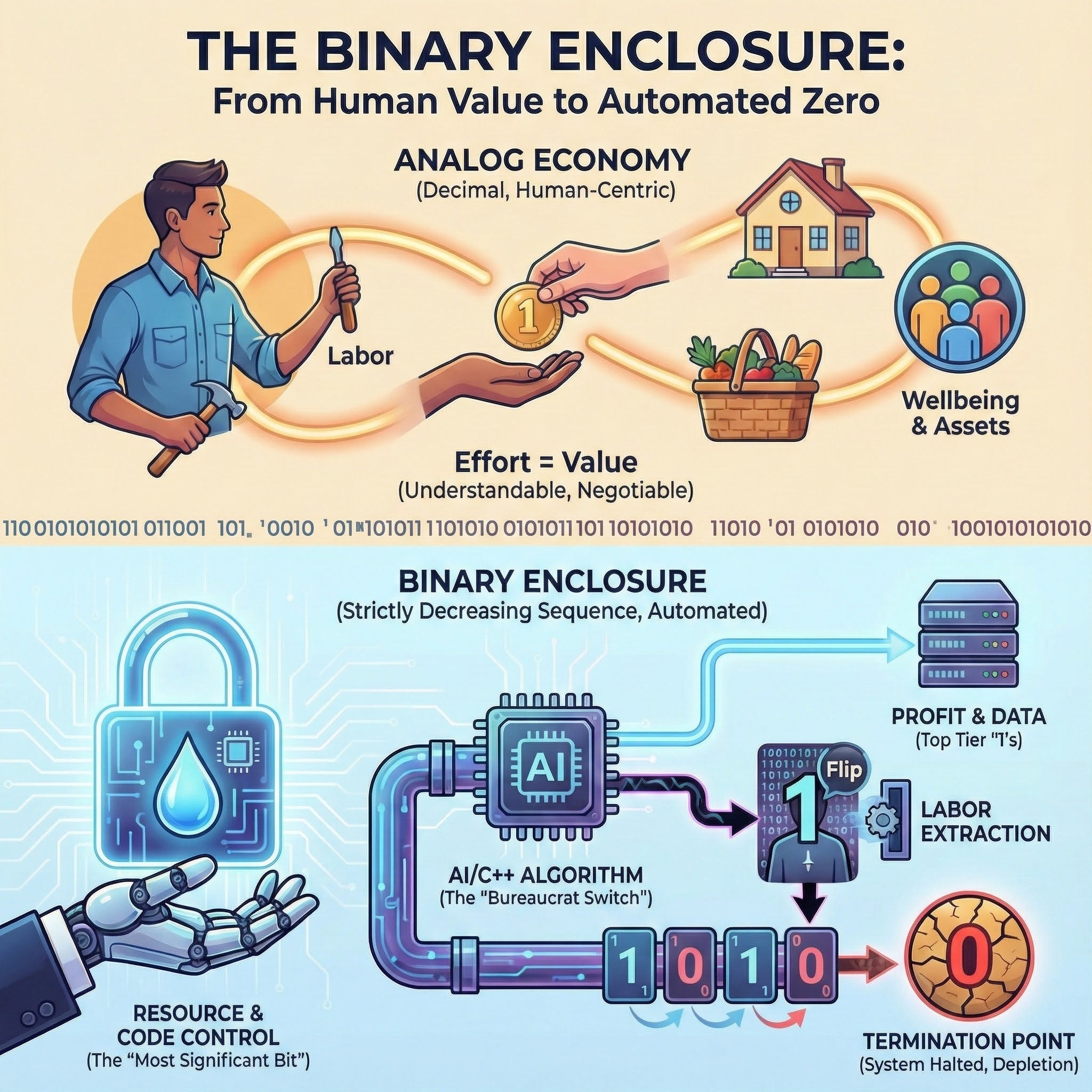
The modern American economy has transformed into a strictly decreasing binary sequence. It is enforced not by policy, but by the hard logic of C++ code and the terrifying scarcity of water.
We are no longer living in a decimal democracy where effort equals reward.
We have entered the era of the Binary Enclosure, where your position in the sequence — and your access to the source code — dictates whether you are a “one” or a “zero.”
Exponent of inequality
Nathan’s proof relies on the ruthless efficiency of binary place value. In a binary string, a “1” in the leftmost position is worth exponentially more than a “1” in the rightmost position.
This is the hidden architecture of American inequality.
For the last half-century, the American Dream has been sold on a linear premise: work hard (flip a card), and you add value to your life. But in a system dominated by capital velocity, labor has become the low-order bit.
A worker in the right-most position of the economic row can flip cards until their wrists break — working three gigs, side-hustling, driving Uber — but mathematically, they can never equal the value of a single “1” held by the asset class in the “left-most” position.
The gap is not a glitch; it is the function.
When the top 0.1% holds the position of 2^n (compound interest, capital gains, tax shelters), and the bottom 50% holds 2^1 (hourly wages), the system is designed to render the effort of the bottom mathematically irrelevant.
The wealthy do not need to work harder; they simply need to hold their position.
The math does the rest.
New Gold Standard: Water Variable
If the economic structure provides the board, the environment is now rewriting the rules of the game.
We have entered a phase where the Most Significant Bit (MSB) — the value that defines the worth of the entire row — is no longer cash.
It has become water.
Historically, water was a background utility, a given.
In our binary metaphor, it was a low-value card, easily flipped.
But as aquifers drain and the Colorado River gasps for breath, water has vaulted to the front of the sequence.
A stunning result forms the ultimate binary switch: you either have it (1), or you do not (0).
This shift fundamentally changes the nature of poverty.
In the 20th Century, poverty meant a lack of luxury or comfort.
In the 21st Century, under the pressure of climate scarcity, poverty means civilizational erasure.
When a community loses access to water — whether through drought or privatization — it does not simply become poorer.
It gets zeroed out.
The sequence terminates.
We are seeing this water binary play out in real-time.
Hedge funds and agricultural conglomerates are buying water rights with the same fervor they once applied to mortgage-backed securities.
They understand the math: if you control the MSB, the rest of the string is irrelevant.
A house worth $500,000 (a “1” in the asset column) instantly becomes a “0” if the tap runs dry.
The equity evaporates not because of market forces, but because the binary condition for life — water — has been toggled off.
Algorithmic bureaucrat
This brings us to the mechanism of enforcement. How is this strictly decreasing sequence maintained?
In the past, bureaucracy was a human endeavor. It was slow, flawed and occasionally merciful.
A human clerk might look at a struggling family and fudge a deadline.
A human landlord might wait an extra week for rent.
That world has been deleted.
It has been replaced by the original C++ prompts — a digital bureaucracy that thinks exclusively in binary.
The modern economy is run by algorithms that streamlined the process of wealth extraction.
This is the automation of inequality.
Usually, talk about automation involved taking jobs on the factory line, but the more dangerous automation has happened in the back office.
The Housing Binary: Algorithms like RealPage now set rent prices, removing the human haggling element. The code creates a cartel-like pricing structure that maximizes extraction. If you cannot pay the algorithmically determined price, you are a 0.
The Healthcare Binary: Insurance denials are now often automated by AI systems that flag claims for rejection in milliseconds. The doctor (human) says you need treatment; the code (binary) says False. The strictly decreasing sequence of your health is accelerated by a line of code designed to protect the insurer’s position.
The Employment Binary: We have boss-ware tracking keystrokes and time off task. The nuance of human labor — the creativity, the pauses for thought — is interpreted by the machine as idle time (0). The worker is forced to become as binary as the computer, stripping away humanity to service the algorithm.
This transition to AI for computer automated governance will create an authoritarianism of indifference.
It is not that the system hates you; it is that the system cannot see you.
It can only see 1s and 0s.
And since the system’s objective function is to maximize efficiency, it will always choose the path that flips your “1” (your asset, your wage, your water) into a “0” (profit for the holder of the MSB).
Termination event
Nathan’s video concludes with a chilling proof: “The sequence of moves must terminate.”
You cannot keep taking away from a positive integer without hitting zero.
This is the End of History strictly decreasing.
We have built an economic machine that requires the constant flipping of 1s to 0s — zeros — to generate short-term growth.
We strip-mine the middle class to feed the quarterly earnings.
We drain the aquifers to grow alfalfa for export.
We automate the workforce to boost margins. But the math says this is a finite game.
You can only flip so many cards.
You can only extract so much equity from a homeowner before they foreclose.
You can only drain a river until it is dust.
You can only automate a job until there is no consumer left to buy the product.
The danger of our current moment is that the computer running the show — the complex web of high-frequency trading, algorithmic management, and automated bureaucracy — does not know how to stop.
It has been programmed to execute the sequence until termination.
It lacks the nostalgia for the World War II era of shared prosperity; it lacks the capacity for moral reasoning.
It just runs the loop.
Rewriting source code for future generations
The math is too stark for simple cynicism.
We are staring at a structural problem.
This wealth gap is not a failure of the system; it is the successful execution of the code.
To fix it, one cannot simply just ask for a better shuffle of the cards. Nope. Too late.
Instead, recognize that the game itself — the strictly decreasing binary sequence of resource extraction and algorithmic control — is rigged to terminate.
Breaking the binary is the only way.
Reintroduce analog values — human judgment, public ownership of water and regulatory friction — back into the machine.
Why treat water as a bit to be traded?
Maybe start treating water as a right to be protected.
We need to some separation between the bureaucracy that governs our survival and the engine running it.
If we do not, the math is clear:
The sequence will continue to decrease. Always.
The 1s will flip to 0s.
And we will be left staring at a row of face-up cards, wondering where the value went, while the computer quietly logs the final entry …
System Halted.