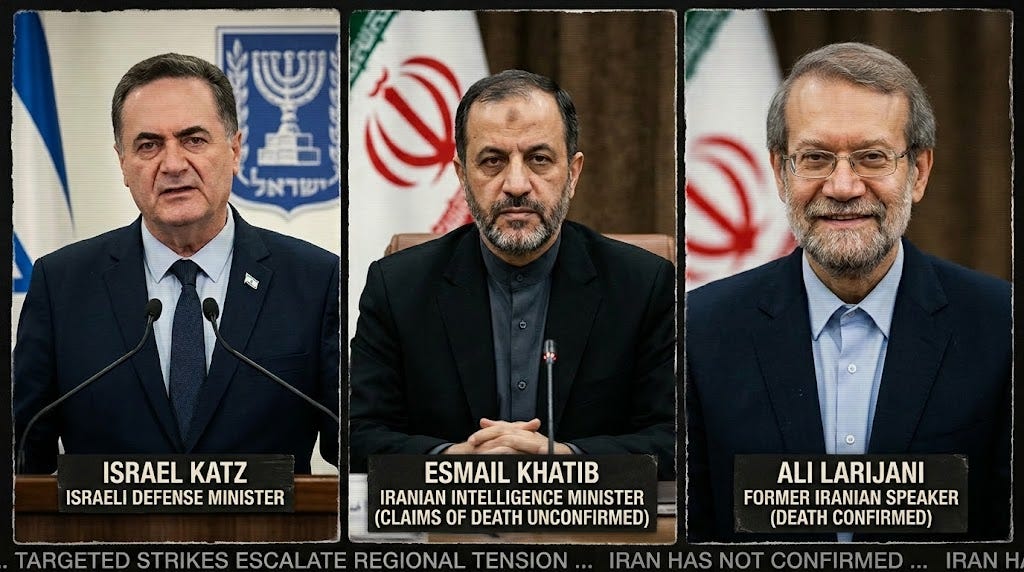
Israel claims killing of Iran Intelligence Chief Esmail Khatib
Defense Minister confirms Tehran strike, the third top official killed in 48 hours as Operation Epic Fury targets Iran’s high command.

Israeli Defense Minister Israel Katz reports an overnight strike kills Iranian Intelligence Minister Esmail Khatib, the latest in a cascade of high-profile deaths that threatens to paralyze the Islamic Republic’s security apparatus.
The operation against Khatib follows the reported killings of top advisor Ali Larijani and Basij commander Gholamreza Soleimani, suggesting a systematic Israeli campaign to dismantle Tehran’s command-and-control hierarchy in real time.
The assassination of Khatib, who managed the regime’s sprawling domestic surveillance and internal security networks, represents a critical blow to an Iranian leadership already destabilized by a vacuum at the highest levels of power.
By targeting the very official responsible for protecting the state from such incursions, Israel appears to be betting that a rapid-fire decapitation of the security apparatus will trigger a systemic collapse before a new command structure can be solidified.
Katz, speaking from Tel Aviv on Wednesday, warns of “significant surprises” across all fronts as the conflict, which began with a joint U.S.-Israeli offensive on February 28, reaches a fever pitch.
While Tehran has not yet officially confirmed Khatib’s death, the Revolutionary Guard retaliated early Wednesday by launching a barrage of Khorramshahr-4 and Qadr cluster missiles toward central Israel, resulting in at least two civilian fatalities near Tel Aviv.
The loss of Khatib, a veteran cleric who managed the regime’s internal security and surveillance apparatus since 2021, leaves a critical void in Iran’s intelligence community at a time when the leadership is already reeling from the death of former Supreme Leader Ali Khamenei.
Regional analysts suggest the rapid removal of these figures, often referred to as the “architects of the crackdown,” aims to spark internal collapse as independent reports emerge of celebrations in certain Tehran neighborhoods following the strikes.
A veteran cleric who has led the Iranian Intelligence Ministry since 2021, he leaves behind a legacy defined by aggressive domestic surveillance and the suppression of political dissent.
The U.S. Treasury Department sanctioned Khatib in 2022, accusing his ministry of directing cyber espionage and ransomware attacks against international targets while facilitating serious human rights abuses within Iran.
Under his leadership, the ministry reportedly operated secret detention centers and targeted journalists and activists, making him a central figure in the regime’s survival strategy.
The loss of the intelligence chief follows the assassination of Ali Larijani, the former speaker of parliament who had emerged as Iran’s de facto leader following the death of Supreme Leader Ali Khamenei in February.
Larijani was widely viewed as the only figure capable of bridging the gap between rival hardline and moderate factions during the onset of the current conflict. His death, confirmed by the Supreme National Security Council, removes a key pillar of stability from a government already reeling from sustained aerial bombardment.
Simultaneously, the killing of Gholamreza Soleimani, commander of the paramilitary Basij forces, deals a devastating blow to the regime’s internal security apparatus. For six years, Soleimani oversaw the “Organization for the Mobilization of the Oppressed,” transforming the volunteer militia into a kinetic force used to quell nationwide protests through lethal means.
The IDF confirms that Soleimani was eliminated in a “precision strike” while hiding in a makeshift tent area in central Tehran, an effort to evade the high-tech tracking that has characterized this campaign.
These targeted killings are part of the broader U.S.-led “Operation Epic Fury”, a massive military campaign launched on February 28 alongside Israel’s “Operation Roaring Lion.”
The mission objective is to permanently dismantle Iran’s ballistic missile industry and nuclear infrastructure while severing the command links between Tehran and its regional proxies.
Strategic analysts note that the rapid pace of ministerial-level assassinations suggests a coordinated effort to force a systemic collapse by removing the regime’s most experienced decision-makers in quick succession.
As Tehran prepares for the funerals of its fallen leaders, the city remains under a state of high alert with 34 major squares reportedly sealed off by security forces.
The overlapping losses of Khatib, Larijani, and Soleimani create a historic power vacuum that Mojtaba Khamenei, the son of the late Supreme Leader, must now navigate amid growing internal unrest.
While the Revolutionary Guard vows “definite revenge,” the absence of a unified high command significantly complicates Iran’s ability to coordinate a sustained response to the ongoing allied offensive.