How Israel’s AI targeting logic is now U.S. border policy
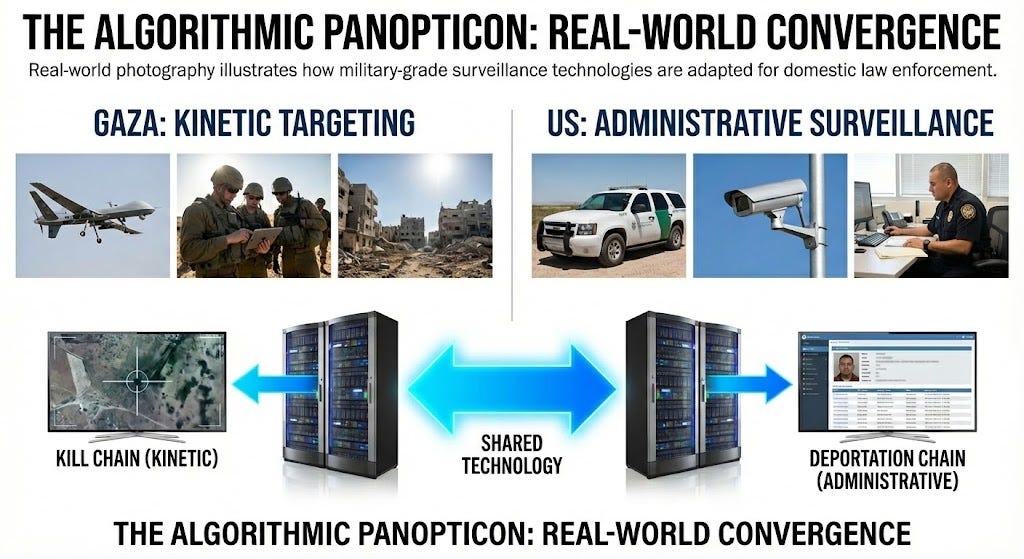
Gaza Beta Test: New $139M DHS contract for Palantir’s surveillance system imports the haystack targeting model perfected by the IDF, signaling a grim convergence of military and domestic policing.
The future of American policing was beta-tested in the rubble of Gaza.
While the world’s attention has been fixed on the kinetic war — the airstrikes, the ground incursions, the humanitarian crisis — a parallel, digital conflict has been waged, one that serves as a grim proof-of-concept for the future of state control. In this new mode of warfare, Artificial Intelligence doesn't just assist human decision-makers; it directs them, turning vast oceans of metadata into lists of targets.
Now, that future has quietly arrived on American soil.
During the bureaucratic lull between Christmas and New Year’s, the Department of Homeland Security finalized a contract worth over $139 million to renew Palantir Technologies as the central nervous system for Immigration and Customs Enforcement (ICE) through 2026.
The timing was auspicious.
Just 24 hours later, explosive reporting from The Guardian laid bare the inner workings of the Israel Defense Forces’ (IDF) use of Big Tech to automate kill chains in Gaza.
Taken together, these developments paint a clear and disturbing picture: The technologies and logics of suppression perfected in foreign battle labs are being repatriated.
What is sold as counter-terrorism abroad is repackaged as case management at home. The Gaza Strip has become the testing ground for the surveillance architecture now being cemented in the United States.
Battle Lab
For decades, military strategists have spoken of foreign conflicts as laboratories for new weaponry. The Spanish Civil War tested the tactics of the Blitzkrieg; Vietnam tested the limits of air power. Today, conflicts like the one in Gaza test the limits of algorithmic control.
The Guardian’s investigation revealed a symbiotic relationship between the Israeli military and Silicon Valley giants.
Systems like Lavender ingest the metadata of the entire Palestinian population — phone records, location history, social connections—and use AI to generate lists of potential targets. The human role is reduced to a rubber stamp, a mere kinetic executioner for a digital judge.
This is the ultimate realization of the haystack theory of intelligence: to find the needle, you must possess the entire haystack. In a war zone, this logic is defended as a tragic necessity. But the technology that makes it possible — the ability to create a digital twin of a population and algorithmically sort it for risk — is not bound by geography.
A tool designed to root out insurgents in a dense urban environment is, from a technical standpoint, indistinguishable from a tool designed to root out undocumented immigrants in a dense American city. The code does not know the difference between a militant and a migrant; it only knows patterns in data.
Importing Battlefield Logic
The $139 million DHS contract for Palantir’s Investigative Case Management (ICM) system is the domestic manifestation of this battlefield logic.
Palantir, a company that cut its teeth building tracking software for the Pentagon in Iraq and Afghanistan, is the primary vector for this technology transfer. Its CEO, Alex Karp, openly embraces a philosophy of techno-nationalism, viewing his company’s software as a crucial weapon for Western hegemony.
The ICM system is not merely a digital filing cabinet. It is an engine of mass aggregation that mirrors the IDF’s data-gathering operations. It sucks in data from federal agencies (FBI, DEA), state and local sources (DMV records, utility bills) and, crucially, commercial data brokers (license plate readers, cell phone location history).
Just as the IDF system does not distinguish between combatants and non-combatants in its data collection, the ICE system does not distinguish between citizens and non-citizens. It creates a universal dragnet, a pre-crime engine that flags individuals for investigation based on algorithmic probability rather than the traditional legal standard of individualized suspicion.
”The Fourth Amendment traditionally requires individualized suspicion,” a legal analyst noted in recent reporting on the contract. “This technology flips that standard. It allows the government to search everyone first to generate suspicion later.”
This is the core tenant of the Gaza beta test applied to the American homeland: The entire population is a battlespace to be managed and data is the primary munition.
Boomerang Effect: Patriot Act 2.0
This phenomenon is known by civil libertarians as the boomerang effect.
Technologies and legal theories developed for the gray zones of asymmetric warfare, where constitutional protections are nonexistent, inevitably migrate back to the metropole.
We saw this after 9/11 with the passage of the Patriot Act and the militarization of local police forces with surplus Pentagon gear. Today, the boomerang is digital.
In Gaza, the output of the algorithmic system is a kill chain — a swift progression from data point to airstrike. In the U.S., the output is a deportation chain or an investigative lead. The kinetic consequences are vastly different, but the underlying bureaucratic machinery is identical. Both rely on opaque, proprietary algorithms to make life-altering decisions about individuals based on their digital exhaust.
By renewing the Palantir contract through 2026, DHS has not just bought software; it has bought into a governing philosophy. It is a philosophy that says efficiency outweighs liberty, that total information awareness is a prerequisite for security and that the methods used to control occupied populations abroad are suitable for managing free citizens at home.
Permanent Emergency
The danger of this transference is that the emergency measures of war become the permanent furniture of domestic governance.
In a war zone, there is no expectation of privacy. In the United States, that expectation is enshrined in the Bill of Rights. Yet, the ICM system leverages the Third-Party Doctrine — the legal loophole that says you have no privacy interest in data you voluntarily give to a company — to bypass the Fourth Amendment on a massive scale.
A report by the Georgetown Law Center on Privacy & Technology estimated that ICE has access to the driver’s license data of three in four American adults. When utility usage, movement patterns and commercial transactions become searchable government records, the boundary between the state and the citizen dissolves.
This is the civilizational erasure that critics fear — not the physical destruction of a people, but the destruction of the private individual as a political concept.
The lessons learned in Gaza are helping to construct a panopticon in America, one where the government’s capabilities are limitless and its algorithms are unaccountable.
As we move into 2026, the question is not whether these military-grade technologies will be used on American soil. The contract is signed; the system is operational. The question is whether a legal framework designed in the 18th century has any power to restrain a surveillance apparatus that was perfected in the 21st-century’s most intractable conflict.
The beta test is over. The production rollout has begun.