Top U.S. general warns of ‘authoritarian axis,’ delivers subtle rebuke of Pentagon protectionism
Speaking from the High North, Gen. Alexus Grynkewich outlines a grim convergence of adversaries from Ukraine to the Arctic
A top U.S. general warned Sunday that a cohesive axis of authoritarian powers is aggressively coordinating against Western interests from the Ukrainian front lines to the melting ice of the High North, delivering a stark assessment that seemed to challenge the isolationist industrial policies of his own leadership in Washington.
Speaking at the Society and Defence National Conference in Sälen, U.S. Air Force Gen. Alexus Grynkewich described a rapidly solidifying alliance between Russia, China, Iran, and North Korea: a grouping analysts term the “CRINK” axis.
Grynkewich cautioned that these adversaries are now “ganging up” on the established international order with a synchronized strategy that demands a unified—and integrated—response from NATO, rather than a retreat into national protectionism.
”When I look around the globe, Russia, China, Iran, North Korea, and others are increasing their collaboration and their cooperation as their interests align against us,” Grynkewich told the assembly of defense officials and policymakers.
While the general’s remarks focused officially on Arctic security and the war in Ukraine, his speech contained a series of intricately worded messages that appeared to push back against the America First defense doctrine championed by Defense Secretary Pete Hegseth.
By praising cross-border industrial cooperation and rejecting “protectionist” narratives, Grynkewich offered a distinct counter-vision to the Pentagon’s current trajectory, emphasizing that the United States cannot secure its future by acting alone.
The Authoritarian Convergence

Grynkewich, known by his call sign “Grynch,” painted a grim picture of the current strategic environment, describing a level of adversary coordination that far exceeds previous assessments. He detailed how the war in Ukraine has become a focal point for this new axis, with Beijing and Tehran underwriting Vladimir Putin’s aggression despite diplomatic overtures from the West.
”While President Trump pushes for a peaceful resolution to a horrible war, China continues to fund Putin’s war machine,” Grynkewich said. He noted that Iran is supplying critical technology and weapons, while North Korean combat troops remain deployed on Ukraine’s border—a deployment that signals a dangerous globalization of the conflict.
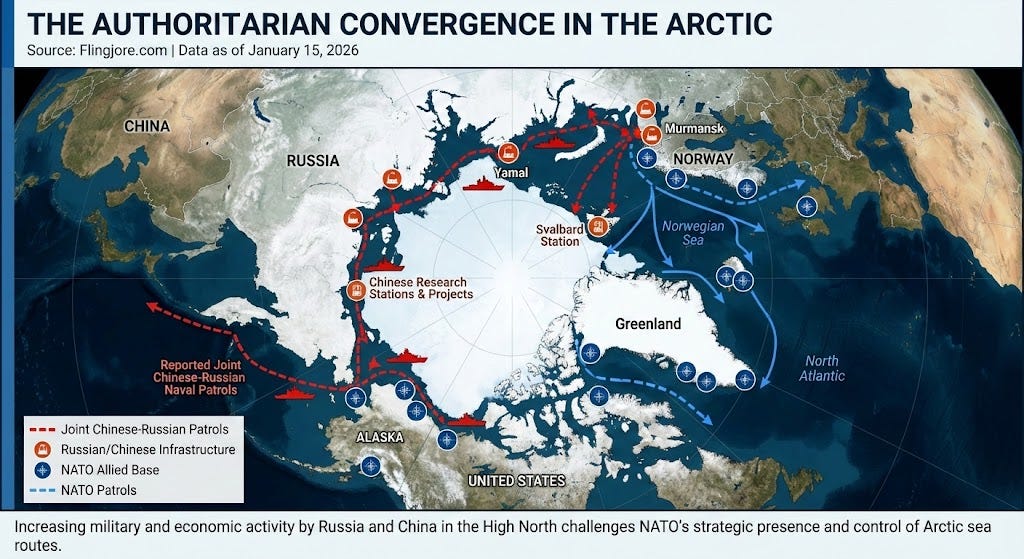
This cooperation, he warned, is now spilling into the Arctic. Grynkewich cited intelligence showing “Chinese icebreakers and research vessels” operating in the High North “not for peaceful purposes,” but to map the seabed for military advantage. He described a “confluence” of hostile actors, including a “dark fleet” of oil tankers involving Russia, Iran, and Venezuela that is successfully bypassing sanctions to fund continued hostilities.
Message to Washington: ‘Made with’ doctrine
In what analysts view as a pointed critique of the Pentagon’s recent push for industrial autonomy, Grynkewich used his platform to champion the integration of allied defense industries. Secretary Hegseth has frequently criticized NATO members for relying on U.S. stockpiles, urging them to “buy American” or build their own domestic capacity in isolation.
Grynkewich, however, lauded Sweden’s approach of deep industrial integration, offering a specific linguistic correction to the prevailing political rhetoric.
”Yesterday I heard the phrase ‘Made with Sweden,’ in stark contrast to the other phrase that you might have chosen, a more protectionist phrase of ‘Made in Sweden,’” Grynkewich said. “This is fantastic. All allies would benefit from adopting this mentality.”
The distinction is significant. By endorsing “Made with” over “Made in,” the General appeared to question the efficacy of strict domestic manufacturing mandates—recently reinforced by Executive Order 14192—that can slow the delivery of critical systems. “A rising tide lifts all boats,” he added, suggesting that shared technology and co-production are superior to autarky. “We can learn from you as you build transatlantic partnerships... or global partnerships with other like-minded nations.”
‘Model ally’ and the checklist
At a time when the Department of Defense has expressed skepticism regarding the value of traditional alliances—with Secretary Hegseth questioning the “warrior ethos” of modern NATO partners—Grynkewich went out of his way to validate the NATO structure, using Sweden as a prime example of its utility. He described the Scandinavian nation not as a burden, but as a standard-setter for the alliance—and perhaps for the U.S. itself.
”Frankly, I think someone gave you all a checklist for being a model ally and you just went down and started checking it off,” Grynkewich said, praising Sweden’s “societal resilience” and its “exceptional commitment” to Ukraine.
This praise stands in contrast to the transactionalist view often espoused by the current administration, which views alliances primarily through the lens of financial contribution. While acknowledging the importance of defense spending, Grynkewich pivoted to a more nuanced metric: actual industrial output.
”Money alone is not a deterrent,” he warned. “We need the equipment, the weapons, and the munitions to start showing up in our allied military inventories.” He argued that while the Defense Investment Pledge was historic, it is meaningless without the industrial flexibility to convert that cash into capability—flexibility he implied is currently hampered by barriers to trade and cooperation.
Arctic security as a coalition effort
Addressing the specific security dynamics of the High North, Grynkewich emphasized that U.S. security in the region is derived from its coalition partners, not just its own power projection. He noted that “seven of eight Arctic nations” are now inside the NATO alliance, leaving Russia as the sole outsider.
”We will and we can get this right,” he said, framing the region as a zone of allied dominance. He highlighted the realignment of NATO’s command structure, specifically the Joint Force Command Norfolk, which now unifies Arctic activities under a single banner to “better defend all allies in Europe in the Arctic and the strategic approaches to North America.”
Underlying tensions
The speech touched on themes likely to resonate with the “old guard” of the military establishment, many of whom have expressed quiet concern over the rapid cultural and doctrinal shifts occurring under Secretary Hegseth.
Grynkewich spoke of “institutional” values and the need for “adaptability” in a way that seemed to defend the career military’s expertise against recent political purges.
When asked about the uncertainty regarding U.S. national strategy and recent statements from President Trump, Grynkewich offered a diplomatic deflection that nonetheless underscored the durability of the alliance’s bureaucracy over political rhetoric.
”I won’t comment on the political dimensions of recent rhetoric,” he said. “But I will just observe... that those dialogues continue in Brussels... they’ve been healthy dialogues.” He emphasized that the “permanent representatives” of the alliance—the career diplomats and officers—continue to work through “thorny issues,” implying that the machinery of NATO remains functional regardless of the political headwinds from Washington.
Coming storm or coming for him?
Defense observers suggest that Grynkewich’s comments may place him at odds with a Pentagon leadership that values loyalty to the America First agenda above all else. His unabashed support for the liberal international order and his critique of protectionism strike at the heart of the current administration’s defense philosophy.
Grynkewich is effectively creating a public record of his strategic advice. He is asserting that the U.S. is stronger with allies and that industrial isolation is a strategic error.
In the current political climate, that is a bold and perhaps dangerous position for a sitting commander to take. Rest assured, however, the military is apolitical.
Read the full transcript of General Grynkewich’s remarks here.


It is important to be precise about what we are up against, so we can effectively counter it with the necessary heft, and tactics.
So I clicked into my favorite browser and typed in these three words:
👉What is fascism?=TRUMP
Here is what appeared on my screen thanks to AI that is quickly overrunning our increasingly👉 dumbed-down, and numb society:
Fascism is a far-right, authoritarian political ideology and movement characterized by extreme nationalism, a strong centralized government led by a dictator, suppression of opposition, militarism, and prioritizing the nation or race above the individual. It promotes social hierarchy, often racism, and severe economic and social control, opposing liberal democracy and individualism while often aligning with powerful business interests.
Here is the Miriam-Webster definition for the sticklers out there:
Fascism : a populist political philosophy, movement, or regime (such as that of the merriam-webster.com/dic…) that exalts nation and often race above the individual, that is associated with a centralized merriam-webster.com/dic… government headed by a merriam-webster.com/dic… leader, and that is characterized by severe economic and social regimentation and by forcible suppression of opposition
Yep. 👉It really is that bad right now, people.
Some Americans will know Italy’s Benito Mussolini, Germany’s Adolf Hitler, and Spain’s Francisco Franco👉 were all murdering fascists that the United States once bravely burned lives and treasure to help stop dead in their tracks.
These days, Russia’s Vladimir Putin most prominently carries the fascist banner, while👉👉👉 dragging his orange puppet in tow, the America-attacking Donald Trump. Under Trump’s fascist regime, America has joined Russia with big talk of attacking NATO countries instead of defending them. BINGO!!!😨
This should be absolutely incomprehensible.
But you’ve read this far and👉👉👉 still somehow aren’t convinced Trump and his party are fascists … Or, there are certain increasingly dangerous people in your life who consume nothing but state-run propaganda like Fox, and never believe a single word you say anymore.
Well, I suggest you send them what I will type next, so they can never say they weren’t warned👉 or complicit in this ongoing attack on America.
Diving into deeper waters researching this piece, I came across a list headlined Characteristics of Fascism. I had seen this before in passing, but am now happy to attribute it to New Hampshire’s Keene State College. And an aside: I lived in Maine for several years, and was always envious of neighboring New Hampshire’s state motto: Live Free or Die.
That has never been more relevant than it is today.
Anyway, here is the list⬇️ that defines fascism from the good people at Keene:
👉Powerful, often exclusionary, populist nationalism centered on cult of a redemptive, “infallible” leader who never admits mistakes.
👉Political power derived from questioning reality, endorsing myth and rage, and promoting lies.
👉Fixation with perceived national decline, humiliation, or victimhood.
👉White Replacement “Theory” used to show that democratic ideals of freedom and equality are a threat. Oppose any initiatives or institutions that are racially, ethnically, or religiously harmonious.
👉Disdain for human rights while seeking purity and cleansing for those they define as part of the nation.
👉Identification of “enemies”/scapegoats as a unifying cause. Imprison and/or murder opposition and minority group leaders.
👉Supremacy of the military and embrace of paramilitarism in an uneasy, but effective collaboration with traditional elites. Fascists arm people and justify and glorify violence as “redemptive”.
👉Rampant sexism.
👉Control of mass media and undermining “truth”.
👉Obsession with national security, crime and punishment, and fostering a sense of the nation under attack.
👉Religion and government are intertwined.
👉Corporate power is protected and labor power is suppressed.
👉Disdain for intellectuals and the arts not aligned with the fascist narrative.
👉Rampant cronyism and corruption. Loyalty to the leader is paramount and often more important than competence.
👉Fraudulent elections and creation of a one-party state.
👉Often seeking to expand territory through armed conflict.
Chilling, no?
This👉👉👉 defines the fascist Republican Party to a T. It should be sent out far and wide to everybody you know —👉 mostly the ignorant’s and those in denial — and pinned to your refrigerator with this subject line:
Fascism isn’t coming to America, it is here.