Pentagon investigated over apocalyptic Iran war briefings
Lawmakers demand a Pentagon Inspector General investigation after commanders allegedly frame the U.S.-Iran war as a biblical prophecy

A formal congressional demand for a Department of Defense Inspector General investigation into military commanders framing the U.S. war in Iran as a biblical prophecy intensifies as civil rights advocates document an alarming surge in domestic anti-Muslim hate, clashing with conservative defenders who dismiss the allegations as an anti-Christian witch hunt.
Reps. Jared Huffman, D-Calif., and Jamie Raskin, D-Md., lead a coalition of 30 Democratic lawmakers officially requesting the Pentagon watchdog investigate the chain of command. The legislative push responds to a synchronized release of whistleblower complaints alleging officers tell troops the ongoing joint U.S.-Israeli offensive is “God’s divine plan.”
The congressional pressure coincides with a new civil rights brief detailing the severe domestic fallout of the war. Data from the Council on American-Islamic Relations reveal that following the onset of the conflict, online Islamophobic content reaches an 11-fold amplification. While critics note kinetic Middle East conflicts historically trigger spikes in online hate regardless of domestic rhetoric, the Council on American-Islamic Relations explicitly connects the surge to top-down religious messaging. CAIR cites Defense Secretary Pete Hegseth’s recent characterization of Iran as a regime “hell-bent on prophetic Islamic delusions.” Advocates point to Hegseth’s 2020 book, American Crusade, arguing this ideology now shapes the Pentagon’s command climate and endangers Muslim Americans.
The controversy within the military traces back to a combat readiness status briefing on the morning of March 2. According to a whistleblower complaint released by the Military Religious Freedom Foundation, a unit commander tells subordinates not to fear the escalating conflict because it aligns with a divine blueprint. The commander references the Book of Revelation and explicitly states that President Donald Trump is “anointed by Jesus to light the signal fire in Iran to cause Armageddon and mark his return to Earth.”
A noncommissioned officer files the initial complaint on behalf of 15 service members in the unit, a group that includes 11 Christians, one Muslim, and one Jewish service member. The NCO notes the commander delivers these remarks with a “big grin on his face,” leaving troops from diverse religious backgrounds deeply unsettled and questioning the ideological motivations behind their deployment.
The scope of the issue rapidly expands beyond a single briefing. The MRFF reports receiving more than 200 similar complaints from personnel across 50 military installations — spanning the Marines, Air Force, and Space Force. The rapid, sequential release of the MRFF leak, the CAIR data brief, and the congressional letter suggests a highly coordinated political maneuver designed to force on-the-record accountability while the Pentagon press pool remains saturated by battlefield updates from establishment media outlets.
Conservative legal groups and Hegseth allies immediately push back, weaponizing the First Amendment’s Free Exercise Clause. Organizations like the First Liberty Institute argue commanders do not lose their constitutional right to express their faith simply because they wear a uniform. Defenders dismiss the MRFF’s reliance on anonymous complaints as unverified hearsay and argue that 200 complaints in a military of 1.3 million active-duty personnel represent isolated, rogue incidents rather than a systemic policy.

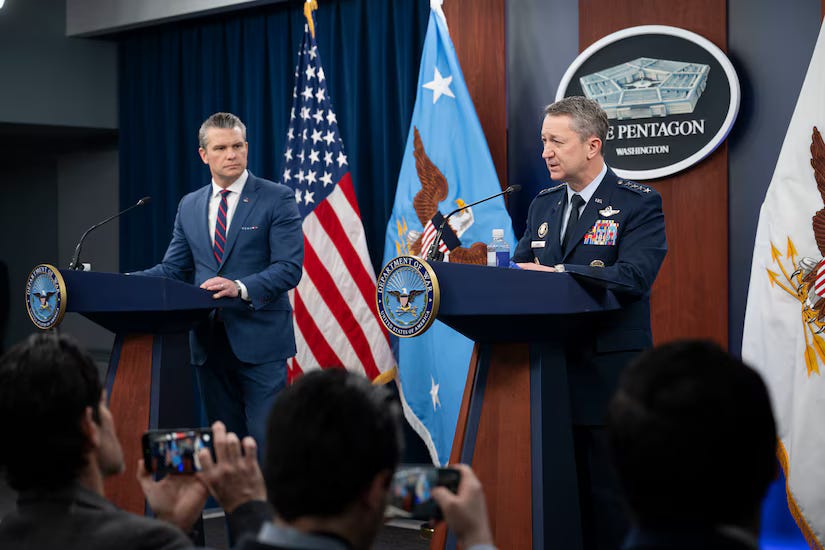
Beyond the immediate political fallout, the incident tests the enforcement of strict military codes. While Hegseth does not deliver the March 2 briefing, watchdog groups, critics, and lawmakers place the blame squarely on the culture he fosters at the Defense Department. Lawmakers seek to determine if this top-down culture acts as a tacit endorsement, emboldening mid-level commanders to violate standing regulations regarding religious proselytizing.
Under Department of Defense Instruction 1300.17, commanders must maintain strict neutrality to avoid the actual or apparent use of their positions to promote personal religious beliefs. When a commander frames a geopolitical conflict as a biblical prophecy during an official briefing, the actions escalate into potential offenses under the Uniform Code of Military Justice. Officers face prosecution or relief of command under Article 92 for failing to obey regulations, and Article 133 for conduct unbecoming an officer, as alienating troops of different faiths destroys essential unit cohesion.
The Pentagon currently declines to comment directly on the watchdog complaints or the congressional inquiry. Defense officials instead point to Hegseth’s previous public statements regarding the strictly operational scope of the military actions in Iran. Ultimately, the Defense Department Inspector General faces the task of weighing the Free Exercise Clause against the Establishment Clause in the midst of an apocalyptic war narrative.