

Rescue Doctrine: Trump frames presidency as existential salvage operation
By centering economic address on a narrative of fixing a mess, the president trades institutional unity for a transactional model of leadership that relies on rhetorical hyperbole over history.

President Trump utilized the solemnity of the White House Diplomatic Reception Room to deliver a prime-time address that effectively redefines the American economic and social landscape as a theater of existential rescue.
Fact-Check: Examining claims made during Trump economic speech to nation
By framing his first 11 months as a singular battle against a mess inherited from his predecessor, the president pivots away from the traditional role of a national unifier, opting instead for a transactional leadership model that trades statistical precision for political narrative.
The address, delivered Wednesday night, marks a significant departure from the historical precedent of presidential communications during periods of perceived national crisis.
Where past leaders sought to consolidate public resolve through shared sacrifice, Trump centered his messaging on the externalization of blame and a vigorous defense of his own perceived victories.
Construction of a mess: Fact vs. narrative
The president’s address relied heavily on the assertion he has inherited a country on the brink of collapse — specifically citing 48-year record inflation and an open border.
An analysis of economic data and federal records, however, suggests a more complex, and often contradictory, reality.
Inflation Myth: Trump has claimed inflation was at its worst in 48 years when he took office in January 2025. In reality, while inflation has peaked at 9.1 percent in June 2022, it has cooled significantly to approximately 3 percent by the start of 2025. The 48-year metric has appeared to be a rhetorical device rather than a reflection of the Consumer Price Index (CPI) at the time of the transition.
Border Numbers: The president’s claim that an army of 25 million people has invaded the country has remained unsupported by any federal or independent agency. Current estimates from the Department of Homeland Security (DHS) have placed the total undocumented population in the U.S. at roughly 11 million — a figure that has remained relatively stable for over a decade.
Criminal Narrative: By citing a specific figure of 11,888 murderers allegedly allowed into the country by the Biden administration, Trump has utilized a data set from ICE that has historically included individuals who have been incarcerated in U.S. prisons for decades, rather than new arrivals.
Leadership style defined by transaction
The tone of the speech has revealed a president who has viewed his role not as a steward of institutions, but as a contractor hired to "fix" a broken system. This transactional leadership has focused on a direct exchange with his base: political loyalty in return for the perceived dismantling of a "corrupt" status quo.
"I inherited a mess, and I’m fixing it."
This specific phrasing underscores a leadership framework where the president distances himself from any institutional continuity.
By portraying the government he now leads as a mess until the moment of his arrival, Trump avoided the traditional ownership of ongoing national challenges.
Unlike a transformational leader who might inspire the public toward a shared future vision, Trump functions as a restorer of a mythical past, focusing on affordability and security as commodities he has personally delivered.
Historical contrast: The crisis of 2025 vs. the crisis of war
To understand the weight of this address, it has been compared to wartime or emergency speeches by previous presidents.
The results highlight a fundamental shift in the American Address to the Nation.
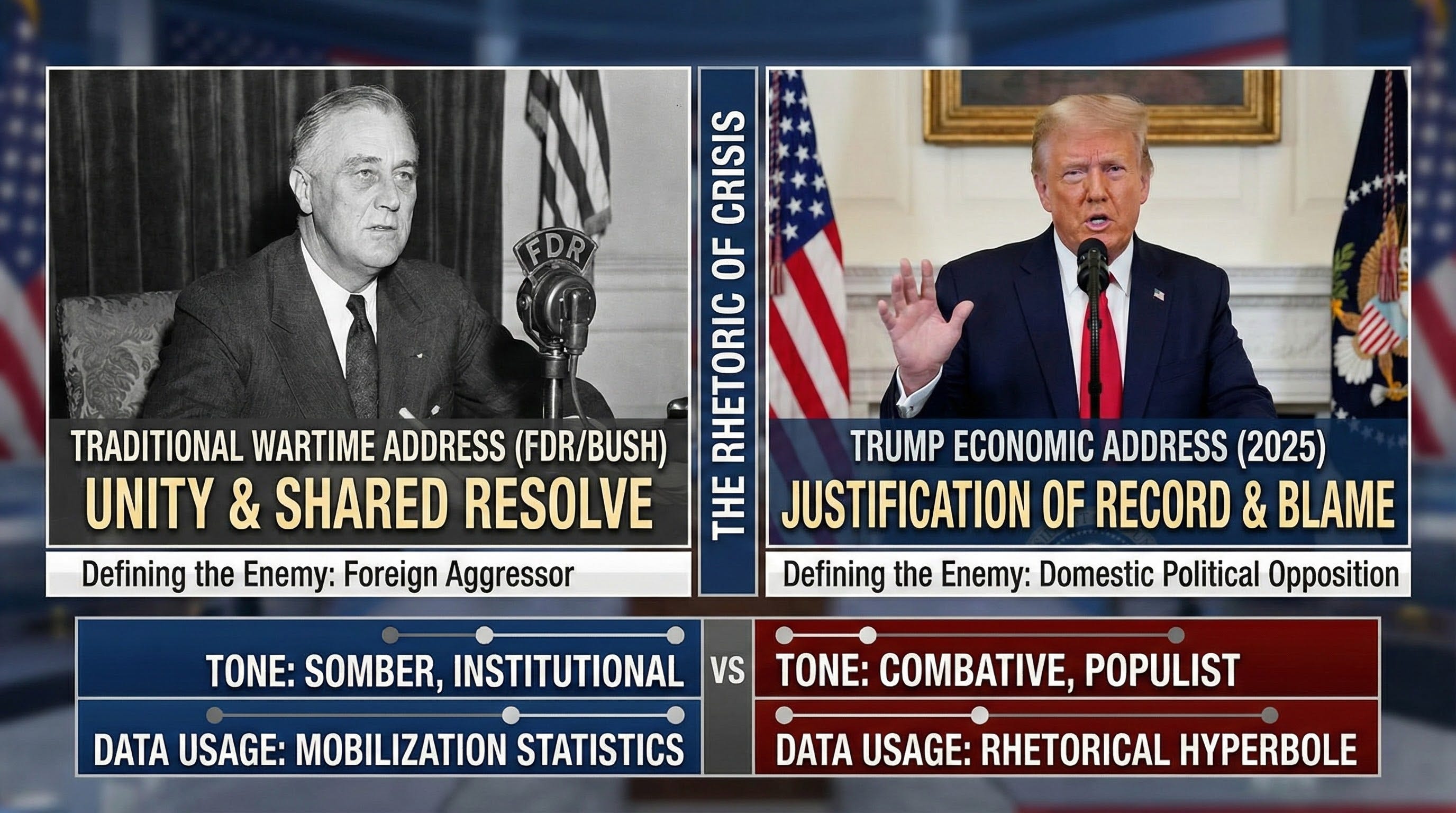
The Roosevelt Comparison: During the Great Depression, FDR’s Fireside Chats used the term "We" to include the banking sector, the laborer and the government in a unified recovery effort. Trump conversely uses "We" to define his administration and his supporters against a Democrat administration and invading forces.
The Bush Comparison: In the aftermath of 9/11, George W. Bush explicitly sought to differentiate between the attackers and the broader immigrant or religious communities. Trump has done the opposite, conflating immigration with mental institutions, insane asylums and murderers, effectively securitizing a humanitarian and economic issue to justify disparate policy shifts.
End of history and the new nostalgia
The president’s rhetoric suggests that the End of History — a theory that Western liberal democracy has reached its final, stable form — has been replaced by a Perpetual Crisis Framework.
By insisting the United States was invaded and unaffordable until his intervention, Trump wants to end the post-WWII era of globalist cooperation and replace it with a nationalistic nostalgia.
This speech has not been about policy; it's about the narrative of decline.
If the president of the United States can convince the electorate that the country was in a state of civilizational erasure prior to his 11-month tenure, then any action taken to fix it — regardless of legal or institutional norms — is framed as a historical necessity.
White House rhetoric of sabotage
President Trump's address contained no fewer than six major factual inaccuracies, yet the efficacy of the speech is not measured by its truth, but by its emotional resonance.
Trump successfully transitioned the national dialogue from "How do we govern?" to "Who is to blame for our decline?"
By refusing to acknowledge global economic variables, such as the post-pandemic recovery or international energy markets, President Trump crafted a story of domestic sabotage.
This suggests that the remainder of Donald J. Trump's second term will not be focused on collaborative leadership, but on a continued cleanup of a mess that, according to the data, may only exist in the rhetoric of the address itself.