The ‘Double Tap’ Distraction
Analysis: How the Debate Over War Crimes Obscures the Militarization of Drug Policy

The video footage shown to lawmakers on Capitol Hill has been described as harrowing: survivors of a U.S. military strike on a small vessel in the Caribbean, clinging to debris in international waters, moments before a second strike—a "double tap"—ended their lives.
The revelation has ignited a firestorm in Washington. Democrats have labeled the second strike a potential war crime. Republicans have defended the authority of the commanders involved. The Pentagon launched investigations into the chain of command, specifically scrutinizing the orders given by Defense Secretary Pete Hegseth and the tactical decisions made by Adm. Frank Bradley.
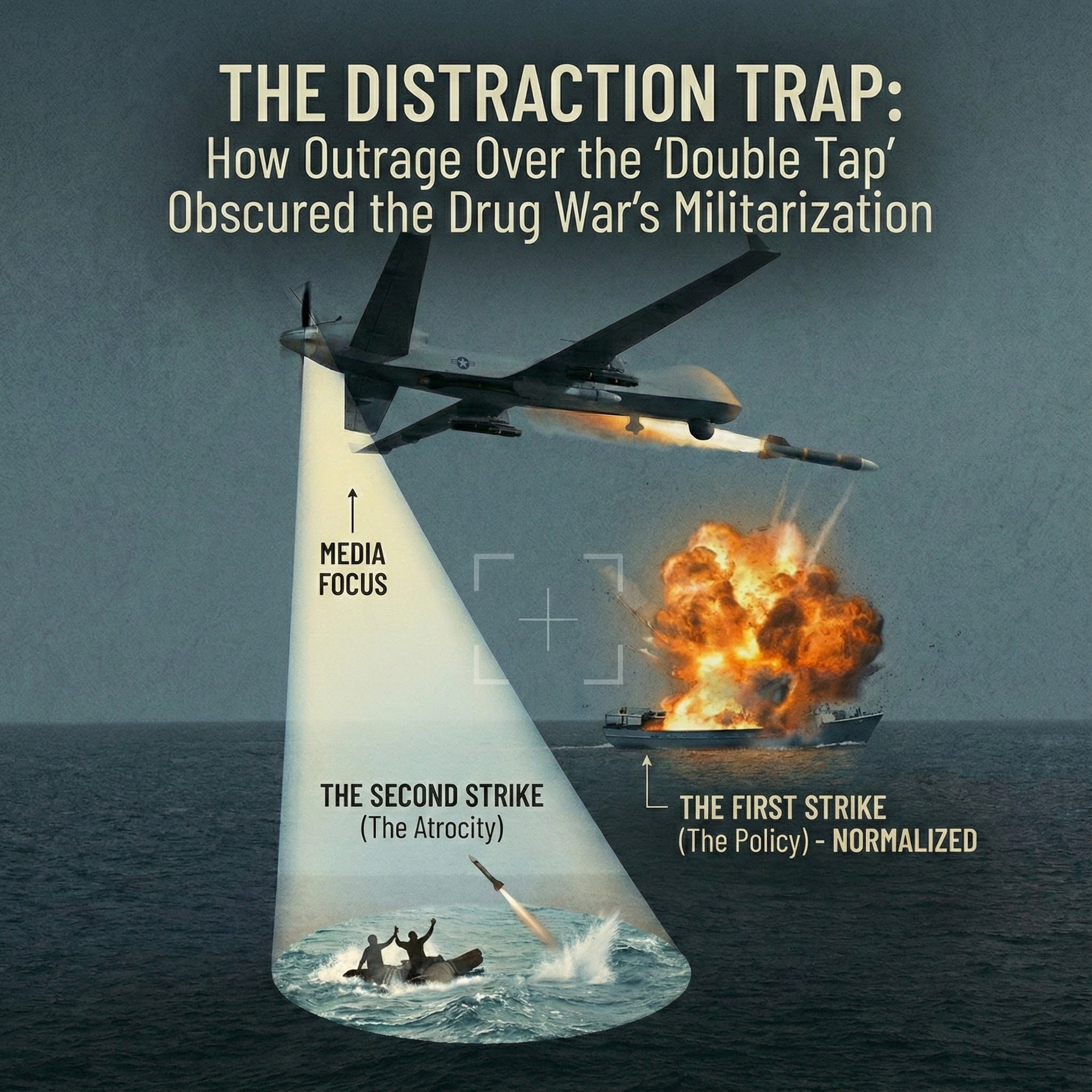
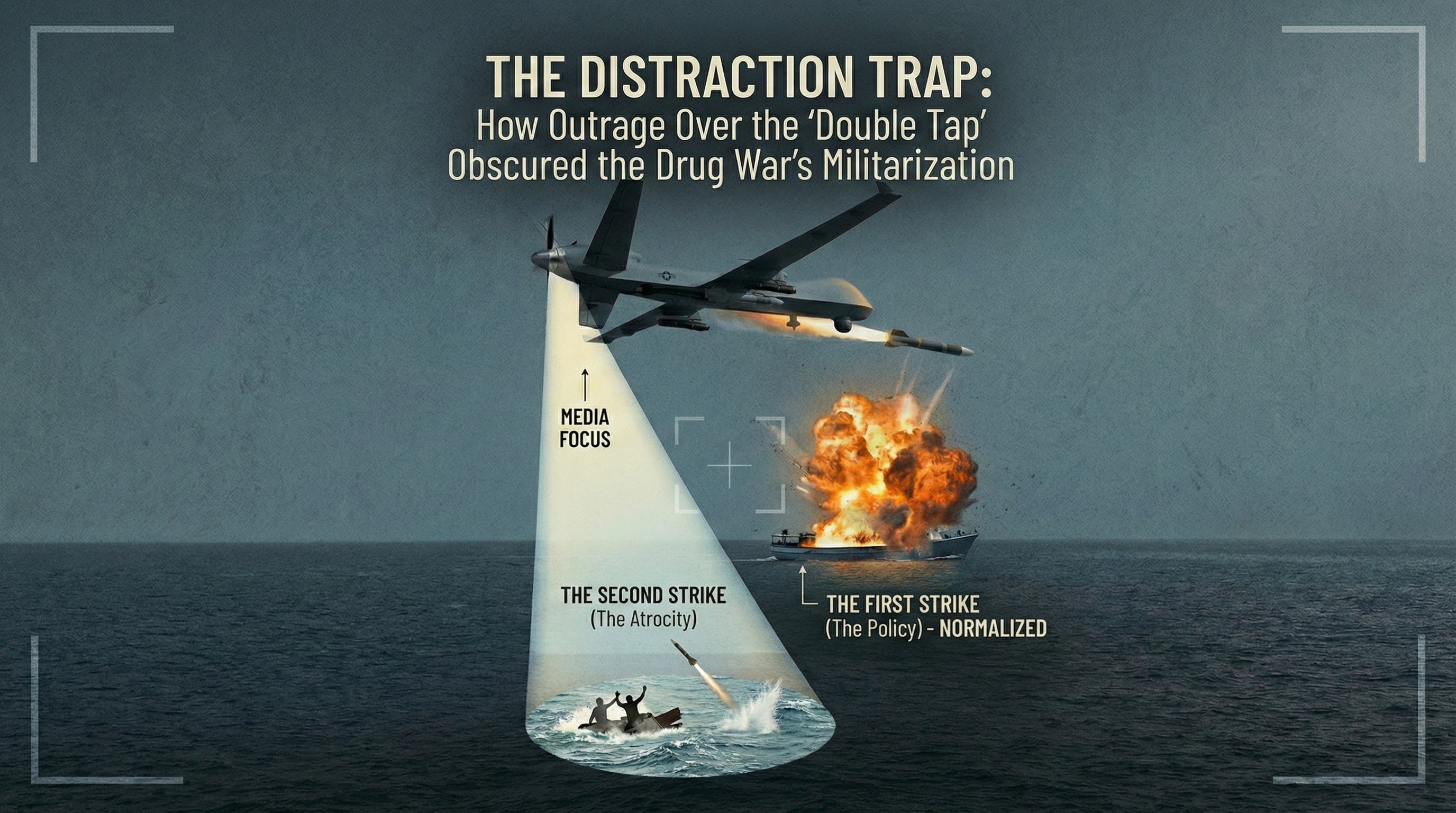
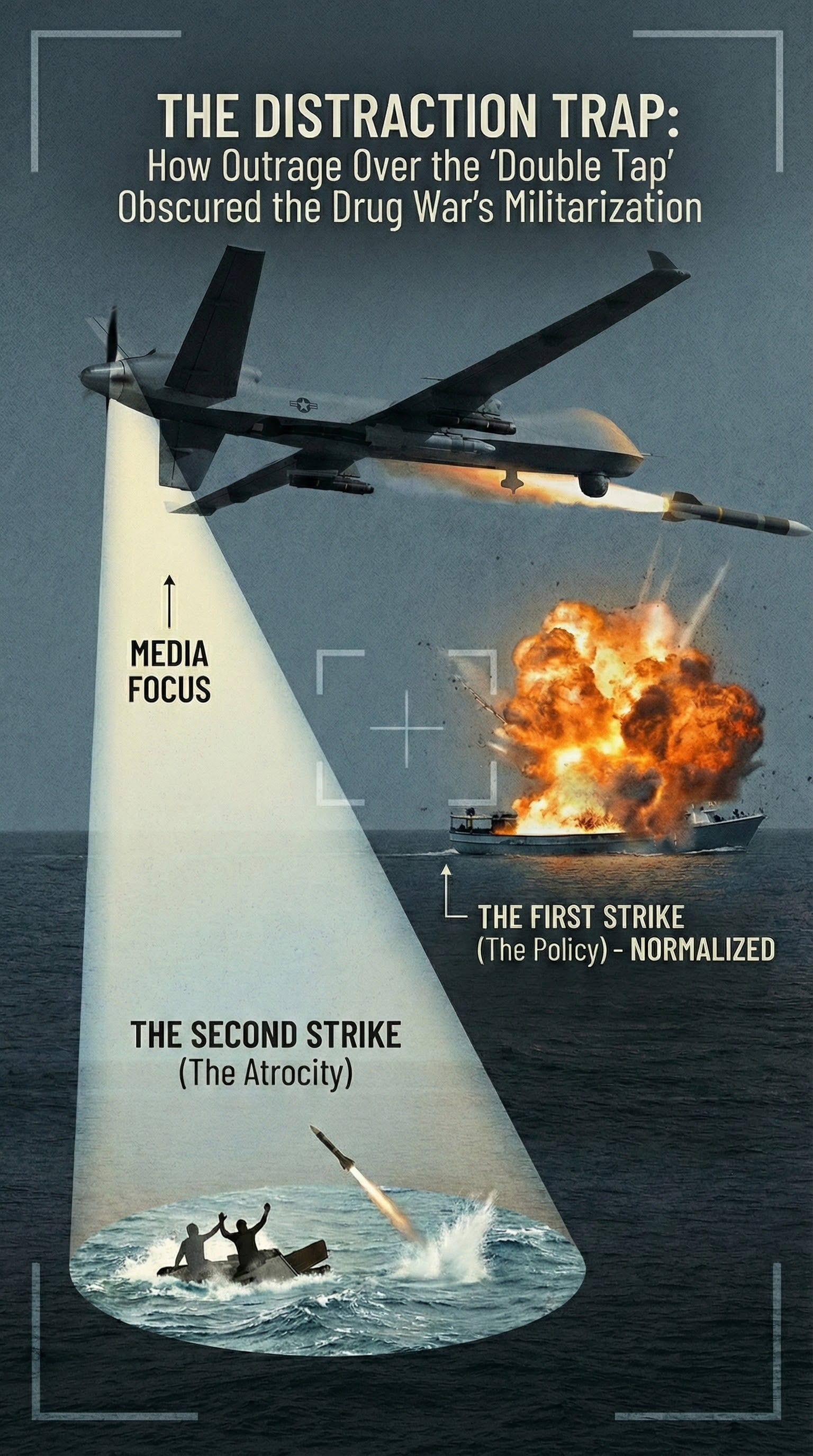
However, a deeper analysis of the discourse suggests that the intensity of the debate over the second strike successfully obscured a far more significant shift in American foreign policy: the normalization of the first strike.
By focusing the political oxygen on the atrocity of killing shipwrecked survivors, the political establishment implicitly accepted a novel and legally precarious premise—that the United States has entered a state of armed conflict with drug traffickers, granting the military license to execute civilian criminal suspects in international waters without due process.
Mechanism of Escalation
The dynamic currently playing out is a textbook example of "normalization by escalation." In political science, this concept describes how introducing an extreme action can make a previously controversial action appear moderate and acceptable by comparison.
Prior to the revelation of the "double tap," the primary controversy facing the Trump administration’s Southern Command operations was the legality of using lethal military force against drug smuggling boats. Under standard interpretations of international law, drug trafficking is a law enforcement issue. Interdiction involves Coast Guard cutters, sirens, boarding parties, arrests and trials.
The administration has sought to reframe this activity under the law of armed conflict by designating cartels as Foreign Terrorist Organizations (FTOs) and labeling smugglers "narco-terrorists." This designation creates a legal fiction that transforms a civilian criminal into an enemy combatant, theoretically making them a legitimate target for lethal force.
This legal theory has been hotly contested by human rights organizations and legal scholars. However, the "double tap" incident shifts the Overton Window. The debate has moved from "Is it legal to bomb drug boats?" to "Is it legal to bomb the survivors of drug boats?"
In condemning the killing of the survivors, critics have inadvertently conceded the battlefield. By arguing that the survivors were hors de combat—a term from the Geneva Conventions referring to combatants who are out of the fight due to injury or shipwreck—lawmakers are implicitly validating the premise that the smugglers were "combatants" in the first place, rather than civilians entitled to a presumption of innocence.
Erasure of the Police-Military Distinction
The most profound implication of this episode is the erasure of the distinction between police work and military action.
Defense Secretary Hegseth champions a more aggressive posture for the military, viewing the drug trade not as a crime wave but as an invasion. This rhetorical shift has materialized into kinetic action. The use of airstrikes to interdict narcotics fundamentally alters the nature of the engagement.
In a law enforcement paradigm, the objective is the seizure of evidence and the capture of suspects to dismantle a network through judicial means. In a military paradigm, the objective is the destruction of enemy assets and personnel to degrade capability.
The "double tap" controversy has highlighted the friction between these two paradigms. The second strike, ordered to "eliminate the threat," follows a ruthless military logic: if the enemy is still alive, the threat persists. However, applied to a civilian context, this logic disintegrates. A wet, unarmed smuggler clinging to a hull poses no immediate threat to a drone operator or a naval vessel miles away.
By treating the "double tap" as an isolated aberration or a failure of specific leadership, Washington misses the broader reality: the brutality of the second strike is the inevitable downstream consequence of applying the laws of war to civilian crime.
Once the military is authorized to treat a boat as a target rather than a crime scene, the escalation to ensuring "no survivors" becomes a tactical decision rather than a moral red line.
The Scapegoat and the Precedent
The administration has skillfully managed the fallout by focusing on the chain of command. By casting Adm. Bradley as the officer who made the specific tactical call to strike the survivors, the White House has created a buffer for Secretary Hegseth and President Trump.
This bureaucratic maneuvering serves two purposes. First, it personalizes the scandal. If the issue is a "rogue admiral" or a "misunderstood order," the system itself remains indicted. Adm. Bradley faced the brunt of the scrutiny, protecting the political architects of the policy.
Second, it validates the "mission command" structure while evading responsibility for its outcomes. Hegseth emphasizes that commanders have the authority to act. By supporting the authority of the strike while distancing themselves from the optics of the result, the administration has reinforced the precedent that the military has a free hand in the Caribbean.
The focus on the "double tap" effectively inoculated the administration against criticism of the broader campaign. Future strikes that destroy boats without killing survivors in the water will now likely be viewed as "clean" and "lawful," despite the fact that they rely on the same disputed legal justification as the controversial strike. The bar for acceptable violence is raised.
What It Means
For the American public and the international community, the implications are stark.
Expansion of the Kill Chain: The United States effectively expanded its drone warfare model—honed in the tribal regions of Pakistan and the deserts of Yemen—to the Western Hemisphere. The criteria for being added to the "kill chain" has expanded from "terrorist with global reach" to "commercial criminal." This sets a precedent that other nations may eventually adopt to deal with their own criminal annoyances.
Desensitization of the Electorate: The outrage cycle regarding the "double tap" demonstrates a public tolerance for the initial violence. There have been no mass protests regarding the bombing of the boats themselves, only the conduct of the cleanup. The public has been conditioned to accept that drug smugglers have forfeited their right to life.
Militarization of the Border: This policy reinforces the narrative that the southern approach to the United States is a war zone. This justification allows for the further deployment of military assets and the suspension of civil liberties in border and maritime regions, framed as necessary measures of national defense.
What’s Next?
Legal Warfare: Expect immediate challenges in federal courts and potentially the International Criminal Court (ICC). However, the administration likely calculated that these challenges will take years to resolve. In the interim, the "facts on the ground"—or on the water—will have established a customary practice of military interdiction.
Bureaucratic Purges: Adm. Bradley appears destined to be the sacrificial lamb. His removal will allow the administration to claim it addressed the "excesses" of the program without altering the program itself. This will likely be followed by the installation of commanders more fully aligned with Hegseth’s interpretation of aggressive engagement.
Escalation on Land: If the maritime strikes are normalized, the logical next step for the administration is to apply the same "narco-terrorist" framework to targets on land in Mexico or South America. The argument will be consistent: if we can strike them at sea, why can we not strike the labs and staging grounds? The acceptance of the boat strikes paves the road for cross-border drone operations.
Congressional Paralysis: Congress finds itself in a bind. Democrats cannot fully defund the operation without appearing soft on cartels\ and Republicans are largely unified behind the "tough on crime" aesthetic. The legislative branch has ceded its oversight power regarding the declaration of war, allowing the executive branch to redefine "war" to suit its policy goals.
The controversy over the double tap served its purpose. It exhausted the public’s capacity for outrage on the specific details of a war crime, while the architecture of a new, indefinite war has been poured, dried and set in the background. The debate over whether the second missile was illegal has ensured that the legality of the first missile is no longer a question.