The Iron Paradox: Invoking Insurrection Act Signals Presidential Weakness, Not Strength
Historical analysis reveals that deploying troops domestically is a high-stakes gamble that often shatters a president's legitimacy, marking a moment of political desperation, not dominance.
Invoking the Insurrection Act is an act of political desperation, and American history shows it is more likely to cripple a presidency than to strengthen it.
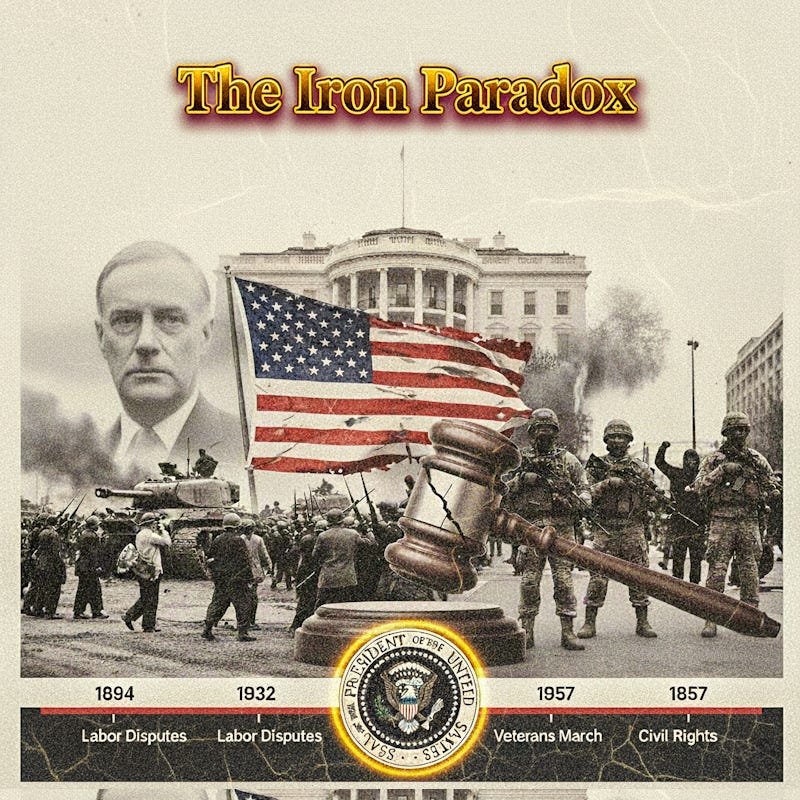
A president who deploys the military against Americans has, by definition, lost control.
It is a public admission that the standard tools of governance — negotiation, public persuasion, and law enforcement — have failed.
Far from projecting strength, the historical record reveals it as a high-risk gamble that often destroys a president’s legitimacy.
Case Study: Herbert Hoover and the Bonus Army (1932)
The most potent example of this political blowback is President Hoover’s handling of the “Bonus Army.”
Facing thousands of destitute World War I veterans peacefully demanding early payment of their service bonuses in Washington D.C., Hoover ordered the U.S. Army to disperse them.
The resulting images of soldiers, led by General Douglas MacArthur, using tanks and tear gas against unarmed veterans and their families were a public relations catastrophe.
The action cemented Hoover’s image as callous and disconnected, contributing significantly to his landslide defeat against Franklin D. Roosevelt later that year.
Force did not restore order; it exposed the president’s political bankruptcy.
Case Study: Grover Cleveland and the Pullman Strike (1894)
President Cleveland invoked the Insurrection Act to break a nationwide railroad strike, sending federal troops to Chicago against the explicit wishes of Illinois Governor John Peter Altgeld.
While the move successfully crushed the strike, it permanently alienated the powerful labor movement and was widely seen as the federal government taking the side of railroad barons against working citizens.
Cleveland paid a heavy political price, losing control of his own Democratic party, which later nominated the populist William Jennings Bryan.
The use of force delegitimized him in the eyes of a huge portion of the electorate.
The Counter-Argument: A Tool to Uphold the Law
The context of the deployment, however, is critical.
When used not to crush popular dissent but to enforce federal law against defiant state officials, the Insurrection Act can be a sign of constitutional resolve.
President Dwight D. Eisenhower was famously reluctant to use federal power, but in 1957 he was forced to act when Arkansas Governor Orval Faubus used the National Guard to block the integration of Little Rock Central High School.
Eisenhower federalized the Guard and sent in the 101st Airborne Division to escort the “Little Rock Nine” to school.
This was not a move to suppress a movement but to uphold a Supreme Court ruling.
In this instance, Eisenhower’s hand was forced by a breakdown in the rule of law, and his action, while a last resort, reinforced the legitimacy of the federal government.
Ultimately, history shows that presidents who resort to the Insurrection Act are rarely untouchable strongmen.
More often, they are leaders whose political authority is so fragile that they must turn to coercion—a move that, unless used to defend the Constitution itself, often shatters the very legitimacy they seek to command.