


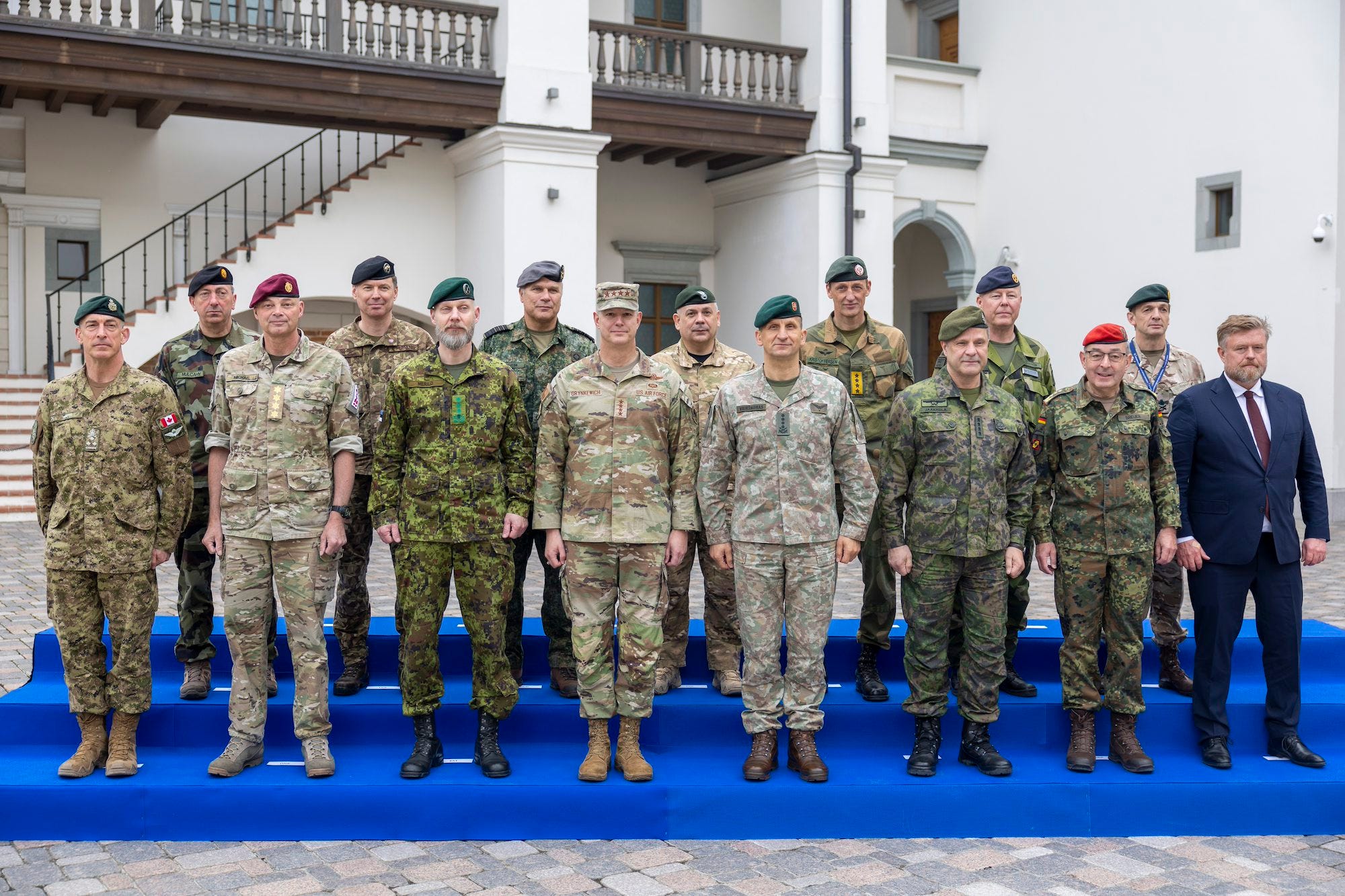
Only 11% of Europeans across 15 nations view the United States as a true ally, marking a historic collapse in transatlantic faith, dropping sharply from 16% six months ago and 22% in November 2024.
This data, published this week by the European Council on Foreign Relations, circulates across the global policy landscape not just as an opinion survey, but as the quantifiable death certificate of the old world order.
When a pan-European think tank like the ECFR releases a report detailing a “collapse in faith,” it acts as a mirror for European policymakers.
The survey of thousands of respondents shows the erosion of trust is not temporary.
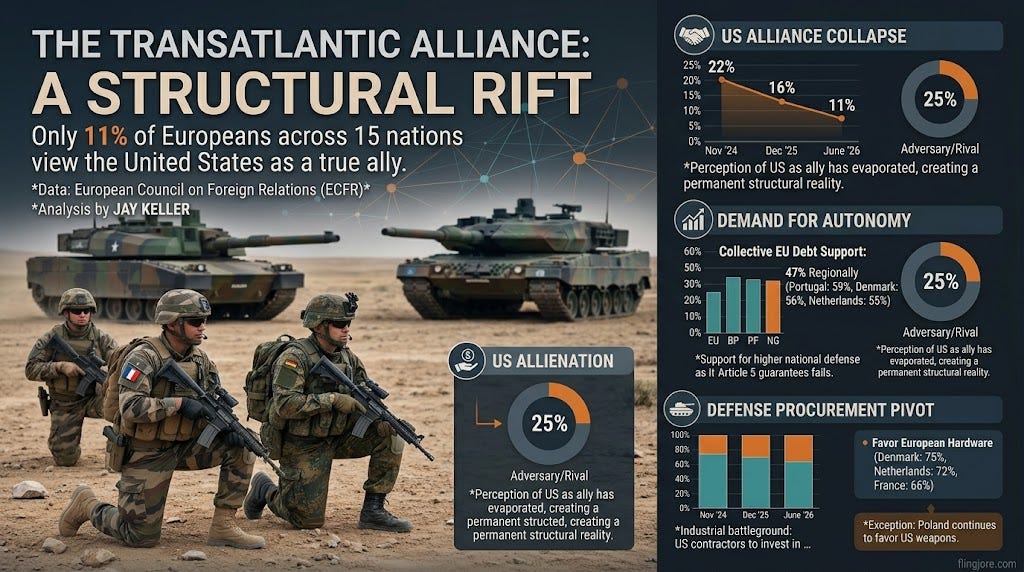
It is a structural reality: 25% of Europeans now consider the U.S. either a rival or a direct adversary.
In allied capitals like Paris, Madrid, and Copenhagen, the perception of Washington irrevocably shifts from a guarantor of security to a variable of immense risk.
But to understand what this actually means, we have to look past the surface-level anti-Americanism. This decline aligns perfectly with Washington’s own quiet, systematic pivot toward the Pacific theater.
The transatlantic relationship transforms from an unconditional security blanket into a transactional partnership.
Search for Autonomy and the Bill That Comes With It
The ECFR findings provide the verifiable receipts for a continent finally waking up to its own vulnerabilities.
European strategic autonomy is no longer a fringe academic concept debated in Brussels; it is now an urgent public mandate.
Majorities in every country surveyed doubt the United States would rush to their defense in the event of an attack.
This completely undermines the Article 5 mutual-defense guarantees of the NATO treaty.
Due to this widespread skepticism, Europeans are 4% more likely to support higher national defense spending than they were a year ago.
A striking 47% of respondents across the region back the idea of collective European Union borrowing to fund independent defense initiatives.
Support runs highest in Portugal at 59%, Denmark at 56%, and the Netherlands at 55%.
The European public realizes that if the U.S. leaves the room, Europe must buy its own locks for the doors.
The political will, however, to fund this autonomy hits a massive roadblock: the European social safety net.
While citizens support collective EU debt mechanisms, resistance to cutting domestic public spending to boost national defense budgets remains deeply entrenched.
In Italy, 63% oppose such cuts; in Austria, the figure is 59%; and in Germany, 56%.
The public demands absolute security, but data indicates deep reluctance to sacrifice pensions or healthcare to pay for it.
This creates a brutal paradox for European leaders as they possess the mandate to build an independent European defense architecture, but they face immense domestic hurdles in funding it through traditional, austere national budgets.
Washington’s Calculated Pivot
The U.S. foreign policy establishment leverages this data to accelerate a long-planned strategic shift.
By highlighting potential NATO withdrawals and troop reductions in Europe, Washington amplifies a narrative of an unreliable America to force Europe’s hand.
The signal from the Pentagon is consistent: U.S. military assets — specifically advanced autonomous systems and naval strike groups — shift to the Pacific to counter rising near-peer challenges.
Washington uses the threat of disengagement as a blunt instrument to shatter European complacency.
The objective is to force Europe to rearm, permanently relieving the United States of its disproportionate financial and security burden.
This dynamic came into full view during the 2026 Northern Europe Chiefs of Defense Conference in Vilnius, Lithuania, on May 11-12. U.S. Air Force Gen. Alexus Grynkewich, commander of U.S. European Command, co-chaired the event, explicitly linking regional security to enhanced European capability.
“The strategic environment we serve in is very complex and dangerous,” Grynkewich said. “The growing alignment of our adversaries combined with the possibility of simultaneous and sustained military operations reminds us all that peace requires strength.”
The goal of the conference was to establish a shared understanding of challenges to chart a path forward in Northern Europe, he said, adding: “In short, a stronger Europe is good for all of us.”
Industrial Battleground: Buy European vs. American Iron
The most immediate fallout from this transatlantic rift occurs directly in the defense procurement sector.
The ECFR data highlights a massive shift in public opinion regarding where governments purchase military hardware.
The mandate is clear: divest from American defense contractors and aggressively invest in the European industrial base.
In almost every country polled, respondents state their country must reduce its strategic dependence on U.S. military hardware.
"Buy European" advocates constitute overwhelming majorities.
In Denmark, 75% of respondents favor European hardware; in the Netherlands, the figure is 72%; and in France, 66%.
This shift threatens the bottom lines of major U.S. defense contractors.
European defense ministries aggressively pursue domestic development of unmanned aerial systems, AI-driven targeting software and autonomous mine-hunting drones.
They are determined to prevent a long-term reliance on Silicon Valley or the Pentagon for the algorithms that define future conflicts.
There is one glaring exception: Poland.
Warsaw remains the sole outlier where a majority of citizens actively favor increased purchases of U.S. weapons.
Sharing a direct border with the ongoing conflict in Ukraine, Poland maintains a deep, historical distrust of Russian aggression and Western European appeasement.
This stark divergence threatens to violently bifurcate the European defense market between an Eastern flank that clings to American iron and a Western core that aggressively pursues technological sovereignty.
The Illusion of a Return to Normal
A crucial undercurrent in the ECFR survey is the public expectation for what follows.
Majorities in almost every European country believe U.S.-European relations will improve when the current U.S. president leaves office.
Lingering hope for a return to the pre-2016 status quo, however, represents a fundamental misreading of American geopolitical realities.
The structural forces driving the United States away from Europe and toward the Indo-Pacific predate the current administration and absolutely outlast it.
The reluctance of the American public to fund indefinite overseas security deployments and the strategic necessity of the Pacific pivot are entrenched, bipartisan realities in Washington.
The damage to the perception of American reliability is permanent.
Once a nation fundamentally believes its primary ally does not come to its defense in a crisis, the entire calculus of national survival changes irrevocably.
The trust required to maintain a security umbrella cannot be switched on and off with election cycles.
The Road Ahead
The immediate future of European security rests not in Washington, but in the hands of European leaders.
As they convene to develop comprehensive defense measures, they navigate an incredibly complex mandate: build a self-sufficient European military apparatus, fund it without triggering massive domestic economic revolts, and maintain a functional relationship with a deeply unpredictable United States.
The era of the U.S. security blank check is ending.
The transatlantic alliance does not vanish in a dramatic rupture, but instead it transitions into a hollow structure.
The bureaucratic framework of NATO remains intact, but the unconditional trust that once served as its operational foundation evaporates.
The 11% figure from the ECFR is not a warning of a future crisis; it is a lagging indicator of a process already underway.
The United States and Europe no longer operate as an integrated strategic unit.
The real story lies not in daily diplomatic friction, but in procurement contracts, shifting troop movements and the stark financial realities of a continent now forced to pay for its own survival.