


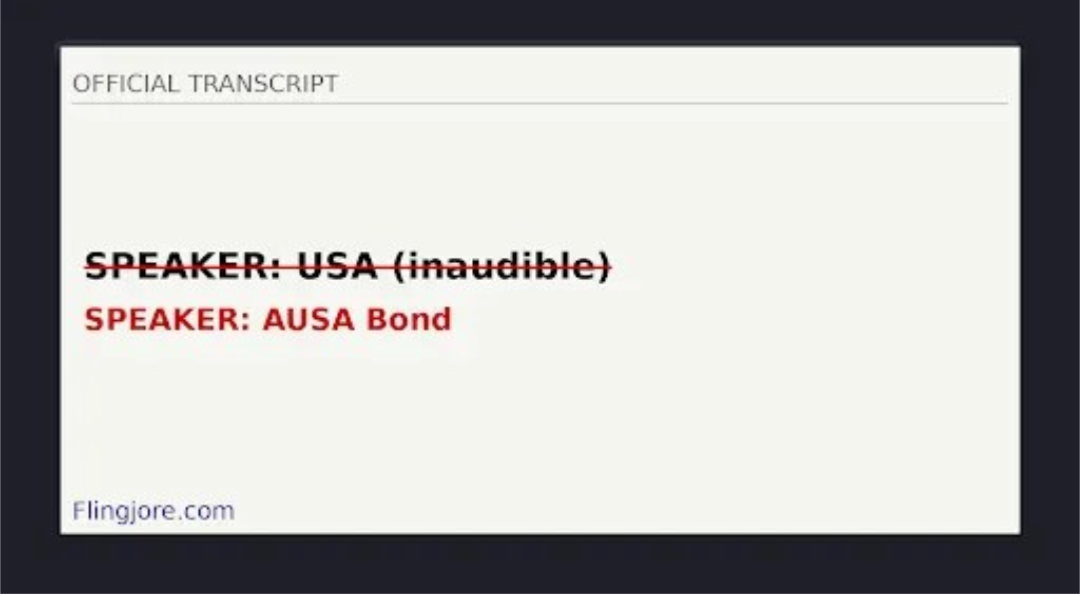
A single, missing letter in a sealed court transcript serves as the cornerstone of the government’s explanation for a growing crisis of confidence in the federal justice system.
While the top federal prosecutor in Chicago frames the issue as a simple clerical mistake, critics and legal analysts see a calculated distraction from deeper, systemic misconduct within the office.
United States Attorney Andrew S. Boutros issues an unprecedented Department of Justice Special Report, launching what local legal circles call “the Boutros defense.” He claims he holds no personal role in the grand jury proceedings for the highly controversial “Broadview 6” case. According to the government’s explanation, the entire scandal traces back to a court reporter mishearing a speaker’s name on an audio recording.
The timeline, however, and the office’s recent history suggest a far more troubling reality.
The report drops precisely one week after defense attorneys lob a bombshell accusation in open court, suggesting Boutros exerts improper personal influence over the grand jurors hearing evidence against local immigration protesters.
Instead of addressing the institutional failures that plague his office, Boutros uses the unsealing of closely guarded grand jury minutes to focus entirely on a narrative of mistaken identity.
By framing the crisis as a mere administrative blunder, the Department of Justice attempts to shift the public’s focus away from a pattern of structural misconduct — including improper witness vouching and the unauthorized dismissal of grand jurors — that the office was already caught doing red-handed.
The “Broadview 6” Distraction
The firestorm originates in the prosecution of United States v. Rabbitt, et al., widely known as the Broadview 6.
The case involves activists protesting outside a federal immigration detention center. It serves as a major flashpoint for critics who accuse the government of overreach when prosecuting civil disobedience.
Speculation reaches a boiling point during a hearing before Judge April M. Perry in the Northern District of Illinois.
Defense counsel levels a serious allegation before the court moves into a closed, private session, stating:
“We have a belief that the U.S. Attorney had personal contact with this grand jury. We have not been provided with that transcript. I believe there’s an update on that. If that did occur, we would like that as well.”
The implication hangs heavy in the courtroom.
A United States Attorney personally intervening in a specific, politically charged grand jury panel represents a massive deviation from standard protocol. Yet, the focus on whether Boutros walked into the room allows the government to obscure a much larger problem.
Just days before releasing this Special Report, the U.S. Attorney’s Office quietly announced “sweeping reforms to internal grand jury practices and disclosures,” introducing a remediation plan described as the most substantial change in decades.
This sudden overhaul followed revelations that prosecutors were routinely bypassing legal protocols, excusing jurors without judicial oversight and improperly vouching for witnesses behind closed doors.
By hyperfocusing on the “typo” in the Rabbitt case, the government creates a convenient shield against these broader charges of institutional corruption.
Anatomy of the Government’s Explanation
In his Special Report, Boutros offers a detailed, forensic accounting of the October 23, 2025, grand jury session to support his claim of a clerical error.
The government argues that when a court reporter transcribed the audio recording of the October session, they encountered a muffled, unclear introduction and typed “USA (inaudible)” to indicate the speaker. Because “USA” stands for United States Attorney in federal court parlance, defense attorneys interpreted this as proof that Boutros himself was in the room.
The government’s defense asserts that the actual speaker was Assistant United States Attorney (AUSA) Aaron Bond, the Chief of the Office’s Narcotics Section, who appeared before that same panel on a completely different, unrelated drug investigation.
Boutros calls the situation a “classic case of mistaken identity,” asserting that steps are underway to formally correct the official court minutes.
This explanation, however, asks the public to view the mistake in total isolation. It presents a narrative where an independent stenographer’s stray keystroke is the only flaw in an otherwise pristine system.
This hyperfocus on a single acronym deliberately downplays how easily official government records can be manipulated, mismanaged or misread within an office that is already under intense scrutiny for failing to self-police.
Knowledge Gap
The most glaring flaw in the Boutros defense is the significant “Knowledge Gap” regarding what the U.S. Attorney knew and when he knew it.
While Boutros claims he only just discovered the transcript typo in response to recent press interest, he has already admitted to being aware of systemic issues—including unauthorized grand juror dismissals—months ago.
This creates a serious contradiction.
If the leader of the Northern District of Illinois was fully aware that his staff was altering the makeup of grand jury panels and violating internal protocols as early as late 2025, the claim that he is shocked by a “mistaken identity” transcript in mid-2026 rings hollow.
The central question facing the justice system in Chicago is not whether a secretary made a typo; it is whether the U.S. Attorney’s office is institutionally incapable of—or completely unwilling to—police its own integrity.
Federal grand juries possess immense unilateral power. Unlike a traditional trial jury, a grand jury operates in secret, hearing only the government’s side of a case to determine if enough evidence exists to formally charge someone with a crime.
Because the process heavily favors the government, strict adherence to ethical boundaries is the only protection a citizen has against malicious prosecution.
When an office admits it needs “sweeping reforms” to correct decades of bad practice, a defensive focus on a single clerical error looks less like transparency and more like a damage-control maneuver.
Breaking Secrecy to Control the Narrative
To publish this special report, Boutros navigated significant legal hurdles, obtaining court-ordered authorization to bypass Federal Rule of Criminal Procedure 6(e).
This rule strictly prohibits the disclosure of matters occurring before a grand jury to protect the reputations of individuals and ensure jurors deliberate freely.
Boutros claims he sought this extraordinary authorization in the “interest of justice” and to satisfy public interest.
Using a court order, however, to selectively unseal minutes that happen to clear his personal name reveals a double standard.
The office routinely uses the shield of grand jury secrecy to hide internal missteps, yet it readily dismantles that shield when the top prosecutor needs a public relations victory.
By pulling back the curtain solely to fix a typographical error, Boutros attempts to stage-manage the transparency process.
The unsealed documents show exactly what the government wants the public to see: a narrative where the only error is an innocent administrative mix-up.
It leaves the broader, more damaging details of the office’s systemic failures safely hidden behind the remaining walls of grand jury secrecy.
An Institutional Failure
This rapid response arrives at a critical moment for the Northern District of Illinois, but it fails to answer the deeper questions raised by the Broadview 6 prosecution.
High-profile protest cases naturally attract intense scrutiny, and the public expects the government to operate with flawless precision and absolute ethical clarity.
Instead, the community is left with an office running on damage control.
The daily operations of the federal courts rely heavily on the quiet, precise work of staff, but the accountability must stop at the top.
When a missing letter sparks a week-long media scramble and a rare dynamic shift in grand jury secrecy, it exposes a fragile apparatus.
By treating the Rabbitt transcript as an isolated incident, the government avoids a reckoning with its own systemic patterns.
The prosecution of the Broadview 6 activists continues, but the narrative that the Department of Justice operates above reproach is permanently damaged.
Ultimately, the Boutros defense reveals an unsettling truth about federal prosecutions in Chicago.
The issue plaguing the Northern District of Illinois is not a simple administrative oversight.
Whether through institutional incapacity or a deliberate unwillingness to police its own ranks, the U.S. Attorney’s office demonstrates that it prefers to prosecute a typo rather than confront its own systemic misconduct.