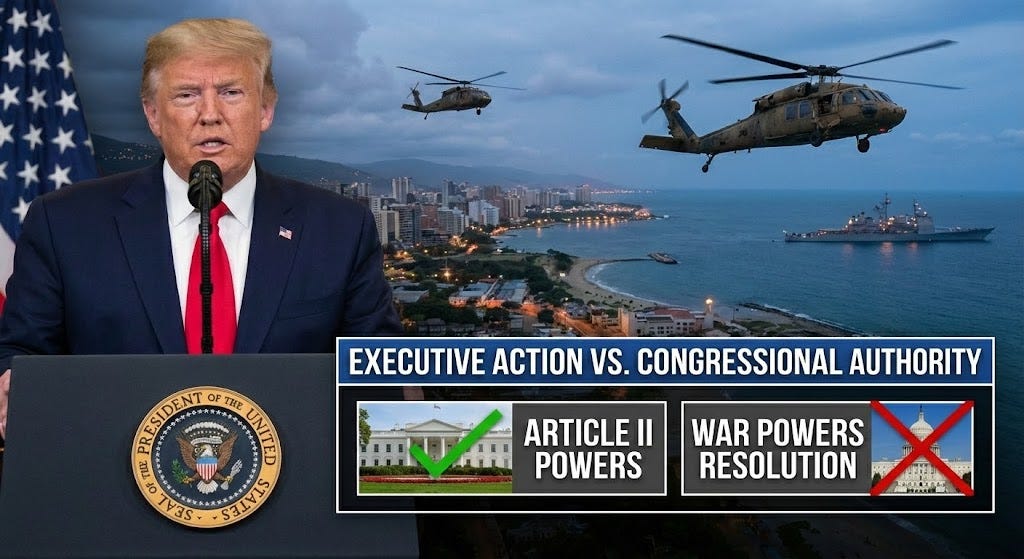
Trump didn't declare war. He just served a warrant. Here is why that matters.
President strikes Venezuela, cites arrest warrant to bypass Congress using a 2020 indictment as justification. Analysis: How the Sheriff's Star Doctrine rewrites war powers and Monroe Doctrine.
President Donald Trump did not declare war on Venezuela, nor did he ask Congress for the authority to wage it.
Instead, by framing the toppling of a foreign government as the execution of a domestic arrest warrant, the administration has effectively rendered the congressional war power obsolete.
The weekend raid that seized Nicolás Maduro was not justified as a geopolitical necessity or a response to an imminent attack, but as a law enforcement operation on a global scale.
In doing so, the White House has bypassed the need for an Authorization for Use of Military Force (AUMF), betting that the machinery of the American justice system can provide the legal cover that the Constitution traditionally reserves for the legislative branch.
The precedent is stark: If a federal indictment is sufficient grounds for a regime-change invasion, the line between the FBI and the 82nd Airborne has not just blurred — it has vanished.
Sheriff’s Star Doctrine installed
To understand why the president felt empowered to ignore Capitol Hill, one must look at the legal instrument he wielded. It wasn’t a declaration of war; it was a 2020 indictment unsealed by the Department of Justice, charging Maduro with narcoterrorism, drug trafficking and corruption.
By leaning on this document, the administration is deploying a novel legal framework we might call the Sheriff’s Star Doctrine.
The argument goes like this: The President is not waging war against the sovereign state of Venezuela (which would trigger Article I, Section 8 of the Constitution).
Instead, he is exercising his Article II executive power to enforce U.S. law against a criminal fugitive who happens to be a head of state.
It is a masterful, if cynical, piece of statutory gymnastics.
It treats the Venezuelan military not as a foreign army, but as a heavily armed protective detail for a wanted felon. It treats the invasion not as a conquest, but as a high-risk extraction. And critically, it treats Congress not as a coequal branch of government, but as a bystander to a police procedural.
No permission slip necessary
For the average American, the nuances of war powers often feel like inside-the-Beltway baseball. But the distinction between a war and a police action is the difference between a democracy and a dictatorship.
The Founding Fathers were terrified of kings who could drag nations into ruinous conflicts on a whim. Their solution was simple: One branch (the President) commands the army, but only the other branch (Congress) can unleash it.
For decades, that system has eroded. It began with Harry Truman, who intervened in Korea in 1950 without a congressional vote, famously dubbing it a police action under United Nations auspices. But even as executive power expanded, the permission slip remained a polite fiction that presidents felt compelled to honor.
Lyndon B. Johnson sought the Gulf of Tonkin Resolution for Vietnam. George W. Bush sought specific AUMFs for Afghanistan (2001) and Iraq (2002).
These authorizations were broad, often serving as blank checks, but they were still checks. They required debate. They required a vote. They required the people’s representatives to go on the record.
Trump’s move in Venezuela suggests that the era of the AUMF is over. Why beg a divided Congress for a permission slip to fight a war, when you can simply have your Attorney General draft an arrest warrant?
Zombie law: War Powers Resolution
Critics in the Senate are currently citing the War Powers Resolution of 1973. Passed over Richard Nixon’s veto in the wake of Vietnam, this law was supposed to be Congress’s leash on the dog of war.
It mandates that a president must notify Congress within 48 hours of committing forces and must withdraw them within 60 to 90 days unless Congress declares war.
In practice, the War Powers Resolution is a zombie law — technically alive, but functionally dead. Presidents of both parties have consistently viewed it as an unconstitutional infringement on their role as Commander-in-Chief.
By framing the Venezuela raid as a quick strike — in and out, a smash-and-grab for Maduro — Trump is exploiting the timeline of the Resolution.
If the operation is over before the 60-day clock runs out, the question of congressional authorization becomes moot. It is a fait accompli.
The legal debate will drag on in law reviews for years; the reality on the ground in Caracas was established in hours.
Imminent threat loophole
The administration’s secondary defense—that this was done to protect U.S. national security—relies on an ever-expanding definition of imminent threat.
Traditionally, imminent meant troops massing on the border or missiles fueling on the launchpad. In the post-9/11 era, the concept of preemptive war shifted that definition. If a bad actor might sell weapons to a terrorist someday, that was considered imminent enough to invade Iraq.
Now, the definition has shifted again. The threat is not an invasion of Florida, but the existence of a narcoterrorist regime.
The logic implies that the mere presence of criminality in a foreign government constitutes a standing threat to the United States that justifies military intervention at any time, without warning.
Democratic deficit
The danger here is not just legal; it’s political. Wars are difficult. Occupation is messy. As noted, toppling Maduro is the easy part. The hard part is the vacuum that follows — the factions, the militias, the economic collapse.
When Congress votes on a war, it invests the American public in the outcome. It forces a consensus. By bypassing Congress, Trump owns this conflict entirely. There is no shared responsibility.
If Venezuela descends into a prolonged, bloody insurgency — similar to the aftermath in Iraq — there is no legislative buy-in to sustain the mission.
We are witnessing the final evolution of the Imperial Presidency. The Executive Branch now holds the sword (the military) and the purse (through emergency funding reallocations) and now, it effectively writes its own warrants.
The Venezuela Police Action serves as a stark lesson for the 2026 midterm electorate.
The checks and balances you learned about in civics class assume that the branches of government will fight to protect their turf.
But if Congress remains silent, content to tweet its disapproval rather than enforce its powers, then the Constitution is just a piece of paper and the President is a King with a badge.


Nice write up.