


The U.S. Treasury vault operates on a simple premise: to force open the door, a litigant usually endures a grueling, yearslong legal siege.
The federal government possesses limitless resources, armies of career attorneys and a mandate to protect taxpayer money at all costs.
Yet the machinery of government runs with astonishing, frictionless grace when the attorney defending the vault simply hands the combination to his former boss.
The adversarial justice system dissolves into a gentleman’s agreement, and the public purse opens without a single shot fired.
But that seamless harmony now hits a judicial stop-work order. The gears of a staggering $1.776 billion payout grind to a halt inside a Florida federal courthouse.
Caught in a high-stakes standoff over executive power and taxpayer money, the Justice Department formally pauses the settlement between President Donald Trump and the Internal Revenue Service.
Following a stinging order from U.S. District Judge Kathleen M. Williams — and a sudden chill in support from congressional Republicans that prompts the administration to reconsider the fund’s future — the government retreats to explain itself by a June 12 deadline.
As detailed by Democracy Docket, Judge Williams is actively probing whether the court was deceived.
If Williams determines the administration commits a “fraud on the court,” she possesses the power to permanently kill a settlement that fundamentally rewrites the rules of American litigation.
To understand how an American president successfully sues his own administration for over a billion dollars, you have to look at the anatomy of the deal. It is a masterclass in bypassing Congress, neutralizing ethics laws and weaponizing the very legal mechanisms designed to protect the public.
Precipitating Crime: The Littlejohn Leaks
The entire crisis traces its origins to a genuine crime.
In January 2026, Trump, his sons and the Trump Organization file a $10 billion lawsuit against the IRS and the Treasury Department. They claim the federal government entirely fails to safeguard their constitutional right to privacy after a rogue government contractor leaks their highly confidential tax returns to the press.
The breach of privacy is entirely real, and the facts of the leak are not in dispute. Between May 2019 and September 2020, an IRS consultant named Charles “Chaz” Littlejohn accesses the sensitive financial data of thousands of wealthy Americans, including the president. He subsequently hands the data over to major news organizations, fueling years of investigative reporting.
The Justice Department catches Littlejohn. He pleads guilty to the unauthorized disclosure of tax returns, and in early 2024, a federal judge sentences him to five years in federal prison.
With the leaker in prison, Trump’s legal team turns its sights on the agencies that employ him.
The $10 billion lawsuit argues that the IRS possesses a catastrophic failure in its security protocols, making the government directly liable for the damages to the Trump family’s reputation and business empire.
The Expired Clock and the Surrender
Normally, the Justice Department fights back aggressively against a massive civil lawsuit. Government lawyers routinely tie up plaintiffs for decades, filing endless motions, demanding rigorous discovery and utilizing every procedural shield available to the federal government.
In this specific instance, government lawyers possess a massive, insurmountable advantage: a strict statute of limitations.
The law features a very specific timer for when a victim can sue over privacy breaches; The legal time limit to sue over Littlejohn’s specific tax leaks actually expires long before Trump even files the initial paperwork in January 2026.
A first-year law student could draft the motion to dismiss the case based on the expired clock alone.
The government holds the winning hand.
But instead of asserting the expired timeline to defend the public treasury, the Justice Department chooses the path of absolute capitulation.
They surrender the government’s defenses and refuse to point out the expired statute of limitations. As JURIST News reported, they agree to voluntarily dismiss the lawsuit and settle the claims almost immediately.
The Ethics Firewall Collapses
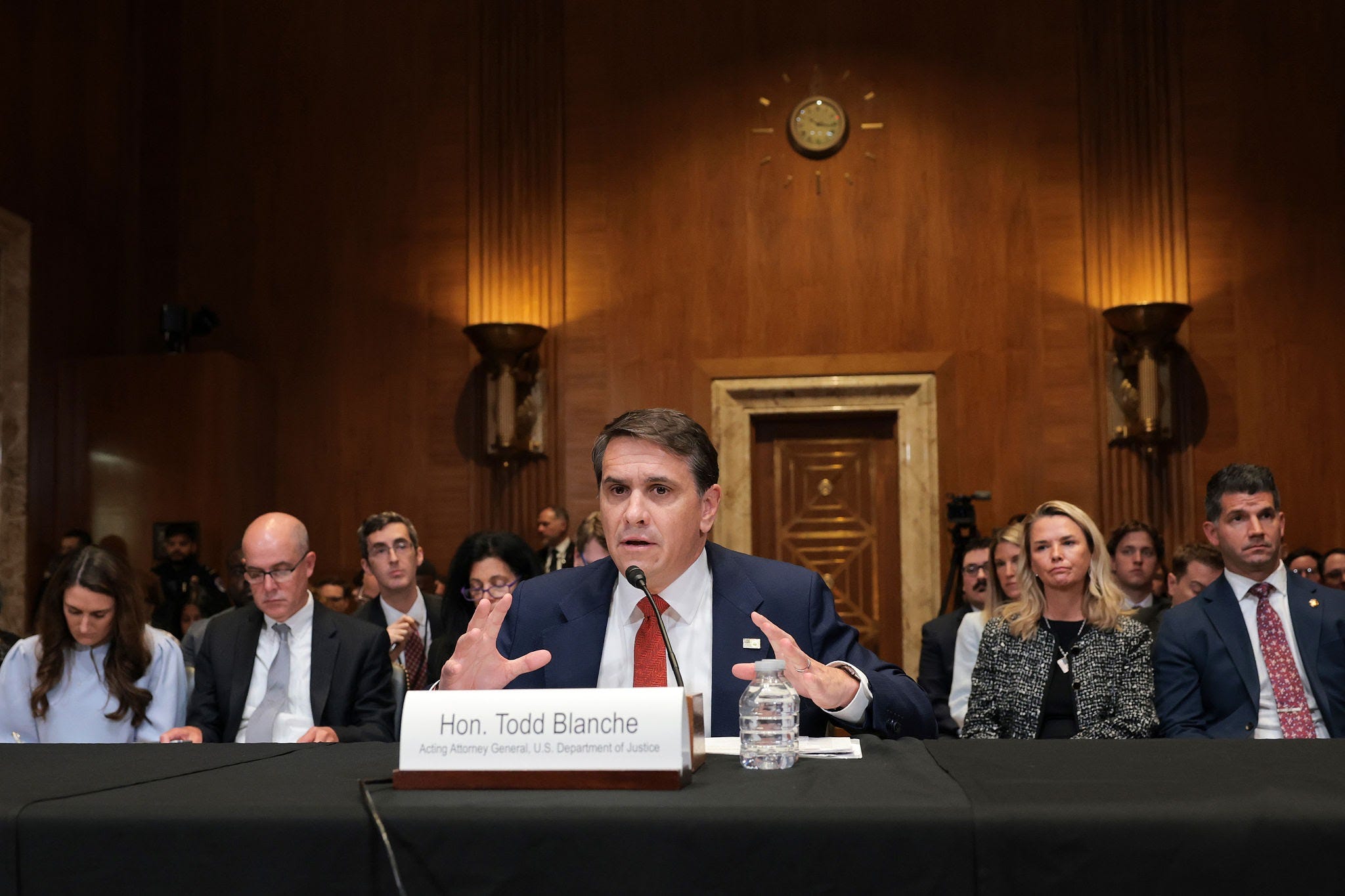
The man who authorizes these staggering concessions is Acting Attorney General Todd Blanche.
Before Blanche takes the helm at the Justice Department, he does not work as an impartial career prosecutor. He stands in courtrooms across the country as Trump’s personal defense attorney during several high-profile criminal trials.
When this massive civil lawsuit against the government lands on his desk at the Justice Department, career ethics lawyers provide Blanche with a clear, written warning. They instruct him to step away from the case immediately.
Federal ethics rules strictly dictate that a government official cannot oversee litigation involving their former private client.
The rules exist specifically to prevent the exact scenario unfolding in Florida: a government official negotiating a billion-dollar payout using public funds to enrich the person who used to sign their paychecks.
In Washington, however, ethical guardrails increasingly serve as mere suggestions for the timid. Blanche ignores the ethics directives. He retains absolute control of the case. He effectively sits on both sides of the negotiating table — representing the government that holds the money, while facilitating a settlement that rewards his former client.
Bottomless ATM: Bypassing Congress
The centerpiece of the settlement is the creation of a massive new federal initiative. Under a rapid, quiet deal finalized in May, the government agrees to pull exactly $1.776 billion from a perpetual pool of federal cash known as the Judgment Fund.
The figure — $1.776 billion — is highly deliberate. It is a number curated less for precise accounting accuracy than for political theater, heavily nodding to the year of American independence.
The Judgment Fund acts as the government’s bottomless ATM.
Established by Congress in 1956, the fund exists to pay out routine legal settlements against the United States without forcing lawmakers to vote on every individual slip-and-fall at a post office or medical malpractice claim at a VA hospital.
Because the money flows from this specific, pre-authorized legal mechanism, the administration completely bypasses the standard congressional appropriations process.
No debates occur on the House floor. No votes are cast in the Senate. The money simply moves.
According to the Justice Department’s own announcements, the $1.776 billion is earmarked to create an “Anti-Weaponization Fund.”
The fund is designed to process claims and issue formal apologies and financial payouts to individuals who allege they suffer from Democratic “lawfare,” a term the administration uses to describe criminal investigations and prosecutions it deems politically motivated.
The billion-dollar war chest is managed by a five-member commission of Trump loyalists, all appointed by the attorney general and removable by the president.
Justice Department asserts there are “no partisan requirements” to file a claim, but as reported by TIME, Democrats and ethics experts warn the fund acts as a taxpayer-financed slush fund designed to compensate the administration’s political allies, potentially including defendants charged in connection with the Jan. 6 attack on the U.S. Capitol.
Complete Tax Immunity
Yet the $1.776 billion war chest represents only half the concession.
The monetary fund captures the headlines, but the true prize for the plaintiff lies buried in the fine print.
Inside a one-page addendum to the settlement is an extraordinary, permanent gift of executive immunity. As detailed in reporting from The Guardian, the deal permanently bars the IRS from ever auditing the prior tax returns of the president, his sprawling real estate company, or his sons.
The language is absolute.
The government forever releases, waives and discharges any right to probe the financial history of the Trump Organization prior to the settlement date. The White House literally utilizes taxpayer funds to set up a billion-dollar commission and in exchange, guarantees it never investigates the plaintiff’s finances again.
Rule 60 Revolt
The entire operation nearly succeeds. The Justice Department and the plaintiff submit the paperwork. The case is on the verge of disappearing from the docket.
But the suspension exists solely because a bipartisan coalition of 35 retired federal judges decides to crash the party and point out a fatal constitutional flaw: the lack of an adversary.
In the American legal system, a lawsuit requires two opposing sides. You cannot sue yourself.
Yet in this case, Donald Trump the private citizen sues the executive branch, which is controlled by Donald Trump the president, represented by Todd Blanche, the president’s former defense attorney.
On May 27, these 35 retired legal experts deploy a rare and powerful procedural weapon: Rule 60 of the Federal Rules of Civil Procedure.
To the average citizen, Rule 60 functions as the legal equivalent of an emergency brake. It allows a federal judge to tear up a finalized, legally binding agreement if someone proves the deal results from severe fraud, misrepresentation, or misconduct.
Judges almost never permit third parties to pull this lever. Usually, when the government and a plaintiff settle a civil dispute, the court simply rubber-stamps the paperwork and moves on.
But the retired judges argue this is not a normal legal resolution. They frame the deal as a backdoor transfer of wealth designed to bypass the legislative branch, utilizing the federal bench as an unwitting accomplice to theft.
This legal resistance is further bolstered by organizations stepping in directly; as outlined in Democracy Forward’s lawsuit, a broad coalition of individuals and advocates are simultaneously suing to block the fund completely, calling it a politically discriminatory slush fund.
By stepping in, they force Judge Williams to freeze the payout, reopen the docket and investigate the very government officials who sign off on the paperwork.
As Williams notes in her order demanding answers, there is currently “no settlement of record” that the court officially recognizes.
Standoff in Miami
Now, facing sudden judicial intervention and a fracturing political coalition, that billion-dollar capitulation sits suspended in Miami.
The Department of Justice formally pauses the rollout of the Anti-Weaponization Fund, though it publicly maintains that the settlement is entirely lawful and appropriate.
The June 12 deadline looms large.
When federal attorneys return to Judge Williams’ courtroom, they must explain how a lawsuit with an expired statute of limitations, overseen by an attorney with a glaring conflict of interest, resulting in a billion-dollar payout and total tax immunity for the chief executive, constitutes a fair and adversarial legal process.
If the judge allows the settlement to proceed, it establishes a terrifying new precedent, creating a roadmap for any future administration to bypass Congress, sue itself in friendly courts and drain the Judgment Fund to enrich political allies.
But if the judge drops the gavel and declares the settlement a fraud on the court, the vault slams shut. The machinery of government returns to its slow, grinding, adversarial nature and the public purse lives to fight another day.