

U.S. commandeers Venezuelan oil sales ‘indefinitely,’ seizes control of revenue flow
Energy Department guidelines authorize the immediate sale of up to 50 million barrels of crude with all proceeds bypassing Caracas to settle in U.S.-controlled accounts.

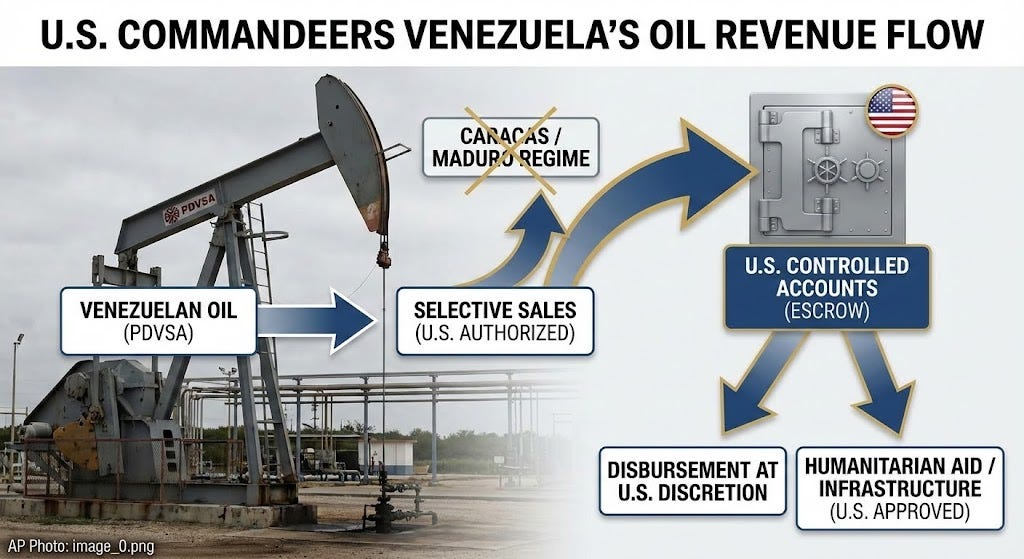
The United States has effectively commandeered Venezuela’s oil economy.
In a move that redefines the concept of sanctions enforcement, the Department of Energy on Wednesday released a policy outline detailing plans to “selectively” lift prohibitions on Venezuelan crude. The directive authorizes the immediate sale of 30 million to 50 million barrels of oil, with the proceeds bypassing Caracas entirely to settle in U.S.-controlled accounts.
The policy, which the administration states will continue “indefinitely,” marks the final economic seizure of the petro-state following the U.S. military’s capture of Nicolás Maduro over the weekend. By redirecting revenue flows from the state-owned Petróleos de Venezuela, S.A. (PDVSA) to accounts administered at the “discretion” of the White House, President Donald Trump has fulfilled a vision he articulated nearly a decade ago: that the victor belongs the spoils, or at least the reimbursement receipts.
“We’re going to get reimbursed for everything that we spend,” Trump said earlier this week, foreshadowing the policy. “A lot of money is coming out of the ground.”
Mechanics of control
The outline describes a mechanism that functions less like traditional sanctions relief and more like a court-ordered receivership on a national scale. The “selective” lifting of sanctions applies only to cargoes authorized by U.S. administrators.
The initial tranche of 30 million to 50 million barrels—roughly equivalent to two months of Venezuela’s current export capacity—will be released to global markets immediately to stabilize prices and clear storage. The revenue will be deposited into escrow accounts at “globally recognized banks” in the United States.
Crucially, the policy strips the interim government in Caracas of fiscal autonomy. While Delcy Rodríguez, the former vice president now acting as interim leader, technically presides over the state apparatus, she will not hold the checkbook. The Energy Department’s outline explicitly states that funds will be disbursed for humanitarian aid, infrastructure repair, and administrative costs only with U.S. approval.
’Oil for Food’ 2.0?
The structure draws immediate comparisons to the United Nations’ Oil-for-Food Programme in Iraq, which allowed Saddam Hussein’s regime to sell oil in exchange for humanitarian goods under strict monitoring. However, the Trump administration’s version removes the multilateral oversight of the U.N. and places the controls directly within the West Wing.
“This is the monetization of regime change,” said Daniel Yergin, an energy historian. “It effectively turns PDVSA into a subsidiary of U.S. policy. The administration isn’t just buying the oil; they are managing the sovereign wealth of a foreign nation to pay for its own reconstruction—and perhaps the costs of the intervention itself.”
The move effectively sidelines traditional opposition leaders like María Corina Machado, whom the White House has reportedly viewed as having insufficient control over the security apparatus. By keeping the purse strings in Washington, the administration ensures that whoever sits in Miraflores Palace remains tethered to U.S. interests.
Market implications
For the global oil market, the announcement is a bearish signal. Venezuela possesses the world’s largest proven oil reserves, but production has languished below 1 million barrels per day due to years of mismanagement and sanctions.
The involvement of U.S. supermajors is implied but not explicitly detailed in Wednesday’s outline. However, industry analysts expect companies like Chevron—which has maintained a foothold in the country—to be tapped to rehabilitate the crumbling infrastructure. The “indefinite” nature of the sales suggests a long-term roadmap to ramp up production, potentially flooding a market already softening from Chinese demand peaks.
”The infrastructure is badly broken,” Trump noted Saturday. “We’re going to have our very large United States oil companies go in, spend billions, and fix it.”
Geopolitical shockwaves
The policy is a direct challenge to Russia and China, both of whom are owed billions by Caracas and have historically been repaid through oil shipments. With the U.S. asserting control over the physical cargoes and the cash, Beijing and Moscow’s repayment queues have likely evaporated.
The seizure of the Russian-flagged tanker Bella 1 in the North Atlantic earlier Wednesday underscores the administration’s willingness to enforce this new reality kinetically. It sends a stark message: Venezuelan oil now belongs to the market, but its value belongs to Washington.
Legal experts warn the policy enters uncharted waters. While the International Emergency Economic Powers Act (IEEPA) gives the president broad authority to freeze assets, actively selling sovereign resources and deciding how to spend the proceeds pushes the boundaries of executive power and international law.
”This goes beyond freezing assets,” said a former Treasury official. “This is operating a national oil company from the U.S. Treasury. It creates a precedent that any nation with U.S. exposure could see its primary revenue stream not just blocked, but commandeered.”
For now, the pumps in the Orinoco Belt are running, but the profits are flowing north, not to the coffers in Caracas, but to ledgers in Washington.
Trump, he thinks he is a king and he wants it all, to build an empire like Putin, Trump though, is a mentally deranged, a psychopath and as such, he will not stop, unless someone or something that makes him stop, the voters perhaps, so, what else might that be,(Epstein?🤔) for surely it is not his party, they are spineless, nor have decency and the oath they took to the Constitution, it might as well be toilet paper to them, for they serve themselves and Trump and are without honor, and the American people, we are but a mere inconvenience to them, for the GOP, their actual oath, is to their all mighty dollar hence the super wealthy