

How the 2003 Iraq playbook drives the 2026 bombardment of Iran
Trump promises no new wars, but privateers, disaster capitalism and a robust intelligence-media pipeline reveal a highly profitable regime change operation already underway.

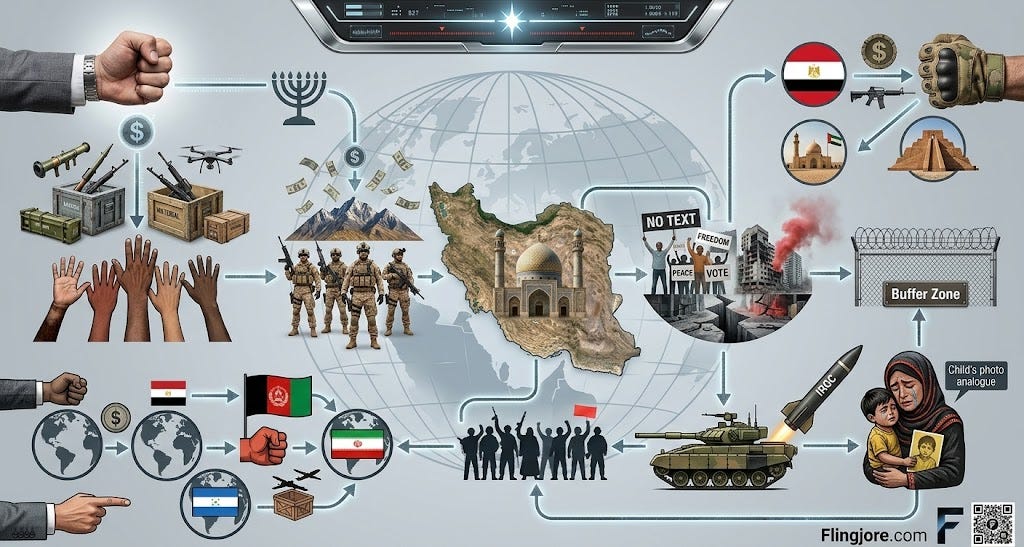
As the U.S.-Israeli war on Iran completes its first week, the architecture of the conflict is fully operational.
Beneath the surface of kinetic strikes and retaliatory missile barrages across the Gulf, the administration implements a turnkey model of regime change that closely mirrors the 2003 invasion of Iraq.
Through strategic intelligence leaks, the mobilization of regional proxy forces and the activation of private military and domestic detention contractors, a synchronized operation emerges. This multi-front strategy bypasses formal congressional war declarations while simultaneously feeding both the foreign defense sector and the domestic detention-industrial complex.
For intelligence analysts and veterans of early 21st-century Middle East conflicts, the forensic traces leave little to the imagination. The blueprint operates on three distinct pillars: the information operation, the privatized ground war and the domestic monetization loop. Together, they form a lucrative ecosystem that transforms geopolitical destabilization into an enduring revenue stream.
Intelligence-media pipeline
The first phase of the operation relies heavily on narrative control. Multiple establishment news outlets report that the Central Intelligence Agency actively negotiates with Iranian Kurdish militias, including the Kurdistan Democratic Party of Iran (KDPI) and the Patriotic Union of Kurdistan (PUK). The objective involves arming these groups to spark a popular uprising, forcing the Iranian Revolutionary Guard Corps to stretch its resources across multiple fronts.
When major establishment outlets simultaneously report on highly classified CIA negotiations, with slightly different takes on the same subject, intelligence veterans recognize the pattern. These are not standard journalistic scoops; they operate as high-probability, state-directed leaks. Just as the Bush administration utilized prestige media to seed the narrative of weapons of mass destruction prior to the 2003 Iraq invasion, the current administration utilizes this intelligence-media pipeline as a functional component of its military operation.
By feeding these narratives to top-tier outlets, the Pentagon and the CIA intentionally target the open-source intelligence networks of adversaries in Tehran. The broadcast serves as a strategic signal, projecting an inevitable second front without requiring the administration to officially confirm the deployment of hardware or personnel. This pipeline establishes the reality of an uprising in the global consciousness before a single proxy soldier crosses the border.
Proxies and privateers (a new Blackwater?)
As the information operation primes the battlespace, the tactical reality on the ground shifts toward privatization. Because the president secures power on a strict platform of preventing new foreign wars, committing conventional U.S. infantry to Iranian soil presents a severe political liability. The solution relies on private military contractors, replacing the Blackwater model of the early 2000s with a new generation of shadowy security firms.
Federal procurement and corporate data point directly to Mooresville, North Carolina-based UG Solutions, a private military contractor registered to former Green Beret Jameson Govoni. UG Solutions first gains notoriety operating militarized distribution sites for the Gaza Humanitarian Foundation in 2025, an operation that draws severe warnings from U.S. lawmakers over potential violations of the Federal War Crimes Act.
Now, as the Iran conflict expands, UG Solutions actively pivots. The firm submits proposals to the administration’s newly established Board of Peace and aggressively recruits hundreds of Arabic-speaking contractors with direct combat experience.
By deploying unaccountable privateers alongside Kurdish guerrilla forces, the administration facilitates the seizure of territory and the creation of buffer zones in western Iran. This outsources the most kinetic elements of regime change. The casualties and operational costs vanish into the opaque budgets of private contracting, isolating the American public from the immediate human toll and preserving the administration’s “anti-war” illusion while achieving conventional military objectives.
Monetizing the machine: Defense tech and domestic detention
The final pillar of the turnkey model involves the seamless monetization of the conflict. Abroad, traditional defense titans secure massive capital infusions. As Iranian drones target U.S. assets across the Gulf, the rapid expenditure of Patriot and THAAD interceptors guarantees immediate, multi-billion dollar replenishment contracts for firms like Lockheed Martin and RTX. This cements a taxpayer-funded “subscription model” for defense hardware.
Simultaneously, the administration transforms the foreign war into a parallel profit engine at home. By framing the Middle East conflict as a catalyst for potential domestic terrorism, the administration justifies sweeping national security emergency powers. This narrative directly accelerates mass immigration crackdowns under the “One Big Beautiful Bill Act” (OBBBA), effectively tripling the budget of U.S. Immigration and Customs Enforcement (ICE).
The primary beneficiary of this militarized domestic posture is The GEO Group, a private prison conglomerate that heavily lobbies for the legislation’s passage. In early 2026, GEO Group executives report net income surging by 800 percent to $254.3 million, with a revenue target approaching $3.1 billion for the year. By utilizing wartime rhetoric to fast-track large-scale detention centers, the administration ensures a guaranteed influx of detainees. The military-industrial complex and the border-security apparatus function as two sides of the same economic coin.
Disaster capitalism and the real estate endgame
The stark reality of the 2026 conflict exposes a profound paradox. An administration that promises to dismantle “forever wars” now executes a textbook replication of the Iraq quagmire—with one unprecedented addition: the integration of the first family’s real estate empire into the postwar reconstruction pipeline.
If the intelligence pipeline sets the stage and the privateers execute the ground game, the final phase is the ultimate real estate play. The blueprint is publicly previewed by the president’s son-in-law, Jared Kushner, who notes that Gaza’s “waterfront property” is “very valuable”, suggesting the area should be “cleaned up” for development.
That disaster capitalism framework applies writ large. As the administration redraws the map of the Middle East, the Trump Organization concurrently executes an aggressive expansion across the exact same region. Partnering with Gulf developers like Saudi Arabia’s Dar Global, the family business unveils billions in luxury projects.
This creates a closed loop of disaster capitalism. The military clears the lot, the private security firms secure the perimeter and partnered developers build luxury resorts over the rubble. The players possess new names and the contractors operate under new corporate umbrellas, but the underlying mechanics represent the zenith of the military-industrial complex. The blueprint hides in plain sight, proving that while the theaters of war change, the business of war remains entirely predictable.