

U.S. Deploys Thousands of Marines to Middle East as NATO Withdraws from Iraq
Pentagon surges rapid-response forces to the region while NATO relocates its advisory mission to Europe amid escalating Iranian threats against global targets.

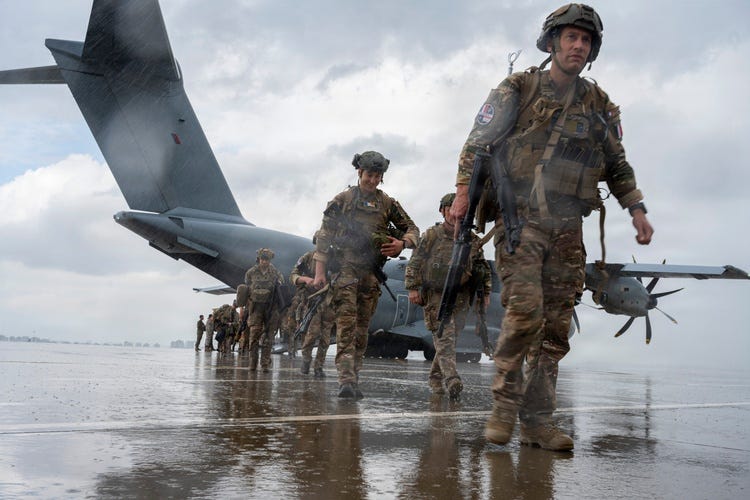
(UPDATED: 10:52 a.m. MT)
Thousands of U.S. Marines surge toward the Middle East on Friday while NATO forces complete a sudden withdrawal from Iraq, a dramatic shift in Western military posture as Iran’s new leadership issues a chilling threat to target “parks, resorts and tourist centers” anywhere in the world.
The arrival of USS Boxer and its accompanying amphibious task force adds roughly 2,500 elite troops to a regional buildup that now totals 9,000 personnel, specifically tasked with counter-asymmetric operations.
The massive realignment, which shutters the alliance’s long-standing advisory mission in Baghdad, marks a decisive pivot from regional stability efforts to an active maritime and asymmetric war.
With the Strait of Hormuz effectively closed and Iranian drone strikes hitting vital energy infrastructure like Kuwait’s Mina Al-Ahmadi refinery, the three-week-old conflict enters a volatile new phase that threatens to transcend the borders of the Middle East and destabilize the global economy.
NATO Withdraws from Iraq Amid Rising Vulnerability
The realignment of Western forces began with the quiet but significant departure of NATO personnel from Iraqi bases. NATO’s top commander confirmed that the alliance has officially pulled its security advisory mission out of Iraq, relocating several hundred personnel to Europe. The last of these troops departed on Friday, effectively ending an on-the-ground presence that has been in place since 2018.
The non-combat mission, originally designed to advise Iraqi authorities on building effective security institutions, found itself in the crosshairs of a conflict it was not designed to fight. The decision to relocate the mission to NATO’s headquarters in Naples, Italy, followed a series of direct attacks by Iranian forces and their proxies on British, French and Italian bases in northern Iraq.
Military analysts note that the withdrawal serves a dual purpose. First, it removes lightly armed, non-combatant European personnel from a theater where they had become sitting targets for Iranian ballistic missiles and drone swarms. Second, it clears the operational airspace and ground environment for a more kinetic U.S. posture. Gen. Alexus Grynkewich confirmed the departure, thanking the Iraqi government and praising the relocated troops as “true professionals,” but the subtext of the hasty exit points to a severe deterioration in local security conditions.
U.S. Surges Forces to the Region
As European advisors vacate their Iraqi posts, the Pentagon is rapidly backfilling the broader region with heavily armed expeditionary forces. U.S. officials confirmed to Reuters that the military is deploying thousands of additional Marines and sailors to the Middle East, representing a major escalation in Washington’s force posture.
The deployment relies heavily on Amphibious Ready Groups (ARGs) and Marine Expeditionary Units (MEUs), which are specifically designed for rapid crisis response, combat operations and potential civilian evacuations. The USS Boxer, carrying the 11th Marine Expeditionary Unit, departed the West Coast of the United States roughly three weeks ahead of its scheduled deployment.
This naval group joins elements of the Tripoli Amphibious Ready Group, which includes the USS Tripoli, USS San Diego and USS New Orleans, alongside the Japan-based 31st Marine Expeditionary Unit. Together, these deployments add roughly 5,000 highly trained combat personnel to the theater.
U.S. Central Command (CENTCOM) requested the deployments as part of intensive contingency planning. While President Donald Trump has reiterated that there are no current plans to deploy American ground troops directly into Iranian territory, the massive naval and marine buildup provides Washington with flexible options. These forces are positioned to protect commercial shipping in the heavily contested Strait of Hormuz, deter further proxy aggression and strike Iranian military assets if the conflict widens.
Iran Threatens Global Tourism and Leisure Sites
The influx of American forces has been met with extraordinary defiance from Tehran. Despite enduring weeks of punishing U.S. and Israeli airstrikes that have decimated its military infrastructure and eliminated high-ranking officials, the Islamic Republic is signaling its intent to expand the battlefield globally.
On Friday, Iran’s top military spokesman, Gen. Abolfazl Shekarchi, issued a chilling warning broadcast on state television. He declared that the safety of enemy citizens could no longer be guaranteed, even far beyond the borders of the Middle East.
”From now on, based on the information we have about you, even parks, recreational areas and tourist destinations anywhere in the world will no longer be safe for you,” Shekarchi stated. “We are watching your cowardly officials and commanders, pilots and wicked soldiers. The promenades, resorts and tourist and entertainment centers in the world will not be safe for you either.”
This rhetoric marks a significant departure from standard military posturing, representing a direct threat of international terrorism and asymmetric warfare. Intelligence agencies worldwide are now on high alert, assessing the credibility of Iran’s threats to utilize its global network of operatives and proxy militias to strike soft targets in Europe, the Americas and Asia.
The threats coincide with the Persian New Year, Nowruz, which has been largely subdued this year amid the ongoing violence. Despite the heavy losses sustained in recent weeks, Iranian officials insist their military-industrial complex remains fully operational. Gen. Ali Mohammad Naini publicly mocked Israeli and American claims that Iran’s military capabilities have been severely degraded, stating that the country is continuing to mass-produce and stockpile ballistic missiles “even during war conditions.”
Leadership Shakeup in Tehran
The aggressive posturing from Tehran comes amid a profound, sudden shift in the nation’s leadership. The war’s opening days saw a targeted Israeli airstrike kill the 86-year-old Supreme Leader, Ayatollah Ali Khamenei. The assassination of the state’s paramount political and religious authority plunged the nation into a brief period of uncertainty before his son, Ayatollah Mojtaba Khamenei, swiftly consolidated power.
Mojtaba Khamenei, who has long operated in the shadows wielding vast influence over the Islamic Revolutionary Guard Corps (IRGC) and the state’s security apparatus, released a rare public statement on Friday. Striking a distinctly uncompromising tone, the new Supreme Leader declared that Iran’s enemies must have their “security” permanently stripped away.
Under Mojtaba Khamenei’s direction, the IRGC appears to have fully embraced a strategy of regional attrition and economic disruption. State media has consistently cast the younger Khamenei as a resilient wartime leader capable of weathering the unprecedented storm of Western military pressure.
Economic Fallout and the Strait of Hormuz
The kinetic military actions have inevitably triggered a severe economic crisis, with global energy markets bearing the brunt of the fallout. The IRGC has effectively closed off the Strait of Hormuz, a critical maritime chokepoint that connects the Persian Gulf to the Indian Ocean. Roughly 20 percent of the world’s oil supplies pass through this narrow waterway.
Iran’s strategy of choking off energy flows has been compounded by direct strikes on neighboring infrastructure. Recent days have seen Iranian missiles hit Kuwaiti oil refineries, sending plumes of black smoke into the sky and triggering massive explosions. Additionally, air defense systems in Dubai have been forced to intercept incoming fire over the city, terrifying residents during Eid al-Fitr celebrations.
The International Energy Agency has warned that policymakers and financial markets may be underestimating the catastrophic potential of this disruption. If the Strait of Hormuz remains closed and Gulf energy infrastructure continues to burn, the global economy could face an inflationary shock unseen since the 1970s oil crisis.
A Prolonged Conflict Looms
As the third week of the war concludes, the prospect of a diplomatic off-ramp appears virtually nonexistent. Western nations have entirely transitioned to a war footing in the region, prioritizing the defense of strategic waterways and the degradation of Iran’s military capabilities over advisory missions and diplomacy.
For its part, Iran has made it abundantly clear that it views the conflict as an existential struggle. “These people expect the war to continue until the enemy is completely exhausted,” Gen. Naini declared shortly before he was reportedly killed in a fresh wave of airstrikes.
The withdrawal of NATO forces from Iraq removes one vulnerable pawn from the geopolitical chessboard, but the arrival of 5,000 U.S. Marines guarantees that the Western military footprint in the region remains formidable and lethal. With Iran now threatening to bring the war to tourist beaches and global capitals, the conflict has transcended the borders of the Middle East, demanding the attention of security forces worldwide and leaving the international community bracing for the next unpredictable strike.
Staff and wire from the Associated Press, Reuters and other news outlets contributed to this developing report.