

U.S. doctrine shift: Seizure of empty tanker expands sanctions war to high seas
By targeting a vessel in ballast 1,000 miles offshore, Washington signals that the Shadow Fleet infrastructure, not just its cargo, is now a seized asset.

The seizure of the Bella 1—a tanker empty of cargo, retreating from its destination and intercepted more than 1,000 miles from the coastline it sought to reach—marks a structural pivot in how the United States enforces its economic sovereignty on the high seas.
For decades, maritime sanctions enforcement operated on a specific, transactional logic: Interdict the contraband, stop the flow of funds and disrupt the immediate trade. The vessel itself was often viewed as a neutral conduit, a commercial carrier that could be cleared and returned to trade once the illicit goods were removed.
That era appears to be over.
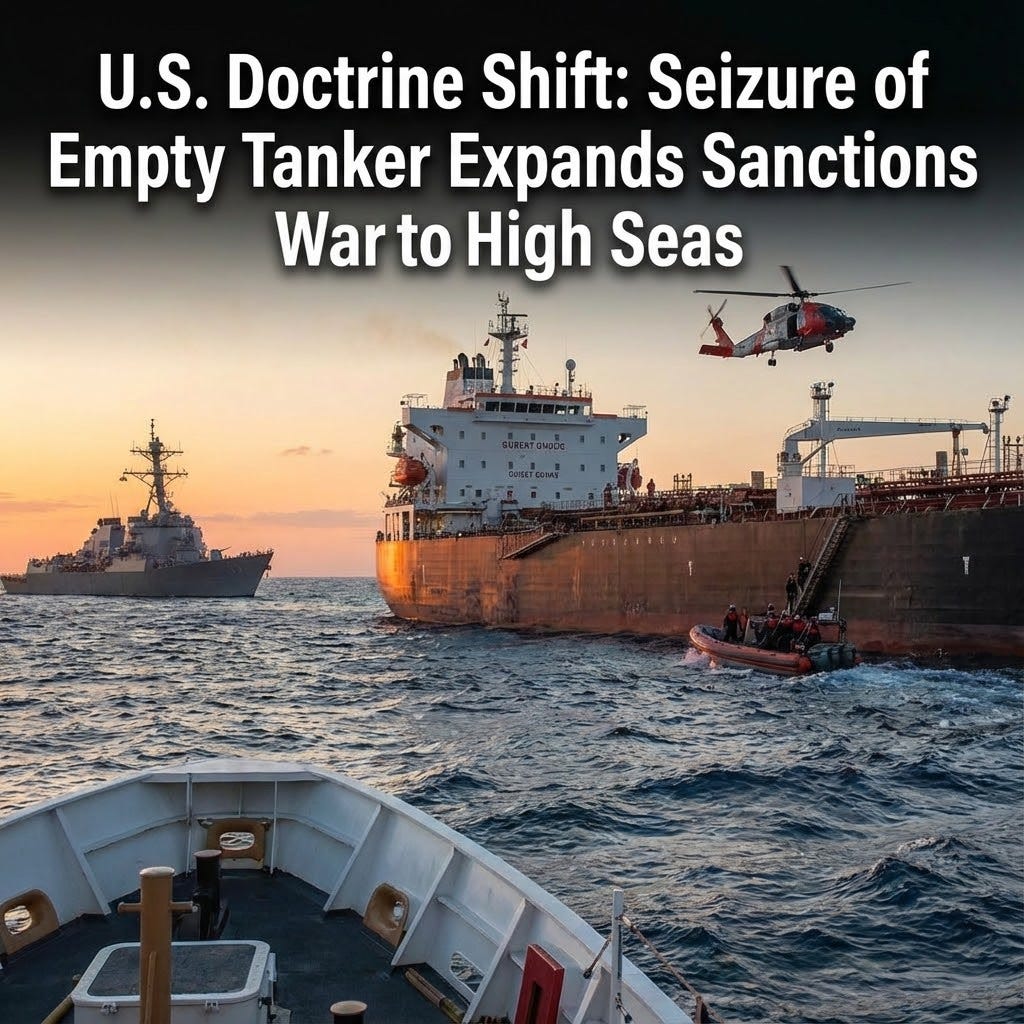
By pursuing and seizing a vessel "in ballast" — carrying only water for stability — the U.S. government has effectively signaled that the ship itself, once engaged in sanctioned trade, becomes the instrumentality of a crime.
It is a doctrine that treats the hull not as a delivery truck caught with illicit goods, but as a weapon system to be decommissioned.
This shift represents a significant escalation in the economic warfare between Washington and the “shadow fleet”—the loose confederation of aging tankers, opaque ownership structures and off-book insurers that keeps oil flowing from Venezuela, Iran and Russia to markets in East Asia. The Bella 1 itself had an extensive history in these trades, having previously moved over 11 million barrels of crude and engaging in ship-to-ship (STS) transfers to mask origins.
The implications of this move ripple far beyond the immediate loss of one tanker.
They challenge the established interpretations of the United Nations Convention on the Law of the Sea (UNCLOS), rewrite the risk calculus for global maritime insurance and signal a new phase of great power competition where the global commons are increasingly enclosed by unilateral enforcement zones.
Doctrine of the tainted asset
The seizure of Bella 1 relies on a legal theory that extends U.S. jurisdiction aggressively. Traditionally, freedom of navigation protects vessels in international waters from interference by foreign states, barring specific exceptions like piracy or statelessness.
However, by designating the vessel itself as blocked property under the International Emergency Economic Powers Act (IEEPA), U.S. authorities are asserting that the ship’s physical location is secondary to its financial status within the U.S. legal framework.
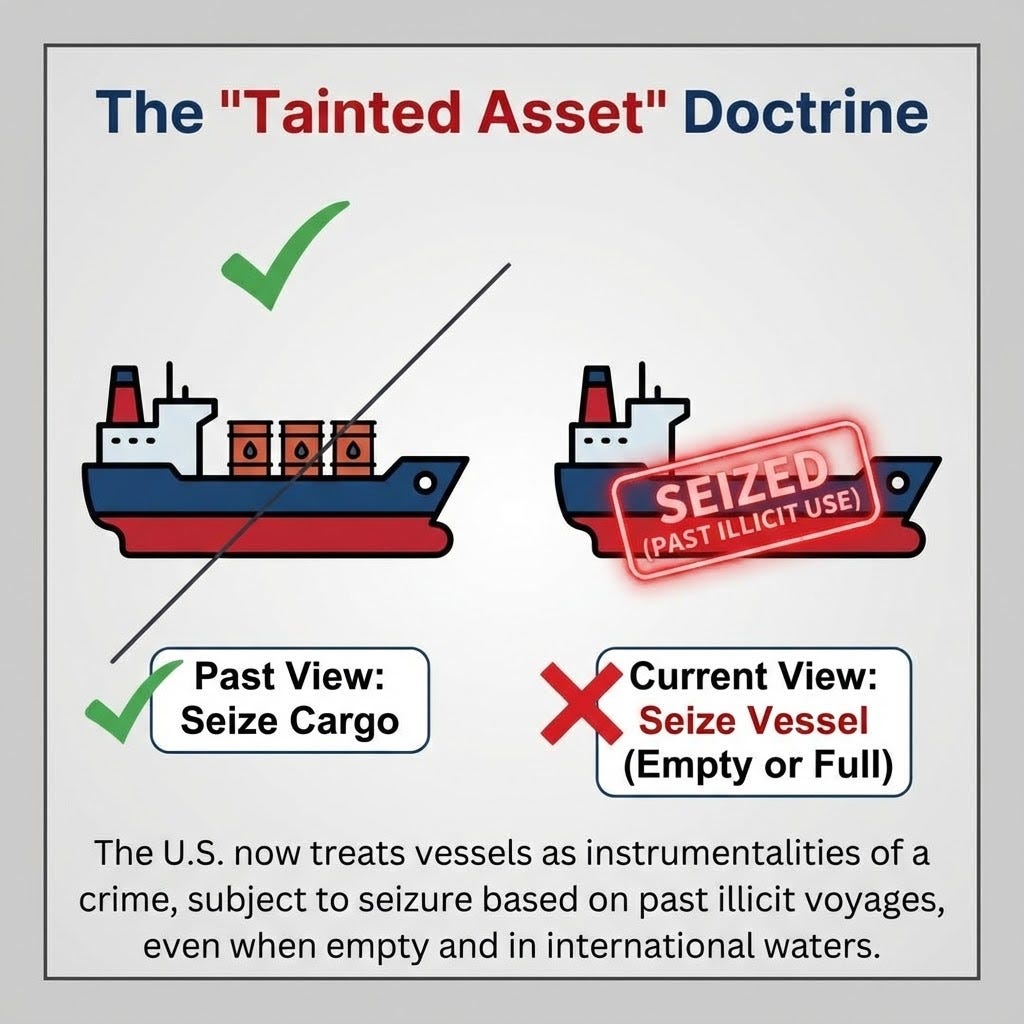
Legal scholars note that this moves sanctions enforcement closer to civil asset forfeiture models used in domestic counternarcotics operations.
In those contexts, a vehicle used to transport drugs is subject to seizure regardless of whether it is carrying drugs at the specific moment of interdiction.
"This is the 'fruit of the poisonous tree' applied to naval architecture," said one maritime law expert who requested anonymity to discuss sensitive ongoing operations. "If the ship moved sanctioned oil three years ago, the U.S. position is now that the ship itself is radioactive. It doesn't matter if it’s empty, carrying grain or carrying water. It is a tainted asset."
This effectively removes the statute of limitations on a voyage.
For shipowners operating in the grey zones of the global energy trade, the Bella 1 incident demonstrates that there is no "safe harbor" in time or space.
A successful delivery in 2021 can result in a hull seizure in 2025.
Operational impact: Dismantling the Shadow Fleet
The Shadow Fleet has relied on a specific operational tempo to survive.
These vessels often turn off their Automatic Identification System (AIS) transponders (going dark), engage in ship-to-ship (STS) transfers in open waters to mask the origin of the crude and reflag frequently to confuse authorities.
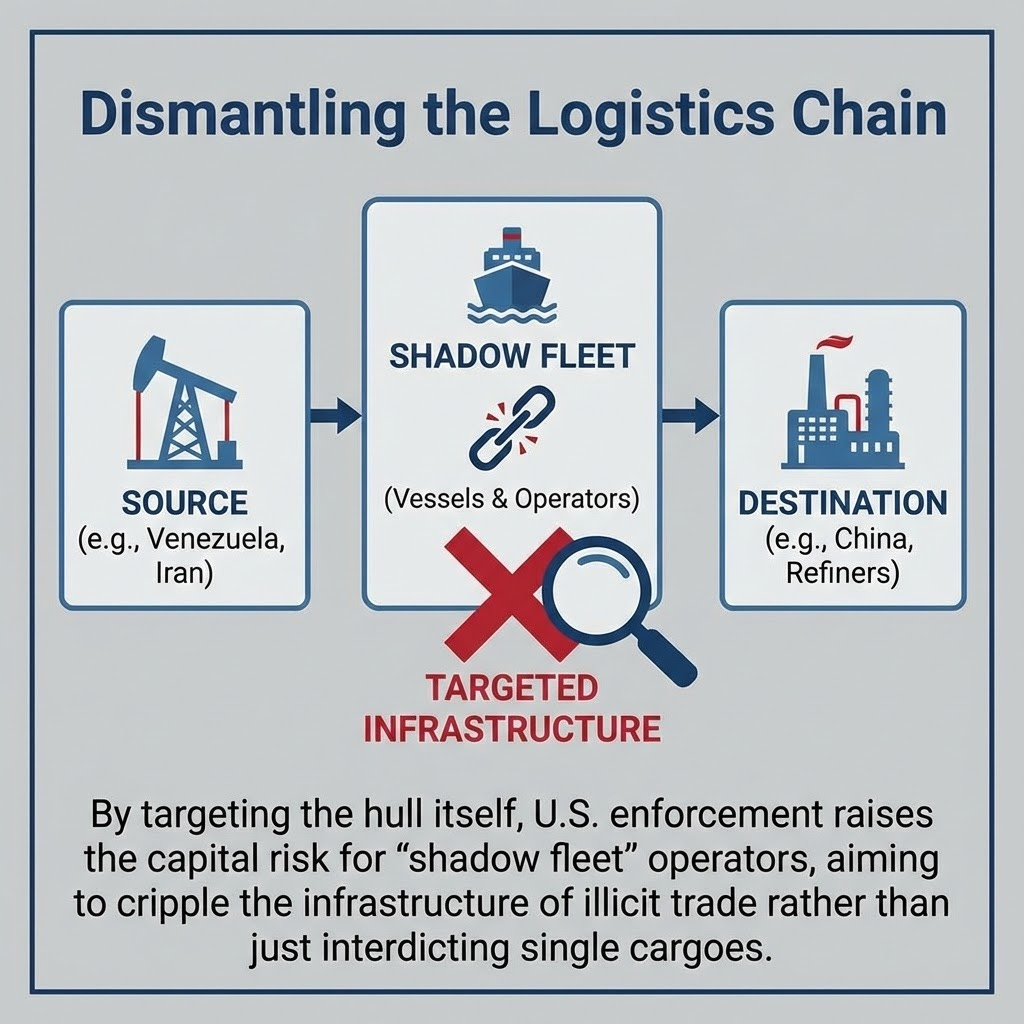
Until now, the primary risk was the seizure of the cargo — a financial loss, certainly, but one that could be priced into the cost of doing business.
The loss of the hull, however, changes the economics of evasion.
Even an aging supertanker is a capital asset worth tens of millions of dollars in scrap steel alone.
If the U.S. campaign now targets the vessels regardless of cargo, the replacement cost for the shadow fleet will skyrocket.
Operators will be forced to demand significantly higher premiums to risk their vessels, driving up the discount on sanctioned oil.
This creates a bottleneck not at the wellhead, but in the logistics chain. As seen with the Bella 1, an approach toward Venezuelan waters was enough to trigger the interdiction.
The vessel’s attempt to flee — turning around and steaming into the Atlantic — did not save it.
The message to other captains is stark: Once you enter the engagement zone, retreat is not an option.
Geopolitical friction and the China connection
The destination for the vast majority of this sanctioned crude is China, and Beijing’s response to the seizure was swift and sharp.
The Chinese Foreign Ministry’s condemnation of the move highlights the deepening chasm between U.S. unilateralism and the Chinese interpretation of global trade norms.
A ministry spokesman stated China stands against “unilateral illicit sanctions” and argued that by seizing foreign vessels, the U.S. has “seriously violated international law.”
From Beijing’s perspective, the U.S. is weaponizing its naval supremacy to override the principles of the UN Charter.
However, the U.S. strategy appears to be one of calculated indifference to these complaints.
By targeting the physical infrastructure of the trade — the ships — Washington is forcing Beijing to decide how far it is willing to go to protect its energy imports.
Will China begin providing naval escorts for shadow fleet tankers? Such a move would significantly raise the risk of direct military confrontation.
Without such protection, Chinese independent refiners (teapots), which consume much of this oil, may find the supply chain becoming unreliable.
If the U.S. can interdict empty vessels en route to pickup points, the reliability of the “energy bridge” between Caracas and Shandong collapses.
Erosion of the "High Seas" concept
Perhaps the most profound implication of the Bella 1 seizure is what it means for the concept of the "High Seas" as a global common.
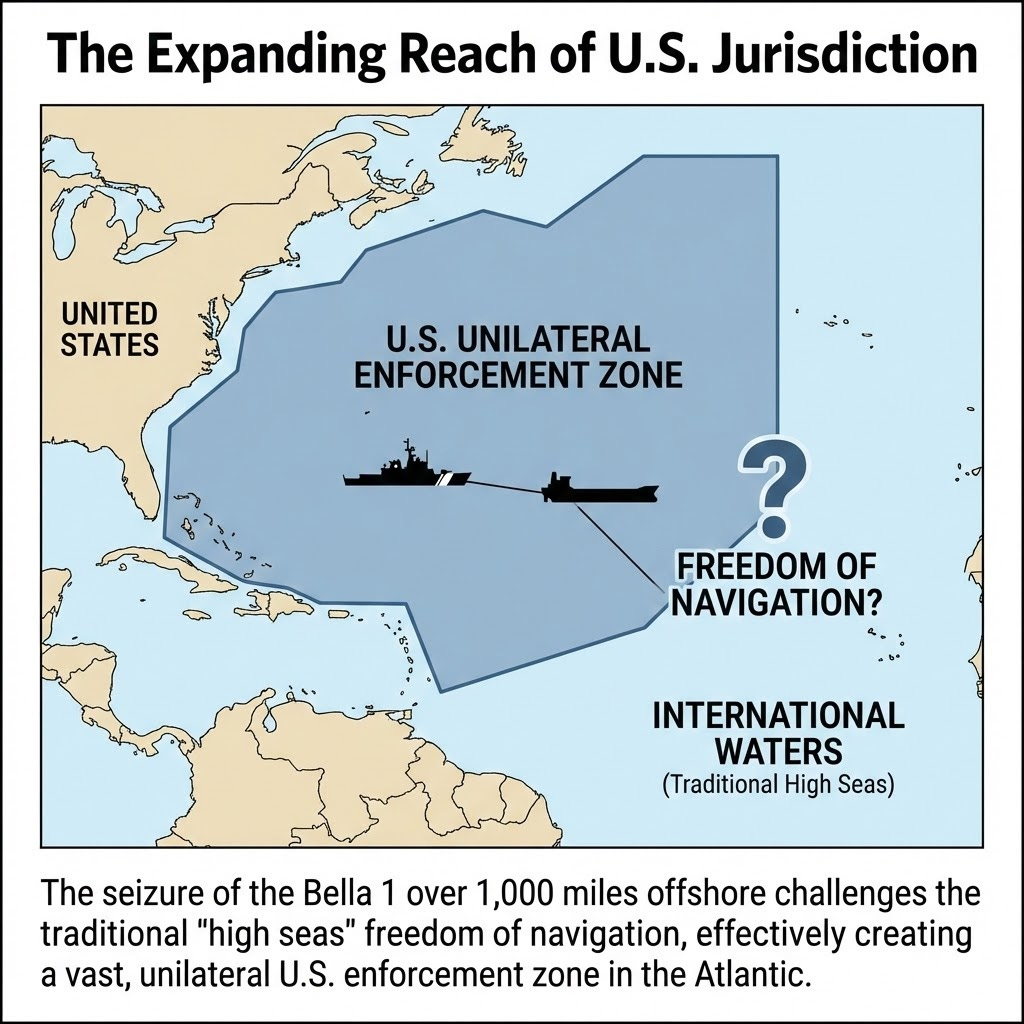
For centuries, the foundational principle of maritime law has been mare liberum (freedom of the seas).
While coastal states control their territorial waters, the open ocean was meant to be free for trade. The U.S. Navy has traditionally been the guarantor of this freedom, ensuring that sea lanes remain open.
Critics argue that by seizing commercial vessels in international waters based on unilateral sanctions, the U.S. is undermining the very system it built.
It signals a move toward a more enclosed, permission-based maritime order, where freedom of navigation is conditional on compliance with U.S. foreign policy.
"We are seeing the end of the post-Cold War maritime consensus," said a defense analyst specializing in naval strategy. "The oceans are no longer a neutral space for commerce. They are a contested domain where economic laws are enforced with kinetic assets. The Atlantic is becoming a jurisdictional extension of the Southern District of New York."
Insurance and classification squeeze
The maritime industry runs on paper as much as it runs on fuel.
Insurance (P&I Clubs) and classification societies (which certify a ship is seaworthy) are the gatekeepers of legitimate trade.
The Bella 1 seizure will likely accelerate the de-risking trend among Western service providers. Insurers, fearing that they could be implicated in a vessel seizure or lose a client’s asset to U.S. authorities, will likely widen their exclusion zones.
This pushes the shadow fleet further into the margins, relying on non-standard insurance and dubious certification.
While this keeps the ships moving in the short term, it increases the risk of environmental catastrophe. A fleet of uninsured, uninspected tankers running dark in busy shipping lanes is a recipe for a collision or spill.
The Trump administration appears to have calculated that this environmental risk is outweighed by the strategic necessity of choking off revenue to adversaries.
The resolve mentioned by officials suggests that environmental fallout will be blamed on the rogue regimes, not the enforcers.
New era of naval statecraft
The seizure of the Bella 1 is not an isolated police action; it is a policy statement.
It redefines the tanker not as a vehicle, but as a target. It extends the reach of U.S. law enforcement to the middle of the Atlantic.
And it serves notice that in the current geopolitical climate, the "neutrality" of commerce is a relic of the past.
For the global energy market, the immediate effect may be a tightening of supply as shadow fleet operators pause to reassess their vulnerabilities.
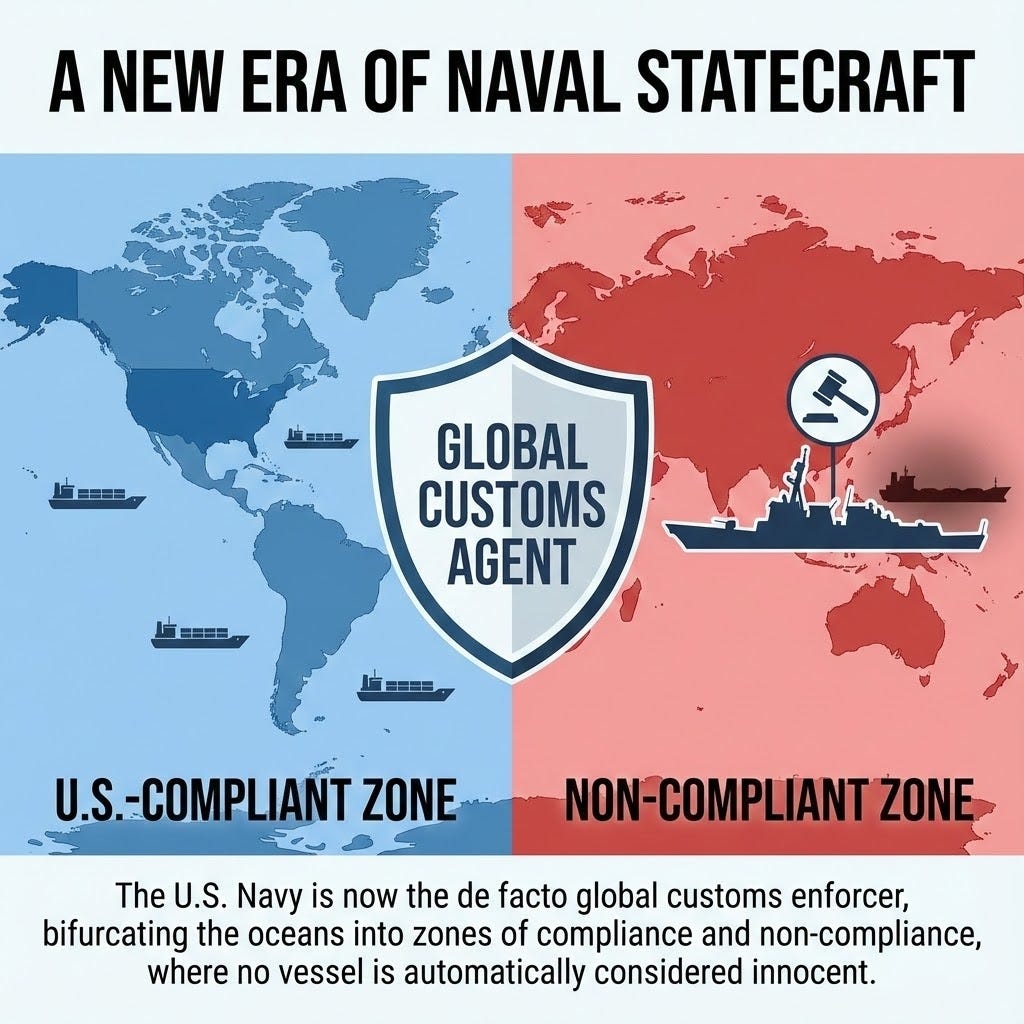
But the long-term effect is more structural: The bifurcation of the world’s oceans into U.S.-compliant and Non-compliant Zones, with The Navy acting as a customs agent for the world.
As the Bella 1 is towed to a U.S. port, it carries with it a heavy cargo of legal and geopolitical precedent.
The empty hold speaks volumes: In the new era of economic statecraft, there is no such thing as an innocent ship.
Regarding the topic of the article, that 'weapon system' analogy really resonates.
https://bsky.app/profile/flingjore.com/post/3mau4yzk2pu2p