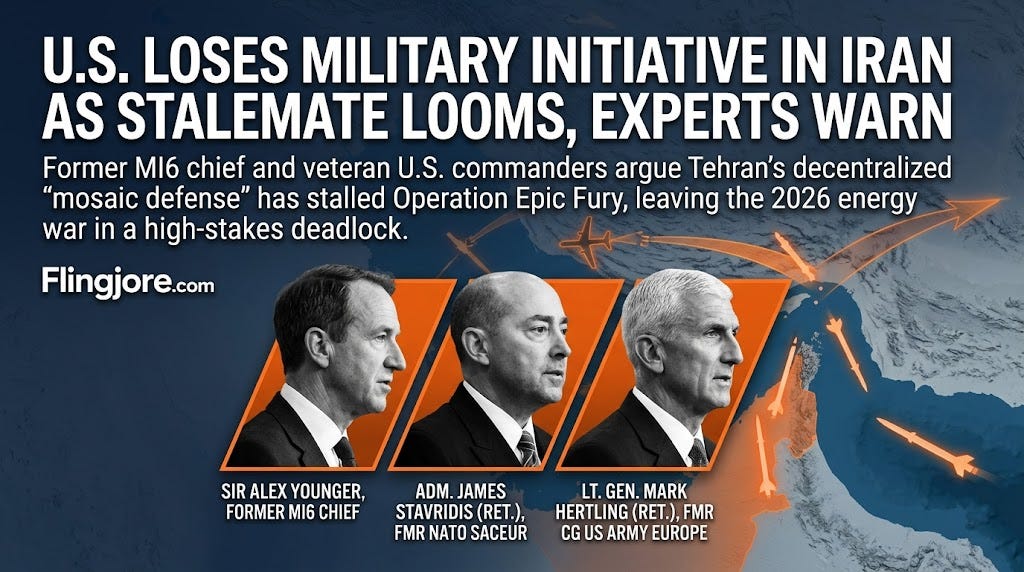
U.S. Loses Military Initiative in Iran as Stalemate Looms
Despite "perfect" air strikes and assassination of the Supreme Leader, Tehran’s decentralized defense has stalled Operation Epic Fury, leaving the 2026 energy war in a high-stakes deadlock.
Iran has seized the military initiative from the United States and Israel by employing a decentralized “drone war” and horizontal escalation to maintain its grip on global energy corridors, according to a former chief of the British Secret Intelligence Service and a growing chorus of retired Western commanders.
The assessment by Sir Alex Younger, who led MI6 from 2014 to 2020, suggests that the Islamic Revolutionary Guard Corps (IRGC) has successfully countered a “perfectly executed” Western air campaign by weaponizing global oil markets and treating the conflict as a “civilizational” fight for survival. This strategic shift effectively stalls the Trump administration’s efforts to reopen the Strait of Hormuz, forcing a high-stakes war of attrition that leaves the U.S. and its allies with “limited and not great” options for the remainder of 2026.
The shift in momentum comes as President Trump extends a deadline to April 6 for Tehran to end its blockade, even as the U.S. prepares to deploy thousands of paratroopers to the region. Younger argues that the U.S. underestimated the task because Tehran’s “mosaic defense” was designed to survive the exact type of decapitation strikes that killed Supreme Leader Ali Khamenei on Feb. 28. By dispersing military hardware and delegating launch authority to local commanders as early as last June, the IRGC created a resilient system that remains functional under the new leadership of Mojtaba Khamenei.
This skepticism is echoed by veteran military commanders who have previously supported U.S. operations but now question the lack of a clear “end state” for Operation Epic Fury. Adm. James Stavridis (Ret.), the former NATO Supreme Allied Commander, noted that while the U.S. can target the electric grid, it has failed to create the conditions necessary for commercial shipping to resume safely. Lt. Gen. Mark Hertling (Ret.) warned that “it doesn’t matter how much ammunition you spend” if it fails to reach a measurable strategic objective, describing the current campaign as a costly example of the limits of airpower.
The disparity in commitment remains the primary hurdle for Washington. While the U.S. is engaged in a “war of choice,” the IRGC views the conflict as a war of existence. This has allowed the IRGC to stage an internal takeover, moving toward a military junta as the traditional theocracy wanes. Lt. Gen. Ben Hodges (Ret.) has hit out at the administration’s “repulsive” disdain for allies, warning that the U.S. is in a “mess” without a plan involving regional partners.
This fracture is now public, with British Prime Minister Keir Starmer and German officials drawing clear red lines against being pulled into a broader war. Former NATO chief Jens Stoltenberg cautioned that the conflict is already diverting critical resources from Ukraine and providing an economic lift to Russia. As the war enters its second month, the window for a decisive Western victory appears to be closing, replaced by a grueling stalemate where the initiative remains firmly in Tehran’s hands.