

US finalizes first sale of Venezuelan crude; industry leaders balk at investment push
Administration routes $500 million to Qatari accounts to fund reconstruction, but energy executives warn the White House that legal risks and degraded infrastructure make the sector 'uninvestable."

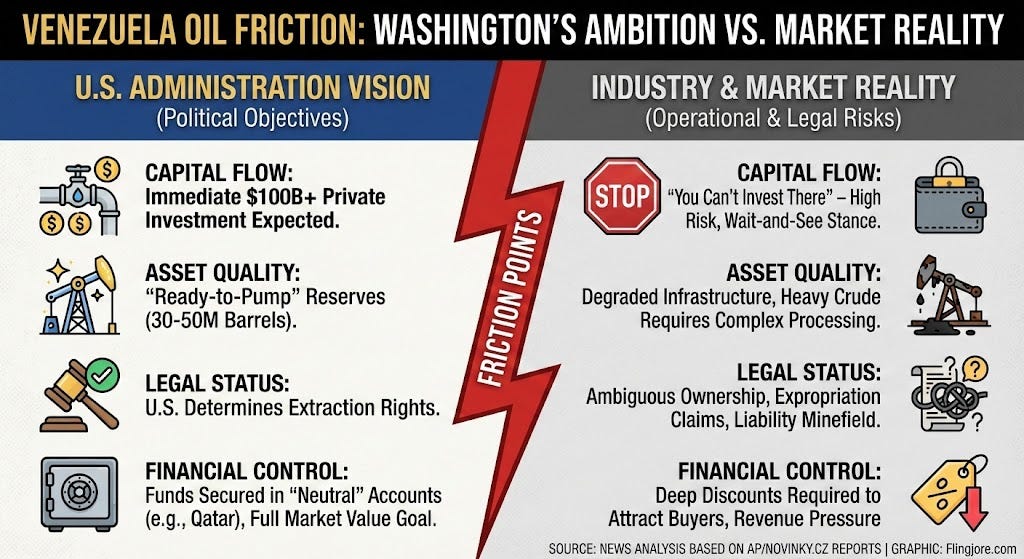
The United States government is finalizing its first sale of Venezuelan crude oil today, securing $500 million in proceeds that are being routed through financial accounts in Qatar. The transaction marks a definitive and controversial shift in the administration’s economic strategy following the recent military intervention in the South American nation.
Administration officials confirm to Reuters and Czech news outlet Novinky.cz that this sale represents the initial tranche of a broader $2 billion agreement reached earlier this month between Washington and interim authorities in Caracas. The funds are strictly controlled, residing in Doha, a location selected for its standing as a neutral financial jurisdiction where assets can move with U.S. approval but remain insulated from immediate seizure by other international creditors.
This complex financial architecture highlights the unique nature of the current U.S. engagement in Venezuela. By acting as the primary broker for Venezuelan resources, the White House is effectively establishing a fiduciary role over the country’s economic engine. President Donald Trump, addressing the development from the White House, characterizes the sale as a necessary step to fund the stabilization of the region following the capture of former President Nicolás Maduro.
”Venezuela has already given us 30 million barrels of oil,” Trump says, indicating the scale of the transfer currently underway. “The U.S. will decide who will continue to extract oil there.”
The President emphasizes that his administration will maintain direct oversight of the revenue to ensure it aids the populations of both the United States and Venezuela. However, this assertion of control is colliding with the operational realities of the global energy market. While the administration projects confidence, the sale is reportedly moving at a discount compared to competing crude grades from Canada, a necessity to attract buyers wary of the legal and logistical complexities attached to the cargo.
Clash between policy and private capital
The divergence between political ambition and market reality is most visible in the administration’s interactions with the U.S. energy sector. The White House is publicly calling for American oil companies to invest at least $100 billion to rebuild Venezuela’s shattered energy infrastructure. The administration views this capital injection as vital for restoring production levels that have plummeted over the last two decades.
However, captains of the industry are signaling deep reluctance. During a closed-door meeting at the White House on Friday, executives from major mining and energy corporations presented a far more pessimistic outlook. Darren Woods, CEO of ExxonMobil, reportedly delivered a blunt assessment to administration officials regarding the feasibility of immediate investment.
”You can’t invest there,” Woods says, according to reports of the meeting. He points to a myriad of unresolved legal frameworks and business liabilities that must be analyzed before shareholders would permit such exposure. For the private sector, Venezuela remains a “stranded asset” risk—a potential quagmire where ownership rights are murky and the physical assets are in a state of advanced decay.
Heavy crude challenge
Beyond the boardroom hesitation lies a stubborn geological fact: Venezuelan oil is notoriously difficult to monetize without significant infrastructure. The country sits on the world’s largest proven reserves, but the vast majority of it is extra-heavy crude. This viscous substance cannot flow through pipelines without being diluted with lighter oils or treated with specialized upgraders—equipment that has been severely neglected.
Under the administrations of Hugo Chávez and Nicolás Maduro, maintenance capital was frequently diverted, leaving the state-owned oil company, PDVSA, with crumbling facilities. Industry experts note that the cost to rehabilitate the extraction equipment and pipeline networks is astronomical. The “heavy” nature of the oil also means it trades at a lower price point than the lighter, “sweet” crude produced in the U.S. Permian Basin, squeezing the potential profit margins that would otherwise entice foreign investment.
The necessity of selling the current stock at a discount, as noted in the Novinky.cz report, confirms that the market is pricing in these difficulties. Traders are demanding lower prices to offset the risk of dealing with sanctioned or legally encumbered cargoes, even with U.S. government backing.
Geopolitical ripples and the China factor
The decision to route funds through Qatar is a strategic maneuver designed to bypass a tangle of international litigation. Venezuela owes billions to various creditors, including arbitration awards to companies whose assets were expropriated in the past. A direct transfer to U.S. accounts could trigger immediate legal claims. Qatar acts as a firewall, allowing the U.S. to direct the use of funds for what it terms “reconstruction” without them being instantly frozen by courts.
Furthermore, the sale raises questions regarding other global powers. The source report indicates that China is seeking to negotiate regarding loans extended to the previous regime. For years, Beijing provided cash-for-oil loans to Caracas. The U.S. move to liquidate Venezuelan oil inventory essentially sells the collateral that underpinned those Chinese loans. How Beijing responds to this liquidation of assets remains a critical variable in the diplomatic fallout of the invasion.
Looking ahead
As the first $500 million settles into the Qatari accounts, the operation proves that the U.S. can physically move Venezuelan oil to market. However, the reluctance of companies like ExxonMobil to commit long-term capital suggests that a sustained recovery is far from guaranteed. Without the technical expertise and massive financial resources of the private majors, the U.S. government risks becoming the sole manager of a dilapidated oil industry, tasked with keeping the pumps running in a volatile occupation zone.
For now, the administration is proceeding with plans for further sales in the coming days and weeks. The White House maintains that this model—U.S. stewardship of Venezuelan resources—is the only viable path to solvency for the crisis-hit nation, even as the energy industry watches from the sidelines, waiting for clarity in the chaos.