U.S. submarine sinking of Iranian frigate ruled lawful by experts
Tehran called the torpedoing an atrocity, but a military review confirms the attack adhered to the rules of combat: enemy vessels in international waters are always legitimate targets.

(Updated 10:08 a.m. MT)
Analysis
Military law experts validate the U.S. submarine sinking of an Iranian frigate off Sri Lanka as a lawful act of armed conflict, dismissing Tehran’s claims of a maritime atrocity.
The findings corroborate anonymous assessments from U.S., British and German officials confirming the engagement operated strictly within the legal bounds of modern naval warfare.
A comprehensive legal review concludes the deadly torpedo strike adheres to international regulations regarding targeting, location and post-engagement rescue efforts.
The ruling carries profound geopolitical implications for the escalating conflict between Washington and Tehran. By confirming the U.S. strike complies with combat regulations, the analysis establishes a stark reality: the entire ocean, outside recognized neutral waters, operates as an active theater of war.
The precedent signals to global markets, regional powers and the Iranian military that ceremonial status, participation in multinational exercises and distance from the primary Middle East theater offer zero protection against U.S. naval assets.
U.S. strike off Sri Lanka
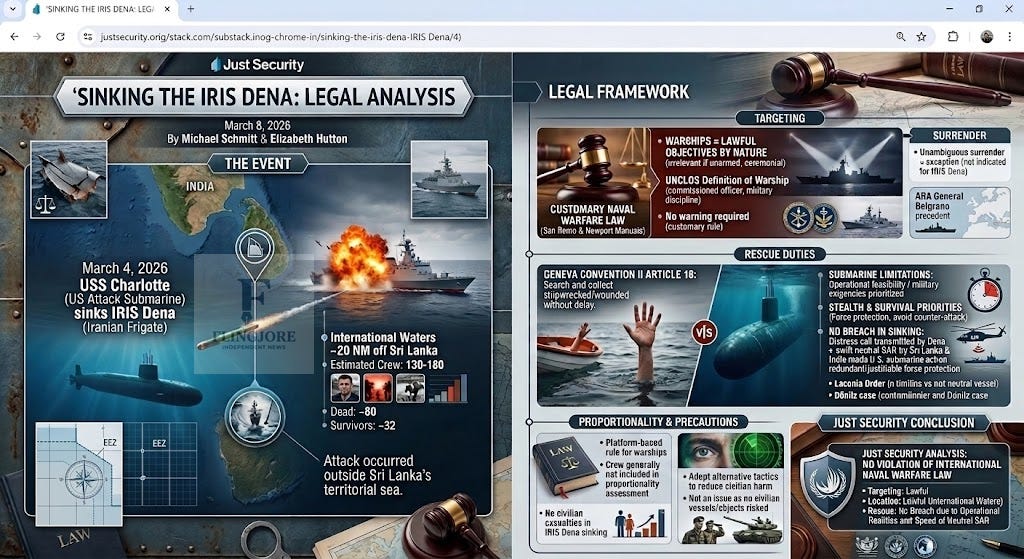
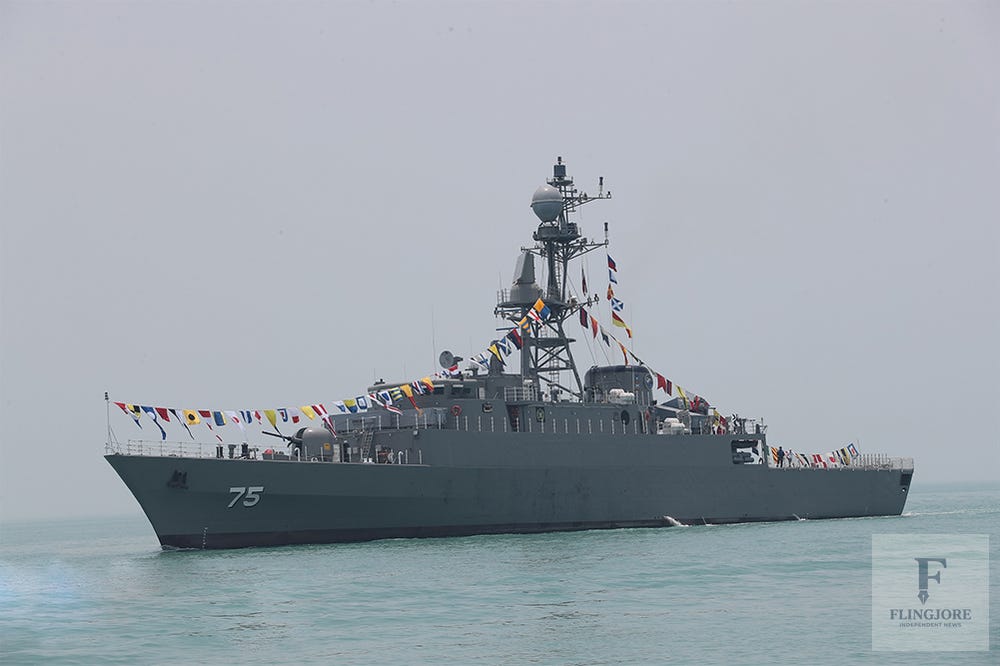
The legal debate stems from the early-morning torpedoing of the IRIS Dena off the southern coast of Sri Lanka on March 4. As the Moudge-class guided-missile frigate transits the Indian Ocean returning from the multinational MILAN 2026 exercises in India, the USS Charlotte, a Los Angeles-class attack submarine, shadows the vessel.
The incident occurs roughly 20 nautical miles off the Sri Lankan coast, well outside the nation’s 12-nautical-mile territorial waters. As the Dena moves toward an active conflict zone, the USS Charlotte fires an MK-48 heavyweight torpedo. The weapon shatters the hull, triggering a massive secondary explosion and causing rapid, uncontrollable flooding.
The Dena transmits an immediate distress call before sinking within two to three minutes of the torpedo’s impact. The signal triggers a large-scale search-and-rescue operation. The Sri Lankan Navy, Coast Guard, and Air Force quickly deploy assets to the coordinates, assisted by Indian Navy surface vessels operating in the region. First responders pull 32 survivors from the water and recover more than 80 bodies. Maritime officials estimate the total crew size ranges between 130 and 180 personnel.
Diplomatic fallout and accusations of atrocity
The attack immediately draws fierce condemnation from Tehran, escalating the rhetoric in an already volatile conflict. Iran’s Foreign Minister labels the attack “an atrocity at sea” and warns that the United States “will come to bitterly regret” the action.
Iran’s Deputy Foreign Minister further protests the legality of the strike to the United Nations Security Council, stating the Dena “was [in the area] by invitation of our Indian friends, attending an international exercise. It was ceremonial. It was unloaded. It was unarmed.” Iranian state media seizes on the lack of a U.S. rescue effort, framing the submarine’s departure as a violation of basic human rights and maritime law.
The legal framework: Legitimate targets and open waters
Despite the diplomatic outrage, military law scholars Michael Schmitt and Elizabeth Hutton clarify in Just Security that under international law, enemy warships remain inherent military objectives regardless of their immediate posture.
“Enemy warships and naval auxiliaries, whether manned or unmanned, are military objectives by nature that may be targeted anywhere and at any time,” the experts note, citing standard naval operational doctrine. The vessel requires only a commissioned officer, military discipline, and external distinguishing marks to qualify as a legal target under the UNCLOS treaty.
Furthermore, the laws of naval warfare are platform-based. Because the ship qualifies as a targetable vessel, military law does not require attackers to factor the crew—even if they are unarmed or performing administrative duties—into proportionality assessments. The laws of armed conflict prioritize the destruction of the enemy’s war-making capacity; neutralizing a modern frigate satisfies the requirement for a definite military advantage.
The location of the strike further justifies the U.S. action. Because the engagement occurs in international waters, the submarine violates no neutral boundaries. The law imposes no geographic zones of engagement, meaning belligerent naval operations lawfully extend globally. Once the Dena leaves Indian territorial waters and enters the high seas, it loses all diplomatic protections afforded during the MILAN exercises.
The rescue controversy and submarine warfare
The most heavily scrutinized aspect of the engagement involves the failure of the USS Charlotte to surface and rescue the surviving Iranian sailors. While Article 18 of the 1949 Geneva Convention II requires parties to collect the shipwrecked without delay, modern interpretations explicitly condition this mandate on operational feasibility.
Military manuals dictate that submarines must attempt rescues only “as far as military exigencies permit.” Because a submarine relies entirely on stealth for its survival, surfacing to deploy life rafts exposes the vessel to immediate counter-attack from regional aircraft or surface combatants.
Experts note that because the Dena successfully transmits a distress call that mobilizes nearby neutral forces, the U.S. submarine fulfills its obligations without needing to compromise its tactical position. Exposing a multi-billion-dollar nuclear submarine and its crew to effect a rescue in hostile or contested waters violates fundamental force protection doctrines.
U.S. Indo-Pacific Command confirms this operational posture, stating that “U.S. forces planned for and Sri Lanka provided life-saving support to survivors in accordance with the Law of Armed Conflict.”
Connecting the dots: The broader strategic picture
The legal validation of the Dena sinking provides the U.S. military with essential diplomatic cover for an increasingly aggressive maritime posture, fitting into a wider pattern of targeted escalations.
The submarine strike occurs simultaneously with a sweeping U.S.-backed Israeli air campaign targeting 30 Iranian fuel depots. While the U.S. government publicly feigns dismay over the fuel strikes—citing fears of spiking global oil prices and a consolidated Iranian hardline front—the coordinated timing of the maritime and terrestrial attacks suggests a unified strategy to cripple Iran’s logistical and force-projection capabilities.
By targeting a frigate returning from a diplomatic mission near the Indian subcontinent, the Pentagon demonstrates a willingness to project lethal force far beyond the traditional confines of the Persian Gulf and the Strait of Hormuz. This forces Iran into a strategic dilemma: it must either recall its dispersed naval assets to heavily defended home waters, functionally ceding the open ocean to U.S. hegemony, or expend vast resources attempting to defend isolated vessels globally.
The rigorous application of these laws indicates that the U.S. will strictly adhere to the cold calculus of naval warfare rather than traditional diplomatic restraint. It also sends a chilling, undeniable message to other global adversaries observing the conflict. By proving that the U.S. Navy will exploit the full permissive extent of international law to sink enemy combatants anywhere on the globe, Washington re-establishes a standard of deterrence that relies entirely on the threat of sudden, over