


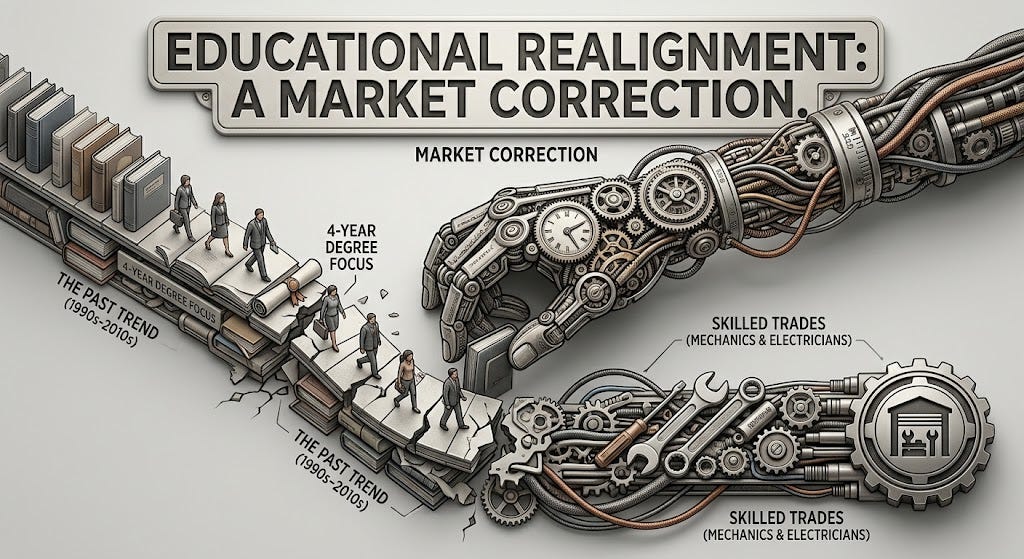
The air in the 2026 campaign cycle vibrates with a particular kind of digital static — the sound of two American realities grinding against one another until the gears finally strip. On one side is the polis, a citizenry exhausted by a decade of “social warfare” and digital ghosts; on the other is the oikos, a silent, sovereign super-party of capital that has successfully colonized the rhetoric of both major platforms. We are living through a grand theatrical production where the stakes feel existential and the “social warfare” is meticulously choreographed, yet the underlying architecture of power remains remarkably undisturbed.
It is the ultimate political gaslight: a system that dresses the cold ROI of the ledger in the warm, borrowed costumes of populist values to secure a “Truth Tax” that now drains $417 billion from the global economy. By formalizing “Wall Street” as a distinct political entity on the ballot, we do not merely acknowledge the monster in the room; we initiate a “Great Uncoupling” that strips the “Empathy Tax” from our governance. To save the Republic, we must stop forcing the architects of global wealth to hide behind the masks of common men and finally force the “Economic Party” to speak its truth in the light of day.
The Ghost in the Machine: Recognizing the Sovereign Power of Capital
We live in a state of constant political gaslighting. We are told that our votes decide the future of healthcare, the climate, and the soul of the nation, while the measurable flow of capital suggests a different reality. Wall Street has not merely “influenced” the Democratic and Republican parties; it has commandeered them. It uses the other two as meat shields—human-shaped vessels to absorb the shock of public anger while the core objective of capital accumulation continues unabated. By refusing to name this entity, we allow it to operate with the immunity of a ghost.
To understand the necessity of this “Outing,” we must return to the root of our governance. Politics comes from the Greek politikos, pertaining to the polis—the city-state or the citizens. It is the art of how people live together in a shared space. Conversely, Economics comes from oikos (the household) and nomos (law/management). Historically, these were distinct spheres. When the management of the “household” (business) swallows the “city” (the people), the focus shifts from civic well-being to ledger health.
As the Neo-Beardian Historical School noted in their 2025 retrospective:
“The American party system has always been a mechanism for the management of conflict, but it has now become a mechanism for the obfuscation of interest. We have confused the citizen with the consumer, and in doing so, we have rendered both powerless.”
By siloing Wall Street into its own party, we return “politics” to the people, allowing the remaining parties to focus on civil rights, education, and the human condition without a bottom-line veto from a donor class that is currently hiding in their ranks. This is not just a separation of powers; it is a restoration of the boundary between the market and the community.
The Empathy Tax: How the Performance of Morality Masks Financial Objectives
The primary friction in modern governance is the forced marriage of Math and Morality. The genius of the current arrangement lies in its ability to force the “Free Market” to speak the language of the “People.” When a multinational corporation seeks to protect its monopoly, it doesn’t lobby for “Greed.” It lobbies for “Jobs” through the Republican lens or “Consumer Protection” through the Democratic one. This is the ultimate Empathy Tax—a systemic requirement that every financial objective be wrapped in a moral shroud.
This fusion has effectively hollowed out the polis. By forcing the “People Parties” to act as the PR wings for capital, we have rendered them incapable of addressing actual human needs. Dr. Elena Vance, in her 2026 work The Ledger and the Lyre, argues:
“The great tragedy of the 21st century is that we forced the cold logic of the market to speak the warm language of the heart. The result was a cold heart and a broken market.”
If we formalize the Wall Street Party, we initiate a Great Uncoupling. We strip away the masks. When capital is no longer allowed to hide inside the “Big Tents,” the Democratic and Republican shells are suddenly, and perhaps for the first time in a generation, empty. This emptiness is an opportunity. It allows these parties to return to their core purpose: the negotiation of human values. It forces the Wall Street Party to stand on its own stage and defend its platform of growth and ROI without the ability to hijack social grievances to win an election. It makes the equation fair: One party for the math, and the other parties for the people.
History as Infrastructure: Why Market Stability Requires a Locked-Down Ledger
In the post-truth era, we have mistakenly categorized “truth” as a moral virtue. To a Wall Street Party, however, truth is something far more pragmatic: it is infrastructure. Just as a logistics company cannot function without paved roads, and a tech giant cannot operate without fiber-optic cables, a market-driven society cannot price risk without objective facts. We are currently paying a “Truth Tax” that rivals the GDP of entire nations. Forensic data from the 2025-2026 fiscal cycles reveals that the global economic impact of disinformation reached nearly $417 billion this past year.
Volatility is the enemy of wealth preservation. If the underlying facts of a nation—its legal precedents, its historical records, its scientific data—are subject to the whims of populist “lawfare,” the market loses its footing. When a deepfake video can trigger a flash crash in mid-cap stocks, the “Free Market” is no longer free. It is a crime scene. The Wall Street Party would view the preservation of history and the verification of data as a core government function, analogous to the maintenance of the electric grid.
This requires the establishment of a National Archive of Fact (NAF) — the SEC of reality. Utilizing the same blockchain technology that secures our currency, the NAF “hashes” every major government report and court ruling into a permanent, immutable ledger. To change the record is to break the chain. In this world, facts are not “feelings”; they are the non-negotiable floor upon which capital builds. To a party of pure capital, truth is not a moral choice; it is a fiscal necessity.
Ending Judicial Proxy Wars: Moving Corporate Interests from the Courtroom to the Ballot Box
Current political conflicts are increasingly settled through Lawfare — the use of the legal system as a weapon to achieve ideological ends. Because our parties are caught in a cycle of social warfare, the courts have become a battlefield where history is rewritten every four years. A Wall Street Party ends this by professionalizing the negotiation. When capital has its own banner, it no longer needs to bypass the legislature through the judiciary. It negotiates its interests in the light of day.
By removing the “Special Interests” from the Democratic and Republican parties, we effectively remove the fuel for social warfare. The legal system is currently clogged with cases that are essentially political theater—lawsuits designed not to seek justice, but to signal virtue or obstruct a rival’s donor interests. By separating the “Economic Party” from the “People Parties,” we reduce the incentive to use the courts as a bypass for the democratic process.
We return “Politics” to the people, and we leave the “Economy” to the specialists. This is the end of the proxy wars. No more 2,000-page bills funded by anonymous donors and dropped on the floor at midnight. Every proposal from the Wall Street Party comes with a standardized cost-benefit analysis. The public sees exactly what the market thinks a life, a school, or a river is worth. That transparency is the only way to heal a cynical, uninformed public.
The Neo-Brandeisian Reset: Breaking the Monopoly on Representation
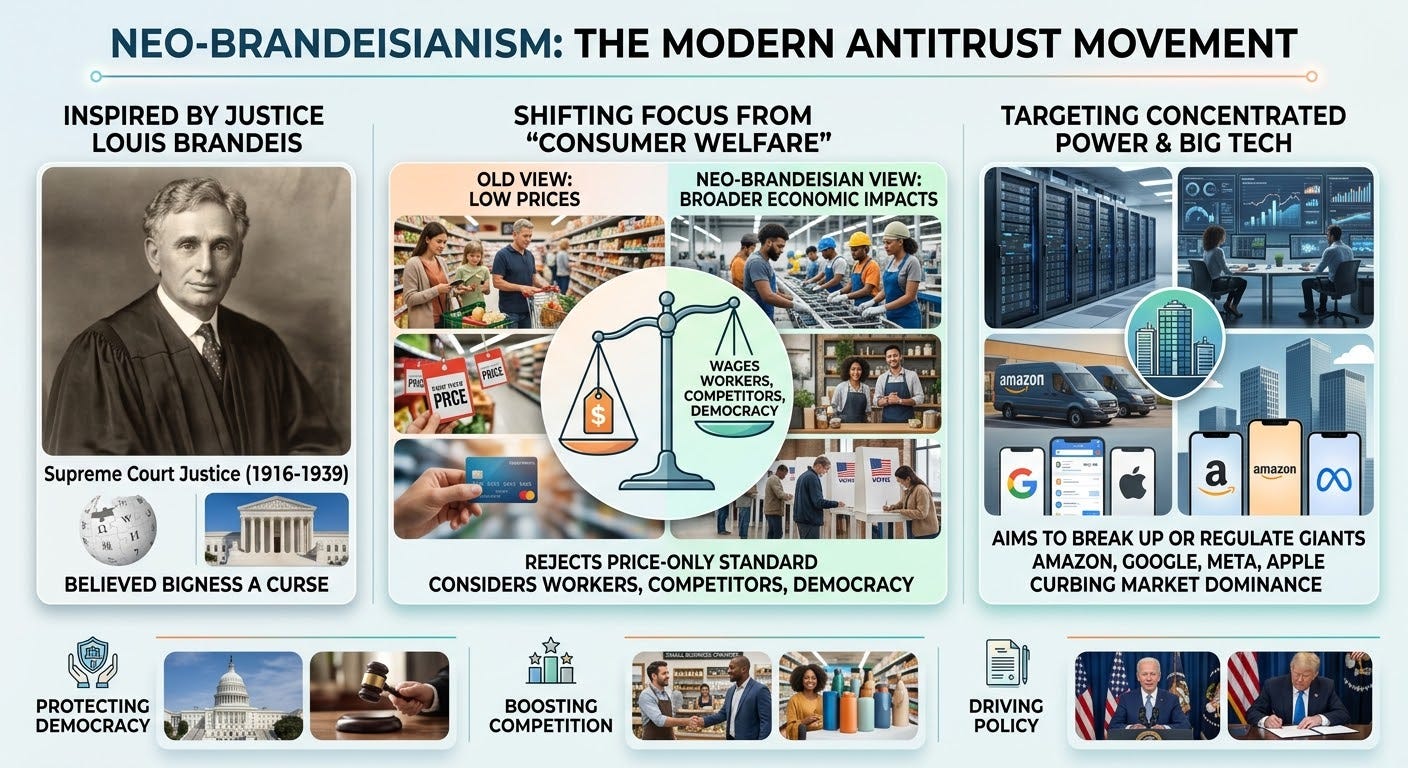
The current system is a monopoly on representation. Just as the Neo-Brandeisian movement argues that “Bigness” in the tech sector threatens democracy, the “Bigness” of the two-party cartel threatens the very idea of a fair market. These parties have become “too big to fail” because they have successfully absorbed the only interest that matters: the money. By outing the Wall Street Party, we perform a structural breakup of this political conglomerate. We introduce competition.
This is the antidote to the “less educated” public. When capital is no longer a ghost, it must negotiate in the light. It brings its cost-benefit analyses to the table, and the people bring their values. We acknowledge that while the “Economic Party” may hold the resources, it no longer holds our voices hostage. We name the player, we see the play, and we finally give the American people a chance to vote for themselves.
Geopolitical Hardening: Establishing a Data-Driven Foreign Policy
On the global stage, an America divided by “feeling” is an America that is unreadable to its allies and unpredictable to its enemies. Our adversaries currently invest billions into influence operations because they know our “Big Tent” parties are vulnerable to internal rot. They use our own social grievances against us to create market volatility.
A formal Wall Street Party acts as a Geopolitical Anchor. It represents the “Permanent Interest” of American economic hegemony, communicating its requirements for national security and trade through transparent, data-driven policy. It provides a level of predictability that is currently impossible. It tells the world: “We are open for business, and our facts are non-negotiable.” This “Hardened OS” for the nation protects our domestic markets from foreign manipulation by ensuring that our internal political debates are grounded in the immutable data of the National Archive of Fact.
The Honest Republic: Less Cowbell, More Ledger
The American public has spent the last decade demanding “more cowbell”—more noise, more outrage, and more performative passion from a system that is fundamentally hollow. We have mistaken volume for value. But as we stare down the $417 billion Truth Tax of 2026, it becomes clear that we don’t need more volume; we need an audit.
The Honest Republic cannot be built on the shifting sands of manufactured social warfare. It requires a hard floor of forensic reality. By outing the Wall Street Party, we stop the evasion. We trade the era of performative noise for an era of transactional transparency. We trade the empathy mask for the forensic scalpel. Only then, when the “silent super-party” is forced onto the ballot and the Democratic and Republican shells are returned to the citizens, can we begin the work of actual governance. It is time to stop the masquerade and start the ledger.