

Wall Street owns 3% of US rental homes. Will a corporate ban fix housing prices?
Lawmakers blame mega-corporations for a housing shortage. But the math shows that banning institutional buyers penalizes renters while ignoring the market's true bottleneck: restrictive local zoning.

Lawmakers across the political spectrum target large institutional investors in the American housing market. Current legislative proposals seek to outright ban private equity firms and hedge funds from purchasing single-family homes, enforcing compliance through severe tax penalties and mandated liquidations. The political narrative relies on a clear, easily identifiable villain: Wall Street outbids local families for starter homes, artificially inflates prices and destroys the American dream of homeownership.
A strict examination of verifiable market data, however, reveals a different structural reality. When analyzing the raw numbers, the math indicates that corporate bans address a populist grievance rather than the underlying mechanics of housing affordability. Removing corporate entities from the buyer pool does not instantly solve the broader housing shortage.
After stripping away the political rhetoric, data show the impact of proposed legislation, the geographic realities of corporate ownership and the unintended consequences these policies pose to the rental market.
The legislative landscape
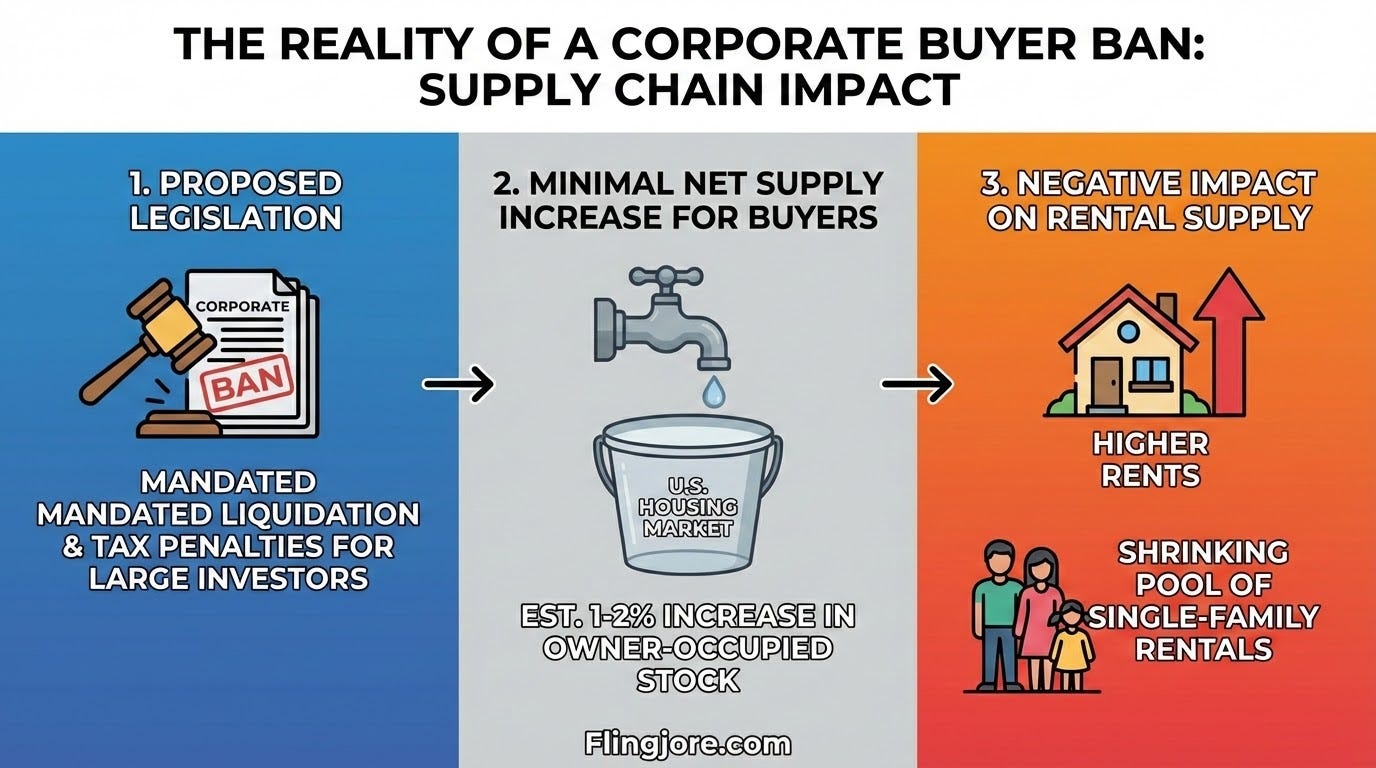
Federal and state legislatures currently debate several bills aimed at curbing corporate homeownership. The most prominent federal proposal is the End Hedge Fund Control of American Homes Act. The legislation imposes a strict mandate: entities with over $50 million in net value or managing funds for investors face a total ban on purchasing single-family homes. The bill requires these institutions to sell off 10% of their single-family portfolios each year over a 10-year period, with noncompliance resulting in a $50,000 per-home tax penalty.
A companion proposal, the Stop Predatory Investing Act, takes a different approach by targeting the tax code. It strips investors who acquire 50 or more single-family rental homes of the ability to deduct interest or depreciation on those properties.
Proponents of these bills argue that Wall Street possesses an unfair advantage, utilizing all-cash offers and algorithmic purchasing power to edge out traditional homebuyers. While the premise holds emotional weight, the scope of the problem requires verification against national housing statistics.
By the numbers: The true scale of institutional ownership
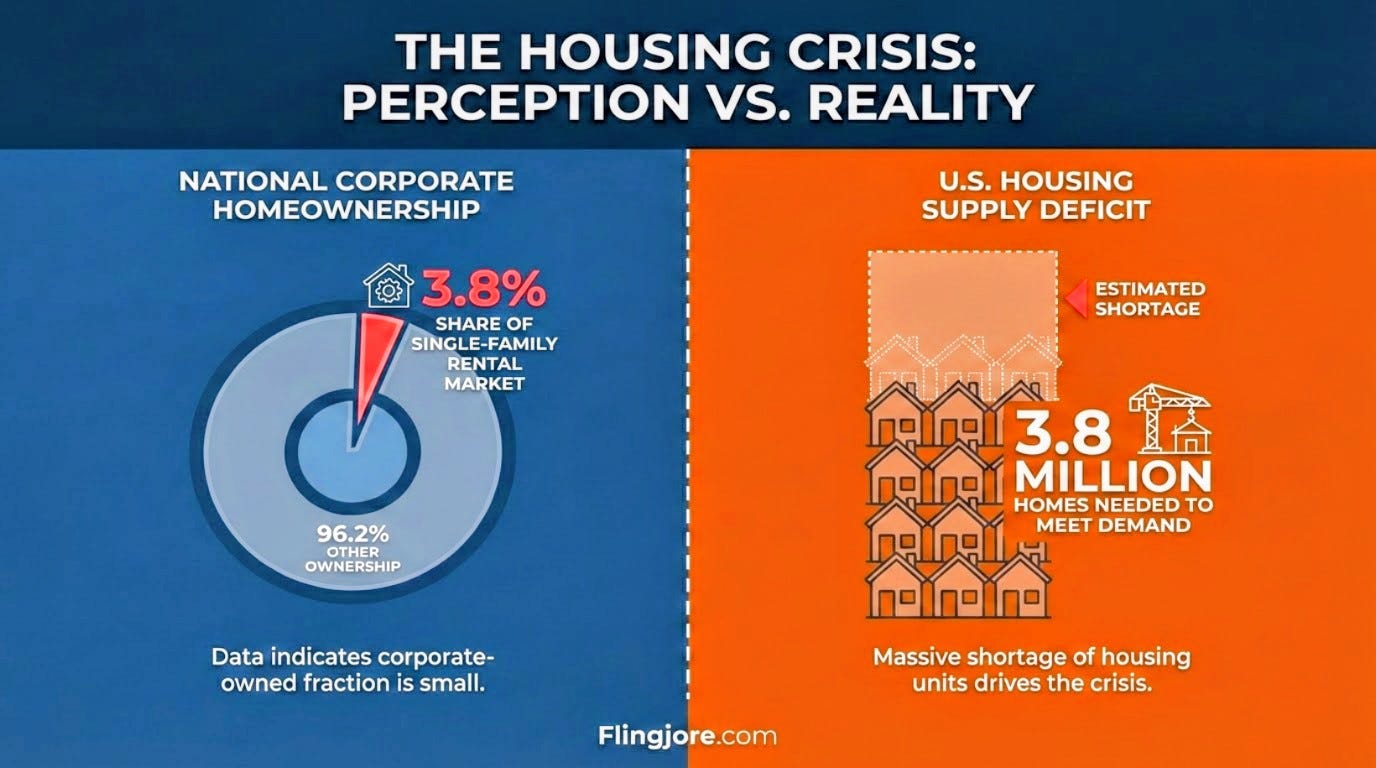
The central question revolves around market share. National data indicates that large institutional investors — typically defined as entities owning more than 100 properties — control roughly 3% of the single-family rental market. According to research from the Urban Institute, the total institutional ownership share sits at just 3.8% of the single-family rental stock.
When expanding the view to the entire U.S. single-family housing market, including owner-occupied homes, institutional ownership accounts for less than 1%.
The vast majority of the investor market, exceeding 90%, belongs to small-scale landlords who own between one and nine properties. By hyper-focusing on the fraction owned by mega-corporations, lawmakers ignore the overwhelming majority of the rental supply chain.
If legislation successfully forces institutions to liquidate their estimated 500,000 to 700,000 homes over a decade, the market absorbs roughly 50,000 to 70,000 homes annually. In a market where over 4 million existing homes sell in a typical year, this liquidation accounts for a statistical fraction of total transactions. Market analysis from the Brookings Institution indicates that forcing these firms to halt purchases produces a minimal net increase in homes available for purchase, potentially expanding the owner-occupied stock by no more than 1% to 2%.
The geographic concentration problem
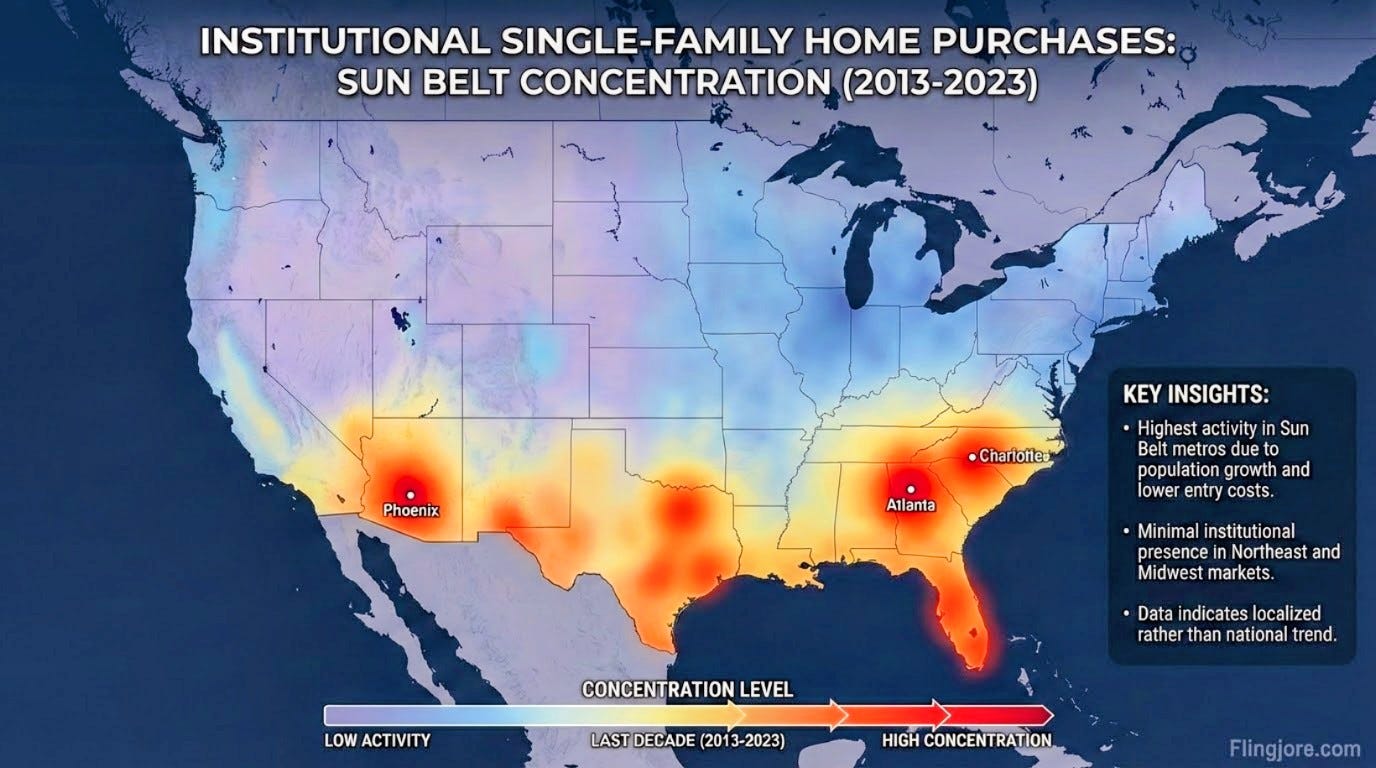
While the national data dilutes the impact of institutional investors, the localized data explains the political outrage. Wall Street does not buy homes evenly across the United States. Institutional acquisitions concentrate heavily in the Sun Belt. Markets like Atlanta, Charlotte, Phoenix, Tampa and Dallas experience disproportionate corporate buying.
In specific zip codes within Atlanta, institutional investors account for more than 25% of all single-family home purchases during peak buying periods. For a prospective homebuyer in a Charlotte suburb, the narrative of competing against an algorithmic cash buyer represents a localized reality.
However, legislating federal housing policy based on localized anomalies in Sun Belt metropolitan areas creates sweeping distortions in markets untouched by corporate buyers. A blanket federal ban impacts housing ecosystems in the Midwest and Northeast, where institutional presence remains functionally nonexistent.
The unintended consequences for renters
One of the most critical analytical blind spots in the legislative push is the assumption that every family currently renting a single-family home possesses the financial positioning or desire to buy one.
Eliminating professional suppliers from the single-family rental market directly applies upward pressure on local rental prices. Institutional investors act as primary, efficient suppliers of rental housing. When legislation limits their ability to purchase and rent out homes, the future supply of rental units shrinks.
If hedge funds must sell their portfolios, many of these homes transition from the rental market to the owner-occupied market. While this slightly increases inventory for buyers, it removes critical inventory from renters. In a market already experiencing constrained supply, shrinking the single-family rental pool drives up rents. This dynamic harms existing renters, proving that policies designed to aid homeownership inadvertently penalize the rental class.
The supply and demand friction
The fundamental challenge remains a severe, structural lack of new housing supply, heavily compounded by restrictive local zoning laws and elevated construction costs. Decades of underbuilding leave the market severely constrained. Estimates from Fannie Mae suggest the United States falls short by roughly 3.8 million housing units needed to meet current demographic demand.
Local municipalities enforce strict zoning codes that make it illegal to build anything other than detached single-family homes on large lots in the vast majority of American residential neighborhoods.
Neighborhood opposition routinely kills projects that attempt to introduce density, such as townhomes, duplexes or small apartment buildings. Regulatory costs, permitting delays and impact fees add tens of thousands of dollars to the final price of every newly constructed home before the foundation is poured.
Institutional investors recognize that local governments make it exceedingly difficult to build new homes, guaranteeing that existing homes appreciate in value and command higher rents. Banning corporate buyers addresses the symptom, but the math suggests it fails to alter the underlying disease. Genuine affordability requires a relentless, politically difficult commitment to building millions of new homes. Until policymakers address the barriers to building new supply, the housing squeeze continues regardless of who holds the deeds.