


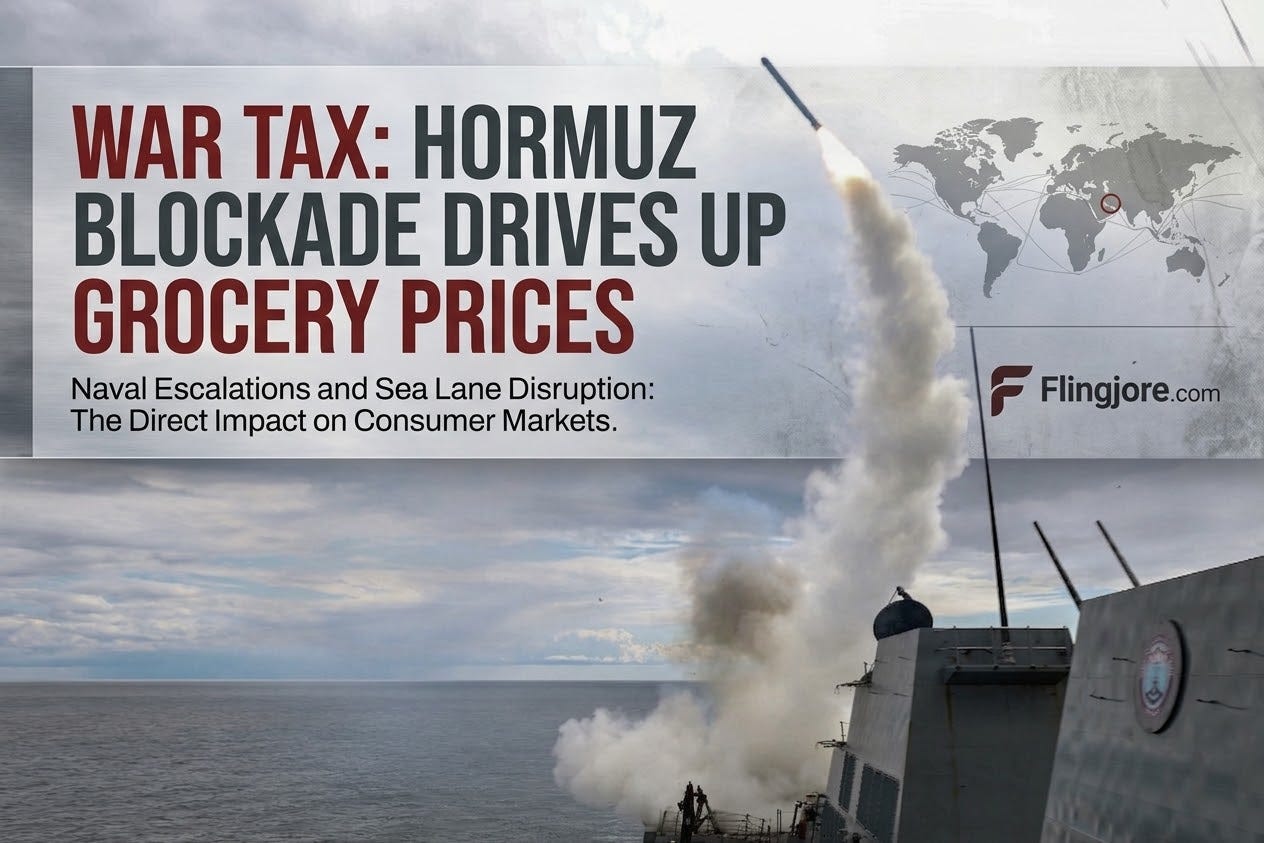
The disconnect between Washington’s economic dashboard and the American kitchen table reaches a fever pitch this week.
The Federal Reserve Bank of New York released its highly anticipated “Survey of Consumer Expectations”, the government’s primary barometer for household economic sentiment.
The report delivers a conclusion that stands in stark contrast to the reality currently locking into global commodities markets: American consumers, the official data claims, expect short-term headline inflation to drop to 3.5% over the coming year, with medium-term expectations holding flat at a cool 3.1%.
Under peacetime circumstances, this signals a policy victory — a sign that post-pandemic price surges are finally under control.
But the release does not reflect the current economy.
It functions as a statistical ghost, smoothing out the violent, real-time shocks of a global supply chain fracture.
We are now three months removed from the March 2 strikes on Tehran that effectively shuttered the Strait of Hormuz.
The spring planting season is over, the die is cast for domestic crop yields and the resulting supply chain paralysis which institutionalized a permanent War Tax on the American consumer.
Yet, the federal government’s most critical forward-looking economic indicator projects stability, signaling safety to policymakers while the physical economy absorbs the most significant agricultural and logistical shock of the decade.
This analytical lag arrives precisely as a critical federal blind spot materializes: the cessation of the government’s primary tool for measuring domestic starvation.
The convergence of aggressively optimistic inflation data, state-directed narrative management regarding the war’s fallout and a total blackout on official hunger statistics means the White House is flying blind into a domestic crisis of its own making.
The kinetic war in the Persian Gulf is actively funded at the American checkout counter, and the official monitors simply refuse to look.
Illusion of the Dashboard
The mechanics of the Fed’s survey are designed for peacetime stability, not wartime volatility.
The survey polls a rotating panel of approximately 1,300 household heads, aggregating their views on price changes for gas, food and housing.
By averaging the economic outlook of disparate demographic groups, the baseline data masks the brutal, K-shaped reality of the current inflationary spike.
While the headline number boasts a 3.5% inflation expectation, the internal data reveals a fractured society.
Behind the optimistic averages, the mean perceived probability of losing one’s job in the next 12 months jumps to 15.1%.
Independent polling directly contradicts the Fed’s rosy outlook on financial stability.
Nearly half of Americans report that their financial situation is worse today than it was a year ago — the highest level of economic pessimism recorded since January 2023.
The disparity is glaring.
The official report claims food inflation expectations sit near 5.8%, but real-time market data dictates a much harsher reality.
Over the past three months, the cost of agricultural inputs — specifically fuel and fertilizer — surges, creating a permanent war premium that the government models refuse to price into its long-term forecasts.
Credit card delinquencies hit their highest levels since the aftermath of the Great Recession.
The average perceived probability of missing a minimum debt payment rises to 12.6%.
The data tells a story of two Americas: one that absorbs the increased costs of the war premium through existing wealth; and another that actively drowns under the rising tide of basic necessities.
When energy prices jump 30% and groceries follow suit, the lower half of the economic spectrum runs out of margin.
The Fed’s dashboard smooths this suffering into a manageable curve, presenting a narrative of resilience that does not exist on the ground.
Invisible Blockade and the War Tax
The War Premium is no longer a theoretical concept warned about in March; it is a permanent line item on every shipping manifest leaving the Middle East.
Since the early spring escalation, maritime insurers effectively institute an invisible blockade by pricing risk out of reach for standard commercial vessels.
The Strait of Hormuz is only 21 miles wide at its narrowest point, yet it serves as the central artery for up to 30% of internationally traded fertilizers and a quarter of global seaborne oil.
Since the kinetic strikes began, maritime traffic through the strait faces a staggering 95% reduction.
This is not a temporary rerouting; it is a structural paralysis.
War-risk premiums, typically a fraction of a percent of a vessel’s value, remain inflated by more than 1,000%.
For a standard tanker or bulk carrier, this adds millions of dollars to the cost of a single voyage.
Shipping giants respond by diverting U.S.-bound cargo to alternative routes around the Cape of Good Hope, adding weeks to transit times, burning millions in additional fuel and stranding goods intended for the American market in transshipment hubs in North Africa or Asia.
This blockade dictates that even if a ceasefire in Tehran materializes tomorrow, the inflationary shockwave is already locked into the domestic logistics pipeline for the remainder of the calendar year.
The energy and agricultural inputs that arrive in June and July carry the exorbitant insurance and fuel costs incurred in April and May.
The consumer ultimately pays this War Tax at the pump and the grocery store, absorbing the geopolitical cost of the conflict directly into their household budget.
Nitrogen Cliff and the Spring Post-Mortem
While the Fed’s data reflects a managed economy, the physical agricultural supply chain flashes red.
The immediate threat to domestic food stability extends far beyond the price of crude oil.
The shuttered Strait of Hormuz chokes off the primary global supply of seaborne urea—a highly concentrated nitrogen fertilizer essential for American crop production.
The Middle East accounts for nearly half of all global urea exports.
With these shipments paralyzed during the critical spring transit window, the global fertilizer market faces a supply shock that makes the 2022 crisis look mild.
In the immediate aftermath of the March strikes, urea prices at the import hub in New Orleans spiked from approximately $450 to more than $600 a ton in a matter of days.
Urea futures today at the U.S. Gulf remain stubbornly elevated, trading around $425 a ton and sitting well above their pre-conflict baselines.
This logistical paralysis hit the American agricultural sector at the exact wrong moment.
The U.S. relies heavily on imported nitrogen to fuel its massive corn crop.
Because it takes roughly 30 days for a vessel to transit from the Gulf to the Port of New Orleans — and additional weeks to move that product up the Mississippi River on barges — the March blockade effectively severed the supply line just as the spring planting window opened.
We are now on the other side of that window, and the post-mortem is grim.
Farmers faced an impossible choice this spring: take on massive debt to purchase hyper-inflated fertilizer, or pivot away from nitrogen-intensive corn toward less demanding crops like soybeans.
This acreage shift and the massive assumption of debt is not simply a localized farming problem; it guarantees higher prices across the entire food sector.
A reduction in corn yields or a massive increase in the cost of producing that corn directly inflates the cost of livestock feed.
This locks in exorbitant prices for meat, dairy, and poultry well into 2027.
The global agricultural sector operates strictly on biological timelines; when a planting window is missed or under-fertilized due to a supply shock, the resulting crop deficit cannot be magically reversed by an interest rate cut in Washington.
The die is cast, and the American consumer is slated to pay the bill.
Narrative Pivot
As the domestic fallout from the Hormuz blockade becomes mathematically impossible to ignore, the narrative emerging from Washington shifts from denial to active expectation management.
A sudden, synchronized chorus of intelligence assessments and geopolitical think-tank analyses now frames the fertilizer squeeze and energy spikes not as failures of foreign policy, but as unavoidable theaters of great power competition.
Recent reports prominently warn that the disruption in the Strait of Hormuz creates a vacuum, allowing Beijing and Moscow to consolidate control over global agricultural supply chains.
Because Russia remains the world’s largest exporter of fertilizer and Belarus controls major potash reserves, the prevailing establishment narrative warns that adversarial nations are actively weaponizing the food supply.
This coordinated messaging serves a specific domestic purpose.
By framing the empty shelves and $6 eggs as the direct result of Russian and Chinese manipulation, policymakers deflect blame from the geopolitical strategies that ignited the Gulf conflict in the first place.
The War Tax is rebranded as a patriotic duty. The administration conditions the American consumer to accept the degradation of their standard of living as a necessary sacrifice for long-term national security.
The underlying hypocrisy is glaring.
The intelligence apparatus issues grave warnings about global food fragility to the press, while simultaneously executing a foreign policy that guarantees that exact fragility.
They prepare the public for the pain, ensuring that when the full weight of the agricultural shortfall hits the grocery store this fall, public anger is directed outward toward foreign adversaries rather than inward toward domestic policy failures.
Official Data Blackout
Perhaps the most alarming aspect of this crisis is the federal government’s deliberate refusal to measure the human toll.
As the cost of agricultural inputs skyrockets and the War Tax drains working-class budgets, the primary mechanism for tracking domestic fallout simply vanishes.
In late 2025, the U.S. Department of Agriculture quietly discontinued its annual “Household Food Security in the United States” report.
For three decades, this comprehensive survey served as the undisputed yardstick for measuring hunger in America.
It provided undeniable, empirical data on exactly how many families skipped meals, stretched rations, or relied on community food banks to survive.
The termination of the report, justified by administrative bureaucrats as a necessary move to reduce “redundant paperwork,” leaves both local policymakers and relief agencies entirely without a baseline.
The final data release from that program, covering 2024, showed that 13.7% of U.S. households — representing nearly 48 million Americans—lacked consistent access to adequate food.
Crucially, that baseline existed before the current war spiked the cost of fertilizer, fuel and transit.
Removing the yardstick does not eliminate the hunger; it merely transforms it into a hidden crisis.
The Trump administration effectively deletes the data just as the cost of basic survival reaches a breaking point.
Without official statistics to point to, the White House maintains plausible deniability.
Press secretaries can cite the Fed’s aggressively smoothed 3.5% inflation expectation while outright ignoring the cascading failure of the domestic food network.
They engineer a reality where the administration succeeds on paper, even as the working class starves in practice.
Colorado Front Range Reality Check
In the absence of federal data, local nonprofits and regional distribution networks serve as the nation’s only remaining early warning system.
Ground truth is found not in the sterile reports of the New York Fed, but on the loading docks of community relief organizations.
Along the Colorado Front Range, the reality of the War Tax is immediate, severe, and highly measurable.
Food distribution centers across the Denver metro area report a sustained 30% increase in first-time visitors over the last three months.
The volume of need is staggering, but the demographic shift is the true indicator of a systemic economic fracture.
Operators note a massive influx of dual-income households entering the relief system. These are not families traditionally categorized as vulnerable.
They are households that pay their mortgages, maintain steady employment, and own vehicles.
When the price of basic protein doubles and gasoline holds steady at $4.50 a gallon to accommodate the maritime war-risk premiums, these households watch their operational margin evaporate entirely.
Their wages completely decouple from the cost of their grocery bills.
This is the exact trajectory of the “War-to-Table” pipeline.
A kinetic strike in Tehran directly inflates the insurance premiums in the Persian Gulf. That premium drastically raises the cost of urea landing at the Port of New Orleans.
That specific logistical cost forces a farmer in Iowa to pivot their acreage away from corn, spiking the futures market for livestock feed.
Three months later, a dual-income family in Broomfield, Colorado, stands in line for a donated box of pasta because their budget can no longer absorb the geopolitical cost of Washington’s foreign policy.
The narrative of economic resilience touted by the federal dashboard is a carefully constructed, comforting fiction.
By relying on peacetime survey metrics to manage a wartime economy, orchestrating intelligence leaks to manage public anger, and systematically dismantling the tools required to track domestic suffering, the government makes a conscious choice to fly blind.
The 48 million uncounted, hungry Americans are not an anomaly; they are the direct, intended funders of a conflict they have no control over.
The dashboard says everything is fine, but the kitchen table knows the truth.