Warflation 2026: How the Iran Gamble Triggered a 1973-Style Economic Trap
Oil surges 20% as 53% of voters brace for a Wall Street crash following the "peace president’s" high-stakes decapitation strike in Iran.


One month after the United States and Israel launched a devastating decapitation strike against the Iranian leadership, the global economy is teetering on a razor’s edge.
As of Friday, the initial shock of Operation Epic Fury has transitioned into a grinding war of markets and munitions, leaving Americans to wonder if the administration’s high-stakes gamble will result in a strategic masterstroke or a generational financial collapse.
Crude oil prices, which spiked toward $120 a barrel earlier this month, have settled into a volatile range between $92 and $101. On Wall Street, the 10-year Treasury yield has pierced 5% for the first time since the 2008 financial crisis.
For an 18-year-old voter looking toward their first midterm election this November, the “Great American Fortress” promised by the White House is being tested by a phenomenon economist Steve Keen calls “Warflation”: a toxic cocktail of military spending, energy shocks and a pre-existing private debt bubble.
The Gamble: Operation Epic Fury
The current crisis traces back to February 28, 2026, when a series of precision strikes targeted the highest echelons of the Iranian state. Reports confirm that Supreme Leader Ali Khamenei was among those killed, an act intended to trigger an immediate collapse of the Islamic Republic.
Instead, the move has created a decapitation paradox.
While Secretary of State Marco Rubio insists the operation is “on or ahead of schedule” to destroy Iran’s missile and drone factories, the regime has proved surprisingly resilient.
By utilizing a pre-established succession system, Tehran has maintained enough control to effectively shut down the Strait of Hormuz, the world’s most critical oil chokepoint.
This closure is the spark for the current economic wildfire.
“This is what’s happened to oil prices today alone,” Keen noted in a recent briefing, highlighting a 9% daily leap that has sent shockwaves through global supply chains.
The administration’s fantasy was a quick surrender; the reality is a siege.
The Case for Doom: The Warflation Theory
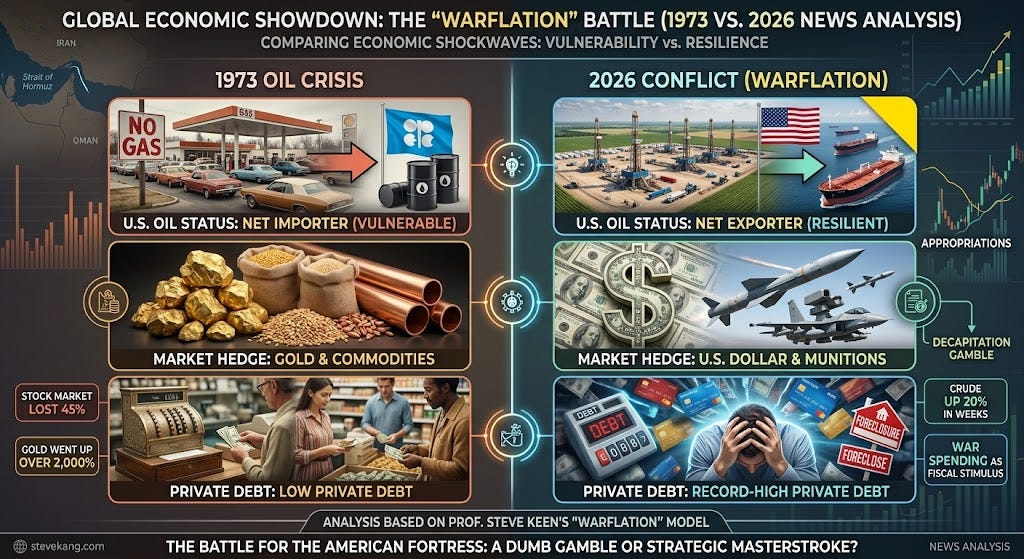
Professor Steve Keen argues that mainstream economists are “blind” to the true danger. Keen’s “Warflation” theory posits that the U.S. is repeating the mistakes of 1973, but with more fragile foundations.
In 1973, an oil embargo caused the stock market to lose 45% of its value while gold prices surged over 2,000%.
In 2026, the signals are eerily similar. Gold has already rocketed to $4,388 an ounce as investors flee a dollar they no longer view as untouchable.
”Whenever you have a conflict of this nature, people’s confidence in the financial system declines,” Keen warns. He identifies the “dumbest gamble” not just as the war itself, but the timing.
The U.S. entered this conflict with record levels of private debt.
As oil prices hike the cost of living, families already drowning in credit card and mortgage debt may finally snap, triggering a “Stagflation Depression” that combines the worst of 1929 and 1970.
Counter Point: The Fortress America Doctrine
Opposing Keen’s dark vision is the “Fortress America” doctrine championed by the White House and institutional analysts. They argue that 2026 is fundamentally different from the 1970s for one primary reason: Energy Independence.
The U.S. is now a net exporter of oil and gas. While higher prices hurt at the pump, they act as a massive “cash injection” for the American energy heartland.
States like Texas and North Dakota are seeing a boom in business activity, with the Dallas Fed Energy Survey showing a dramatic rebound in drilling sentiment.
The Trump administration is leaning into a “Munitions Multiplier.”
By pushing through an $840 billion defense budget, the government is effectively launching a massive industrial stimulus program.
For a young worker in a Rust Belt drone factory, the war isn’t a recession — it’s a job guarantee.
Political Fracture: The Peace President Betrayal
Perhaps the most unpredictable element of the 2026 crisis is the political blowback within the President’s own base.
Having campaigned as the peace president who would end forever wars, the invasion of Iran has sparked a civil war within the MAGA movement and other Republicans over most of President Trump's decisions.
Influential figures “America First” voters like Nick Fuentes have publicly said: “I’ve had it we’ve been conned.” Fuentes and AFPAC argue that the base was promised isolationism but given neo-conservative intervention.
This internal “regime change in American politics“ is gaining steam as the November midterms approach.
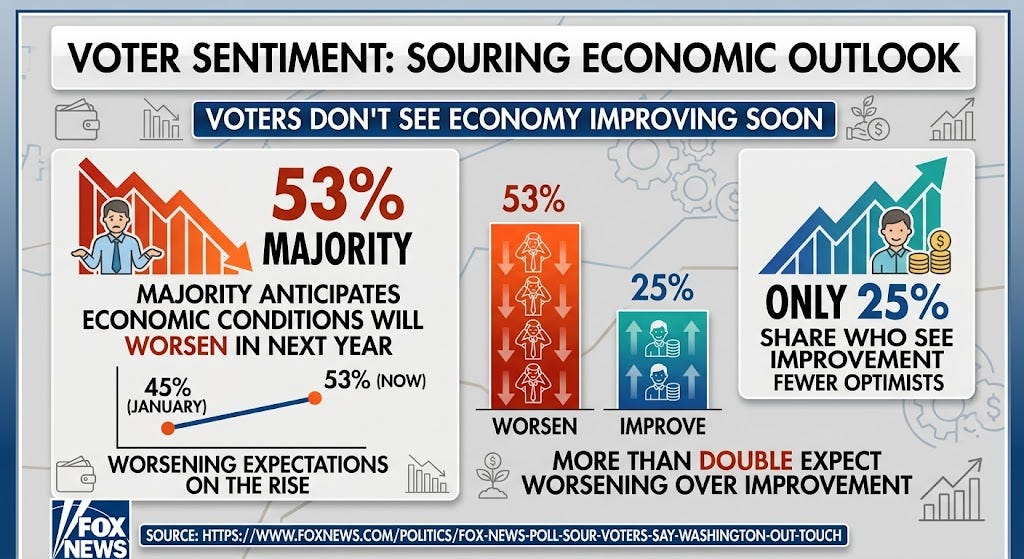
Voters do not see the economy getting better anytime soon as a 53% majority anticipates economic conditions will worsen in the next year, according to a recent Fox News poll, a standard measure for Trump.
This figure is up from 45% in January and stands at more than double the 25% share of respondents who see potential for improvement.
The survey further indicates that 53% of Americans believe the administration’s economic policies have actively made conditions worse, a sentiment that political analysts suggest is creating a perfect storm for Democrats, capable of flipping both the House and Senate in the upcoming 2026 midterm elections.
Global Stakes: Russia and the April 6 Deadline
While Washington and Tehran trade blows, Russia has emerged as an accidental winner.
High oil prices have rescued the Kremlin’s budget, allowing them to ramp up operations in Ukraine even as U.S. resources are diverted to the Middle East.
All eyes are now on the April 6 deadline.
The White House has offered a 15-point peace proposal, demanding that Iran fully open the Strait of Hormuz in exchange for a pause in strikes on power plants.
If Iran blinks, the “non-story” advocates will be proven right, and the markets may see a soft landing.
If they don’t, the world faces what Keen calls an “existential disturbance” for civilization, a conflict where the next escalation could involve nuclear red lines.
Interesting Times Ahead
As the calendar flips to April, the American public is living through a stress test of the modern world.
Whether 2026 is remembered as the year the American Fortress was solidified or the year the global debt bubble finally burst depends on whether munitions can truly outpace the crushing weight of markets.
For now, the only certainty is the old Chinese curse: “we are living in times that are far too interesting for our own good.”