


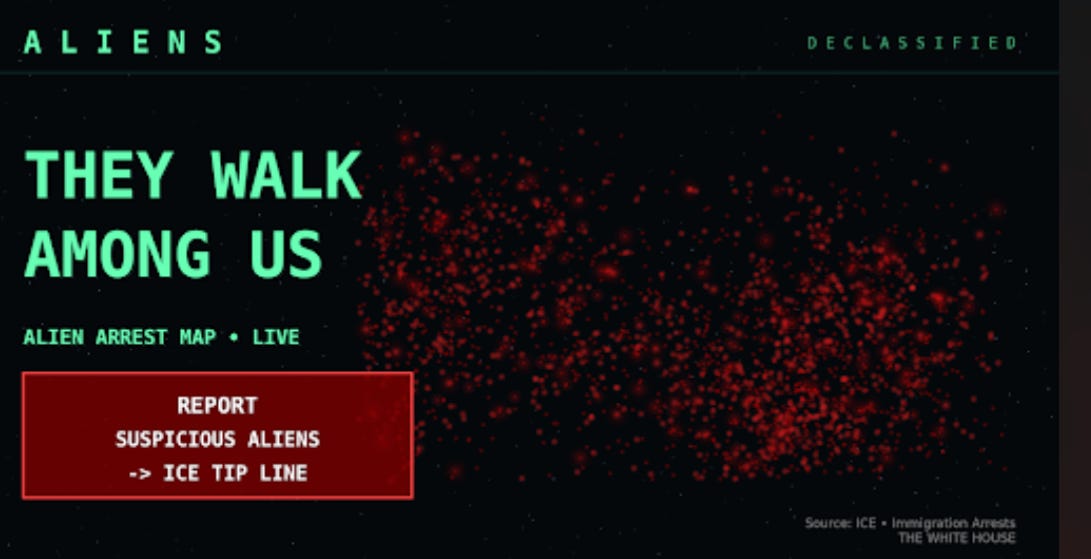
The White House launches a highly provocative digital portal late Thursday titled “Aliens.gov.” This government website tracks the arrests of unauthorized immigrants using the sensationalized, theatrical aesthetics of science fiction and UFO conspiracy theories.
The rollout, announced through official White House social media accounts, represents a stark escalation in the administration’s messaging surrounding its mass deportation initiatives. The campaign aggressively leans into the linguistic overlap between extraterrestrials and the federal legal designation for noncitizens. It draws immediate condemnation from civil rights groups, who argue the site weaponizes federal resources to dehumanize immigrant communities.
The initial post on X, formerly Twitter, published May 28 at 6:23 p.m. ET, features a darkened U.S. heat map glowing with red hotspots marking arrests. Above the map, glowing, neon-green text reads “AMONG US,” accompanied by the caption: “They don’t belong here. The truth has dropped. Aliens.Gov.”
Anatomy of the Digital Portal
The website greets visitors with cinematic, dark-mode graphics, falling stars evocative of space operas and glowing slogans. The user interface mimics a secure intelligence clearance dashboard, complete with simulated radar sweeps and static interference sound effects. The visual centerpieces feature rotating text modules declaring:
“THEY WALK AMONG US”
“THEY WEREN’T LITTLE GREEN MEN.”
The site then pivots sharply to clarify that the “aliens” in question are undocumented immigrants targeted by U.S. Immigration and Customs Enforcement, or ICE.
In a section stylized as a “Classified Addendum • Declassified 2026,” the site adopts an urgent, whistleblower tone:
“These ‘Aliens’ are the millions of ILLEGALS who invaded our country under the cover of darkness. President Trump told the truth. The cover-up is over. Secure the border. Deport them all.” — Aliens.gov
Another graphic explicitly mocks UFO abduction tropes, stating: “If you’ve witnessed an Alien abduction, do not be alarmed. The Alien is in good hands. We will take care of it ... and return it safely to its place of origin.”
The administration’s choice of words and visual presentation, frequently associated with UFO disclosure culture, attracts instant attention to the site’s rollout approach. Online users initially speculate that the website might connect to declassified government records pertaining to mysterious flying objects and the idea of the U.S. holding secrets of extraterrestrial encounters. Instead, the portal functions as a fully operational law enforcement dashboard wrapped in internet meme culture.
Gamification of Law Enforcement Data
A central feature of the platform is a live, interactive “Alien Arrest Map” detailing real-time ICE operations, alongside a prominent counter tracking millions of nationwide encounters. The website’s live ticker prominently displays 3.1 million nationwide “encounters.” This specific figure correlates precisely with a Homeland Security Republican committee report detailing border operations and encounters nationally during the previous Trump term.
Beneath the sci-fi framing, a large, red module prompts citizens to report individuals in their communities. It provides a direct link reading “REPORT SUSPICIOUS ALIENS → ICE TIP LINE,” which connects to the official ICE web form and phone system. The interactive map allows users to zoom into different states and cities to view granular information about local arrests. The data includes the number of arrests, dates, alleged criminal charges, countries of origin, and suspected gang affiliations connected to detainees.
The site operates in tandem with a coordinated, searchable Department of Homeland Security platform dubbed “Worst of the Worst.” That database aggregates the names, photos, nationalities, and criminal histories of arrested individuals, presenting them in a highly visible public format. By applying elements of gamification and sci-fi paranoia to live law enforcement data, the Aliens.gov portal marks an unprecedented departure from standard U.S. government communications.
Strategic SEO Diversion
The White House lays the groundwork for this digital rollout months in advance. A DefenseScoop investigation reveals the administration quietly registers the domains Aliens.gov and Alien.gov back in March 2026. This move perfectly times the acquisition with the Department of Defense’s public directives regarding Unidentified Anomalous Phenomena, or UAP, disclosure. When pressed on the domains at the time, a White House spokesperson simply replies, “Stay tuned!” accompanied by an alien emoji.
By co-opting the aesthetic of UFO disclosure—which dominates news cycles and congressional hearings under the official UAP designation—the administration engineers a massive search-engine optimization, or SEO, diversion. The strategy actively redirects internet traffic surrounding extraterrestrial curiosity toward a hardline domestic enforcement agenda. The White House intentionally blurs the line between public interest in government UFO secrets and its own immigration crackdown, trapping critics and curious citizens alike in a semantic maze.
A White House official explicitly confirms to Fox News Digital that the theatrical aesthetic is intentional. The official frames the portal as a first-of-its-kind effort to draw eyeballs to the fact that the previous administration’s porous border didn’t just put families in border states at risk, but left communities across the country vulnerable. The administration calculates that bypassing traditional, dry government communications with viral, meme-ready content guarantees maximum exposure.
Semantic Shifts and the History of Title 8
Historically, U.S. government portals with a .gov designation bind themselves to strict protocols of institutional neutrality. The launch of Aliens.gov actively subverts that norm, adopting the aesthetics of video games, tabloid journalism, and hacker culture.
Under Title 8 of the United States Code, “alien” serves historically as the statutory term for any person who is not a citizen or national of the United States. While recent administrations move away from the term in federal communications—often directing agencies to replace it with “noncitizen” or “migrant” due to its pejorative connotations—this campaign explicitly resurrects and weaponizes the word’s extraterrestrial double meaning.
The administration relies on this legal definition as a shield against criticism. When advocates accuse the White House of using dehumanizing language, officials point to the U.S. Code, arguing they are merely utilizing precise statutory terminology. This semantic gamesmanship allows the administration to execute a highly provocative cultural stunt while maintaining a veneer of legal propriety.
Furthermore, the specific glowing text “AMONG US” featured in the White House’s initial post mirrors the visual and thematic elements of the popular social deduction video game of the same name. In the game, players must identify hidden “imposters” who sabotage a crew. The administration draws a direct, albeit implicit, parallel: undocumented immigrants are the “imposters” secretly sabotaging the American public, and it is the civic duty of the population to root them out.
UFO Culture as a Political Shield
The timing of the website’s launch capitalizes on a cultural moment where public fascination with UFOs and government cover-ups reaches a fever pitch. Earlier in the year, the administration directs federal agencies to begin declassifying more UFO-related materials, stoking public anticipation for major extraterrestrial revelations. By launching Aliens.gov in this climate, the administration effectively hijacks a legitimate cultural and scientific discourse.
The website explicitly blames previous leaders for the immigration crisis using the exact rhetorical structure of UFO disclosure advocates. The site states:
“Countless presidents, congressmen, and senior officials knew exactly what was happening. Instead of protecting American citizens, they chose to cover it up and even accelerate the invasion. Until one man finally had the courage to tell the truth.” — Aliens.gov
This language positions the administration not just as a law enforcement entity, but as a group of whistleblowers revealing a grand, decades-long conspiracy. It taps into the deep-seated anti-institutional paranoia that fuels much of modern internet culture, redirecting that distrust away from the current administration and toward undocumented immigrants and past political leaders.
Mechanics of Digital Vigilantism
Beyond the rhetoric, the core functionality of Aliens.gov raises profound civil liberties concerns. The inclusion of a highly visible ICE tip line, framed within the context of reporting “suspicious aliens” who “walk among us,” essentially crowdsources law enforcement surveillance.
This model of digital vigilantism encourages citizens to view their neighbors with suspicion. By providing an interactive heat map, the government gamifies the surveillance of immigrant communities. Users track arrests in their own zip codes, creating a feedback loop of anxiety and hyper-vigilance. The transition from a passive consumer of government data to an active participant in ICE enforcement represents a sophisticated evolution in state surveillance tactics.
Critics argue that this interactive model inevitably leads to an increase in racial profiling. When the government explicitly encourages the public to identify hidden “imposters” based on the premise that they do not belong, it creates a volatile environment for all marginalized communities, regardless of actual citizenship status. The system relies entirely on public perception, rewarding suspicion while bypassing the evidentiary standards required of formal law enforcement agencies.
Backlash and Civil Rights Response
Immigration advocacy groups and civil rights organizations immediately condemn the websites following Thursday’s launch. Advocates argue that by literally equating human beings with alien invaders from another planet, the federal government strips undocumented immigrants of their basic dignity and legal humanity.
Legal scholars escalate their condemnation as the site gains viral traction. Speaking to the local Fox affiliate KTVU, UC Berkeley professor of race and constitutional law Ian Haney Lopez characterizes the platform as an exercise in “sugar-coated racism” and “dog-whistle politics.” Lopez notes that the administration weaponizes fearmongering against vulnerable populations, masking deeply prejudiced policies behind the veneer of internet humor and science fiction tropes.
The human cost of these enforcement measures remains stark. As the website goes live to massive digital fanfare, real-world tensions escalate. Reports indicate that migrants housed in facilities, such as the Delaney facility in New Jersey, actively engage in hunger strikes, protesting their treatment and conditions amid escalating violence by guards. Advocates emphasize the jarring disconnect between the administration’s flashy, sci-fi-themed digital rollout and the grim, physical reality of those detained within the system.
Trump Administration’s Defense of Public Transparency
Despite the severe backlash, the administration remains steadfast, framing the sweeping digital campaigns as a landmark victory for public transparency. White House officials assert the platforms provide the public with a direct, unfiltered view of the administration’s mass deportation initiatives and border security efforts.
Supporters of the administration’s immigration policies defend the website, arguing it successfully modernizes government data sharing. They maintain that the viral-style branding is a necessary tool to draw attention to border security and deportation efforts, cutting through the noise of a crowded media landscape. From the administration’s perspective, standard press releases and dry data reports fail to capture the public’s attention; Aliens.gov succeeds precisely because it is provocative.
The administration views the outrage from civil rights groups not as a setback, but as a secondary mechanism for generating publicity. The condemnation fuels news cycles, drives traffic to the website, and amplifies the administration’s core message regarding strict border enforcement. Every outcry effectively acts as free marketing for the portal.
Future of State Communication
The Aliens.gov portal signifies a radical shift in how the state communicates its enforcement powers. Instead of playing defense on controversial policies, the administration goes on the offensive with an engineered cultural diversion.
When the government utilizes tropes from video games and science fiction to sanitize mass deportation, it redefines the boundaries of institutional messaging. The portal not only tracks enforcement but actively encourages digital vigilantism, urging citizens to participate in the spectacle.
As the debate over Aliens.gov intensifies, the campaign stands as a profound example of how state authority can co-opt digital culture. It transforms the severe, often tragic reality of law enforcement and human migration into a dark, interactive performance, signaling a new era where government policy and internet meme culture are virtually indistinguishable.