White House Terrorism Strategy Targets Domestic Political Groups
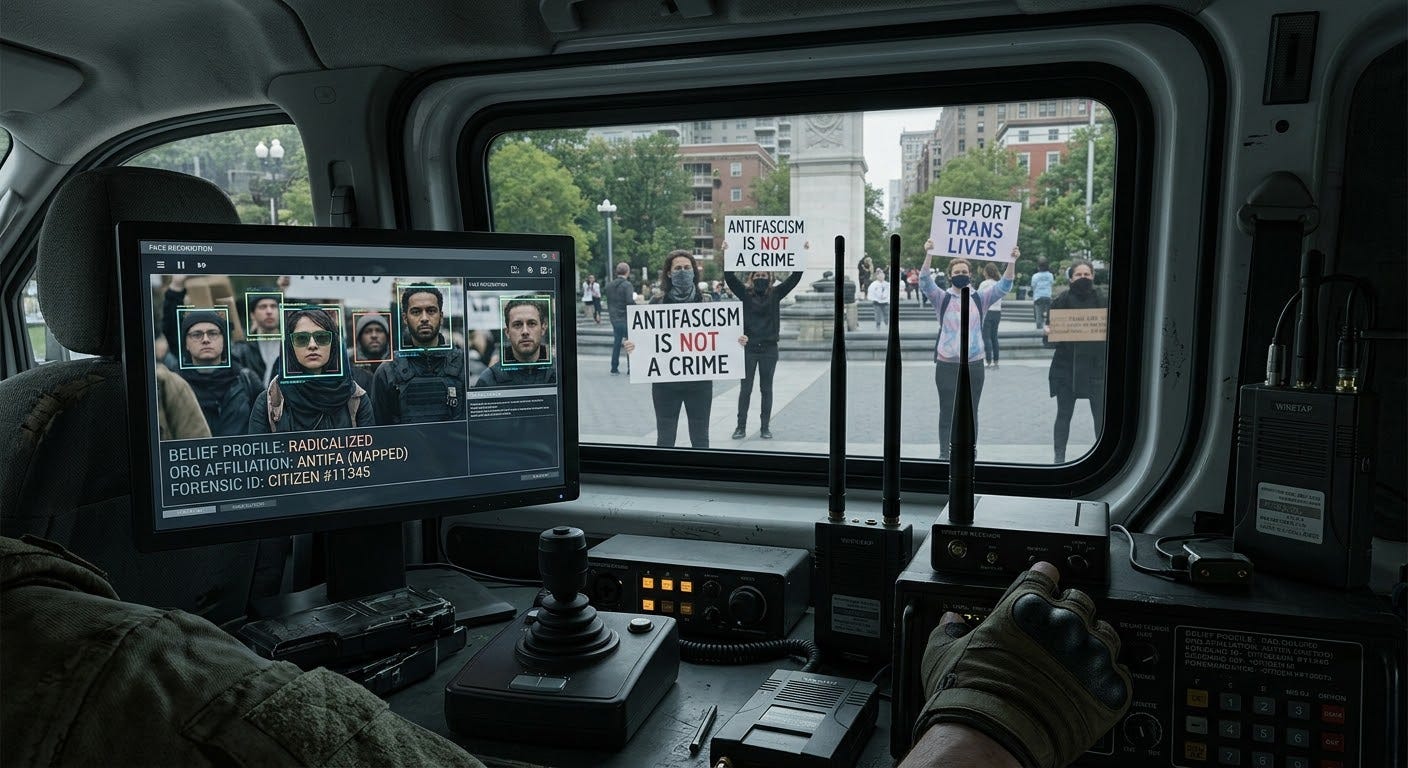
The 2026 framework removes right-wing extremism from its threat list, redirecting international surveillance tools toward anti-fascist organizations.
The White House released its 2026 Counterterrorism Strategy, fundamentally restructuring the federal government’s definition of domestic enemies while claiming credit for sweeping global military and diplomatic operations. The 16-page document formally elevates domestic ideological opponents to the exact threat level as transnational drug cartels and global jihadist networks, triggering intense historical and legal scrutiny regarding the weaponization of state power.
Forensic analysis of the document reveals a profound taxonomic shift in how the nation defines terrorism. While the first half of the strategy details kinetic military operations abroad, the second half commits the U.S. national security apparatus to mapping, surveilling and neutralizing domestic political activists at home.
The strategy relies heavily on mapping the legal, financial and surveillance tools historically reserved for dismantling billion-dollar cartels onto domestic civil society, raising alarm among historians and legal scholars.
A Posture of Global Dominance
Before addressing the domestic homeland, the strategy outlines a sprawling, aggressive global posture that the foreword describes as a return to “common sense and Peace through Strength.”
The document asserts that the administration “ended the war in Gaza, secured the release of all remaining hostages and began the process of ensuring Gaza can no longer serve as a haven for terrorism and extremism by bringing security and prosperity to the region through the Board of Peace.” It claims the administration brings back 106 American hostages from foreign captivity without paying ransom and notes the apprehension of the “mastermind of the attack on Abbey Gate” within 43 days of the administration taking office.
Globally, the strategy outlines heavy military actions against state sponsors of terror. The text cites kinetic operations, specifically “Operation Midnight Hammer” and “Operation Epic Fury,” declaring these strikes deal “devastating blows to the world’s number one state sponsor of terror, the sinister regime in Iran, to ensure they can never have a nuclear weapon.”
The administration also outlines a campaign against the “top five Islamist terror groups,” specifically prioritizing the destruction of al Qaeda in the Arabian Peninsula (AQAP) and ISIS-Khorasan (ISIS-K). The document weaponizes the foreign terrorist organization (FTO) designation against the Muslim Brotherhood, aiming to maintain pressure “until global MB enterprises can no longer recruit and fund terror against the United States.”
To combat state actors, the strategy mandates overt actions, including sanctions and “shadow fleet oil tanker interdiction,” alongside covert operations targeting dual-use technologies, advanced conventional weapons and the precursor chemicals utilized in narcotics manufacturing. The text also places special strategic emphasis on the threat of non-state actors acquiring weapons of mass destruction, specifically nuclear or radiological devices, citing mandates laid out in NSPM-35 and NSPM-36.
The Taxonomic Shift
Following this detailing of global military dominance, the strategy pivots to the Western Hemisphere and the domestic homeland. On page five, the strategy outlines three primary threat categories. The administration identifies “Narcoterrorists and Transnational Gangs” alongside “Legacy Islamist Terrorists.”
However, the strategy replaces the historically recognized threat of right-wing and white nationalist extremism with a new third pillar: “Violent Left-Wing Extremists, including Anarchists and Anti-Fascists.”
Public historian Tad Stoermer provides a forensic critique of this framework, demonstrating that the document abandons action-based threat models in favor of belief-based targeting.
”Right-wing and white nationalist violence is not minimized in the new strategy,” Stoermer notes in his analysis of the text. “It’s gone. The category that DHS and FBI analysts under Republican and Democratic administrations... repeatedly identified as the largest source of domestic terror fatalities has been removed from the threat picture.”
In its place, the strategy targets four distinct groups. The text defines these targets as “violent secular political groups whose ideology is anti-American, radically pro-transgender and anarchist,” alongside “international organizations like Antifa.”
Stoermer argues the replacement category is defined “not by what people do but by what they believe.”
The strategy commits the intelligence and law enforcement apparatus of the United States to a sweeping domestic surveillance mandate. On page seven, the document states the government mobilizes to “map them at home, identify their membership, map their ties to international organizations like Antifa and use law enforcement tools to cripple them operationally before they can maim or kill the innocent.”
Weaponizing the Cartel Playbook Against Citizens
The strategy draws a direct operational equivalence between dismantling massive transnational cartels and surveilling domestic political activists. However, the text outlines starkly different methodologies for handling these two categories.
For the cartels, the document frames the mission as a military and financial campaign under a modern Monroe Doctrine the document titles the “Trump Corollary.” The text champions “Operation Absolute Resolve,” which the administration notes successfully captures “narco-terrorist outlaw Venezuelan dictator Nicolás Maduro,” bringing him to the United States to face justice.
The foreword highlights the deployment of the military to “stop and destroy their operations.” It celebrates Department of War strikes on cartel drug boats—claiming a 90 percent decrease in maritime smuggling—and utilizes FTO designations to strangle the logistical and financial sinews of borderless syndicates.
In stark contrast to the kinetic military strikes utilized against cartels, the strategy outlines a surveillance-heavy, domestic law enforcement approach to anti-fascists, anarchists and “radically pro-transgender” groups.
Legal and national security experts warn that mapping international counterterrorism tools onto domestic groups fundamentally rewrites the American social contract. A forensic legal analysis published by Just Security notes that the FTO framework the administration relies upon is “deliberately constructed to maximize governmental power against international terrorist threats.”
Applying this framework to decentralized domestic movements bypasses constitutional protections. By categorizing domestic activists under the same FTO frameworks used to bankrupt transnational cartels, the government subjects citizens to financial ruin and federal wiretapping.
”An FTO designation would also seamlessly integrate Antifa into America’s most sophisticated surveillance infrastructure,” the Just Security analysis concludes. Under the Foreign Intelligence Surveillance Act (FISA), the government routinely conducts electronic surveillance on anyone deemed an “agent” of a designated power. Experts warn that utilizing executive memos—such as the recently issued NSPM-7—allows the Joint Terrorism Task Forces (JTTFs) to weaponize financial intelligence to investigate civil society groups, nonprofits, activists and donors under the guise of stopping organized political violence.
Stoermer draws sharp distinctions between these two targets, rejecting the administration’s strategic equivalence entirely.
”Cartels and anti-fascists are not the same problem,” Stoermer states. “Anyone telling you that they are is not solving a problem. They’re building one.”
The Historical Precedent of State Overreach
The historian contextualizes the document within a long trajectory of American state overreach. He compares the document’s mandate to historical abuses of federal power, including the Alien and Sedition Acts, the Palmer Raids, the Red Scare, the Lavender Scare, McCarthy’s loyalty boards, J. Edgar Hoover’s COINTELPRO and the post-9/11 surveillance regime.
”When the authors of a counterterrorism document treat opposition to fascism as a category to be mapped, surveilled and broken, they’re telling you what they expect to need protection from,” Stoermer argues.
He points out that historical records repeatedly demonstrate how “men with state power decided that dissent was subversion, that protest was extremism, that political opponents were threats.”
”The country eventually figured out it had been lied to, but by the time it did, real people had lost real years, real careers and in some cases, their lives,” Stoermer notes.
The strategy explicitly acknowledges the dangers of politicized intelligence, paradoxically dedicating its introduction to criticizing previous administrations. The document claims former leaders use the U.S. government to “politically target individuals,” insisting that under the new strategy, “counterterrorism powers will not be used to target our fellow Americans who simply disagree with us.”
It asserts the national security apparatus must remain “uninfected by politics” and demands that those who abuse counterterrorism powers “pay the full judicial cost for their crimes against the civil rights of innocent Americans.”
Yet the text subsequently links “extreme transgender ideologies” directly to the “assassination of Charlie Kirk,” utilizing this specific incident as justification to prioritize the rapid identification and neutralization of secular political groups.
Structural Flaws and Executive Tone
Stoermer questions the seriousness and the competence of the national security apparatus overseeing this rollout. The forensic analysis reveals structural flaws in the document’s publication. Stoermer points out that the strategy “ships with four uncorrected typos” and features “no defined terms for any of its targeting categories.”
Furthermore, he notes the rollout briefing features Sebastian Gorka using the official platform to refer to critics of the administration’s Iran policy as “testicularly challenged.”
The strategy’s foreword establishes an aggressive, extrajudicial tone. It features a quote from the president outlining his promise to enemies: “We will find you and we will kill you.” The document asserts that “terrorists of any kind will not be allowed to find safe harbor here at home.”
Stoermer concedes that true political violence—whether individuals bomb a building, shoot someone, or conspire to harm—demands strict prosecution.
”The United States has never lacked laws for any of that,” Stoermer says. “What it lacks is the discipline to stop calling political opposition terrorism.”
He outlines the fundamental rights the document threatens to categorize as extremist.
”Anti-fascism is not a crime. Supporting trans people is not a crime. Criticizing the United States, it’s not a crime. Telling the truth about American history, it’s not a crime,” Stoermer states.
By placing cartels, fentanyl and state-sponsored attacks into the “same bucket as ideological opponents,” Stoermer warns, the administration demands the country applaud while the regime “reaches for power it wasn’t given.”
”The seriousness is not there. The intelligence is not there. The targeting, though, is there,” Stoermer concludes. “Historians know what this is, and it’s not new. And what’s also not new is where it leads.”