

Why the Civil Rights Division is suing over Second Amendment protections
Administration’s lawsuit against the U.S. Virgin Islands isn’t just about warrantless searches; it’s a proof-of-concept for weaponizing federal power against the administrative state.

The U.S. Department of Justice filed a sweeping lawsuit against the U.S. Virgin Islands on Tuesday, marking a decisive escalation in the federal government’s campaign to nationalize Second Amendment standards.
The complaint, which targets the territory’s police department and restrictive permitting regime, represents more than a dispute over firearms.
The complaint serves as the kinetic opening of a broader strategy to reorient the Civil Rights Division toward the protection of gun ownership, testing the reach of the Constitution against the precarious legal status of America’s unincorporated territories.
The lawsuit, filed in U.S. District Court, accuses the Virgin Islands government, its police department, and Police Commissioner Mario Brooks of systematically obstructing American citizens’ rights to possess and carry firearms.
By challenging the territory’s requirement for applicants to prove “good moral character” and submit to warrantless home inspections, the Department of Justice (DOJ) is applying the Supreme Court’s New York State Rifle & Pistol Association v. Bruen standard to a jurisdiction that operates under a unique colonial framework.
This legal collision offers the first clear evidence of the administration’s intent to operationalize the conservative legal theories outlined in policy blueprints such as Project 2025.
By deploying the Civil Rights Division — traditionally the vanguard for voting rights and anti-discrimination enforcement — to dismantle local gun control, the administration is establishing a new precedent: the Second Amendment is a fundamental civil right, and the federal government will use its full weight to enforce it, even across the complex legal geography of the Caribbean.
Federal complaint: dismantling the May-Issue regime
The government’s filings paint a picture of a regulatory environment designed to make legal gun ownership functionally impossible.
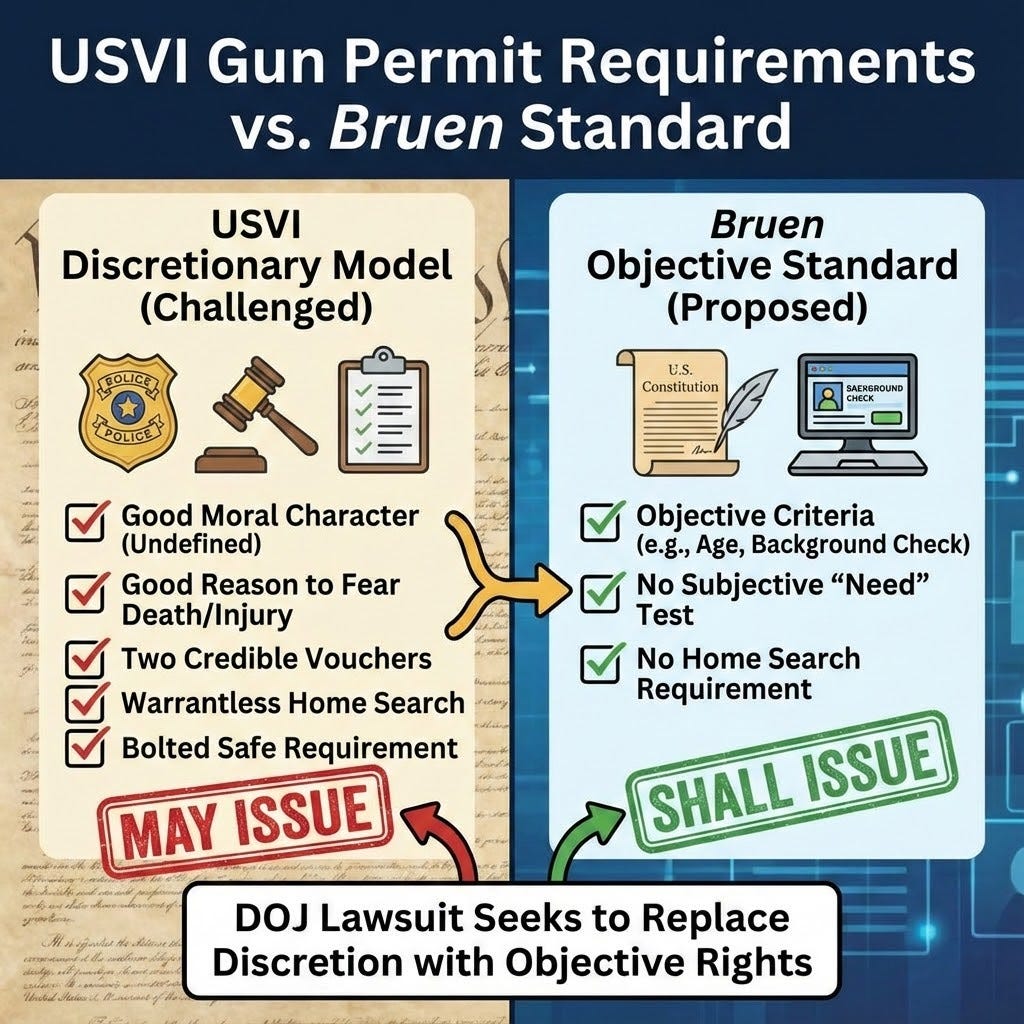
The Trump administration alleges that the Virgin Islands’ licensing system relies on subjective preconditions rather than objective qualifications, a direct violation of the Bruen decision, which invalidated May-Issue regimes that granted officials broad discretion to deny permits.
According to the complaint, the territory requires applicants to demonstrate “good reason to fear death or great injury to his person or property.”
This “need-based” standard mirrors the New York law struck down in 2022.
Furthermore, the territory requires “two credible persons” to vouch for the applicant’s need for a firearm, a third-party veto that the DOJ argues has no historical analogue in American tradition.
Most contentiously, the lawsuit targets the territory’s “moral character” clause.
The complaint notes that “no specific standard has been set or defined” for what constitutes good character under USVI Code, allowing the police commissioner to deem individuals “improper persons” without procedural recourse.
The DOJ argues this lack of definition transforms a constitutional right into a privilege granted at the whim of the state.
The complaint also highlights the operational hurdles imposed on applicants, specifically the requirement to “submit to intrusive and warrantless home searches” as a condition for a permit.
The federal government argues that conditioning Second Amendment rights on the surrender of Fourth Amendment protections creates an unconstitutional dilemma for citizens.
The lawsuit further details requirements for applicants to install expensive safes bolted to the building structure, creating a financial barrier to entry that the DOJ characterizes as a poll tax by another name.
Strategic shift: Civil Rights Division pivot
The filing signifies a profound structural shift within the Department of Justice, aligning with long-standing conservative objectives to reshape the federal bureaucracy.
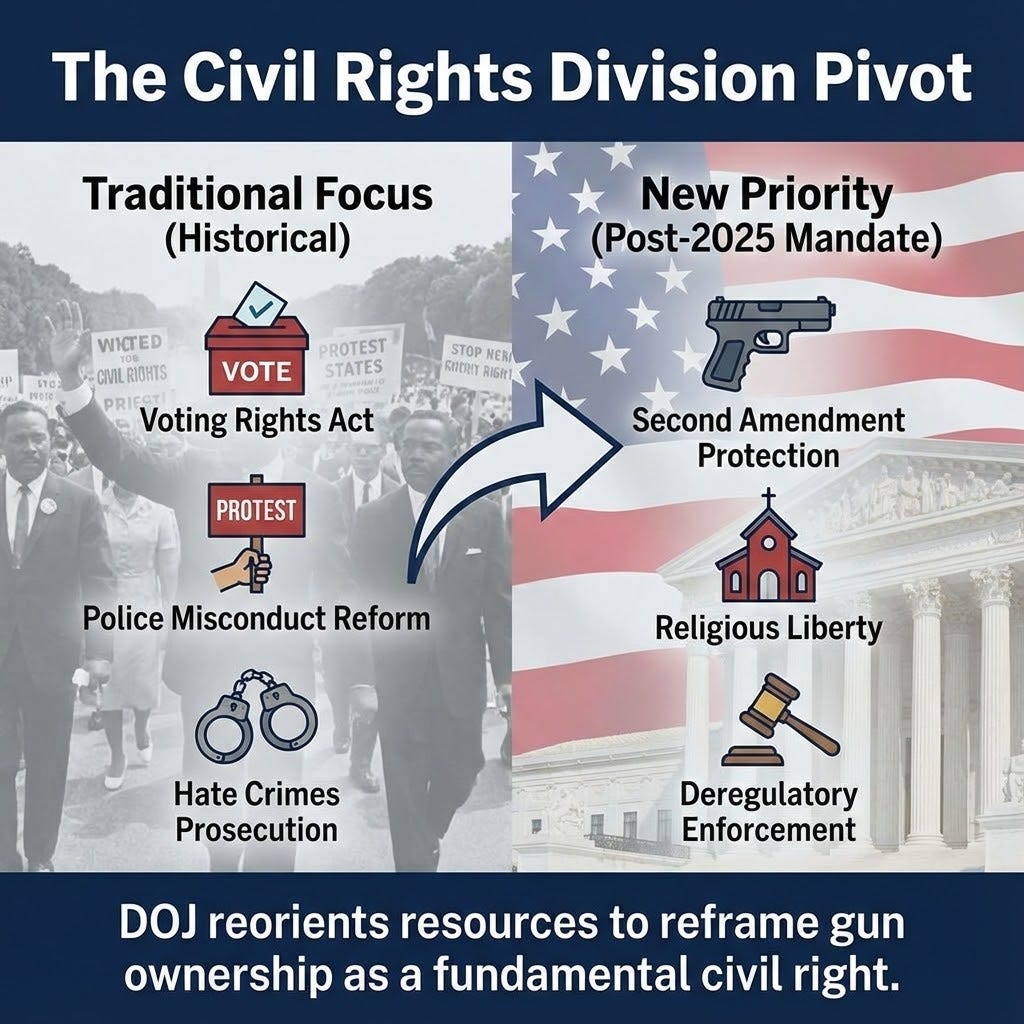
For decades, the Civil Rights Division has focused primarily on investigating systemic police misconduct, ensuring compliance with the Voting Rights Act, and prosecuting hate crimes.
This lawsuit signals that the protection of the Second Amendment is now a co-equal priority for the division.
Legal analysts point to this pivot as the practical application of theories espoused in the Mandate for Leadership, a policy framework that argues the Civil Rights Division has historically neglected the constitutional rights of gun owners and religious organizations.
By framing gun ownership as a civil rights issue, the administration effectively bypasses the traditional political arguments regarding public safety, reframing the debate entirely around liberty and equal protection.
This strategy forces a complex political realignment. It utilizes the machinery of federal oversight — often decried by conservatives when applied to local police departments or environmental regulations — to override local governance in service of deregulation.
It creates a paradigm where the “Unitary Executive” utilizes federal supremacy to enforce a libertarian interpretation of the Bill of Rights, crushing local administrative states that attempt to maintain stricter controls.
The Insular Cases and the colonial paradox
The location of this legal battle is not incidental.
By choosing the U.S. Virgin Islands as the test case, the DOJ is forcing a confrontation with the Insular Cases, a series of Supreme Court rulings from the early 20th century that defined the constitutional status of U.S. territories.
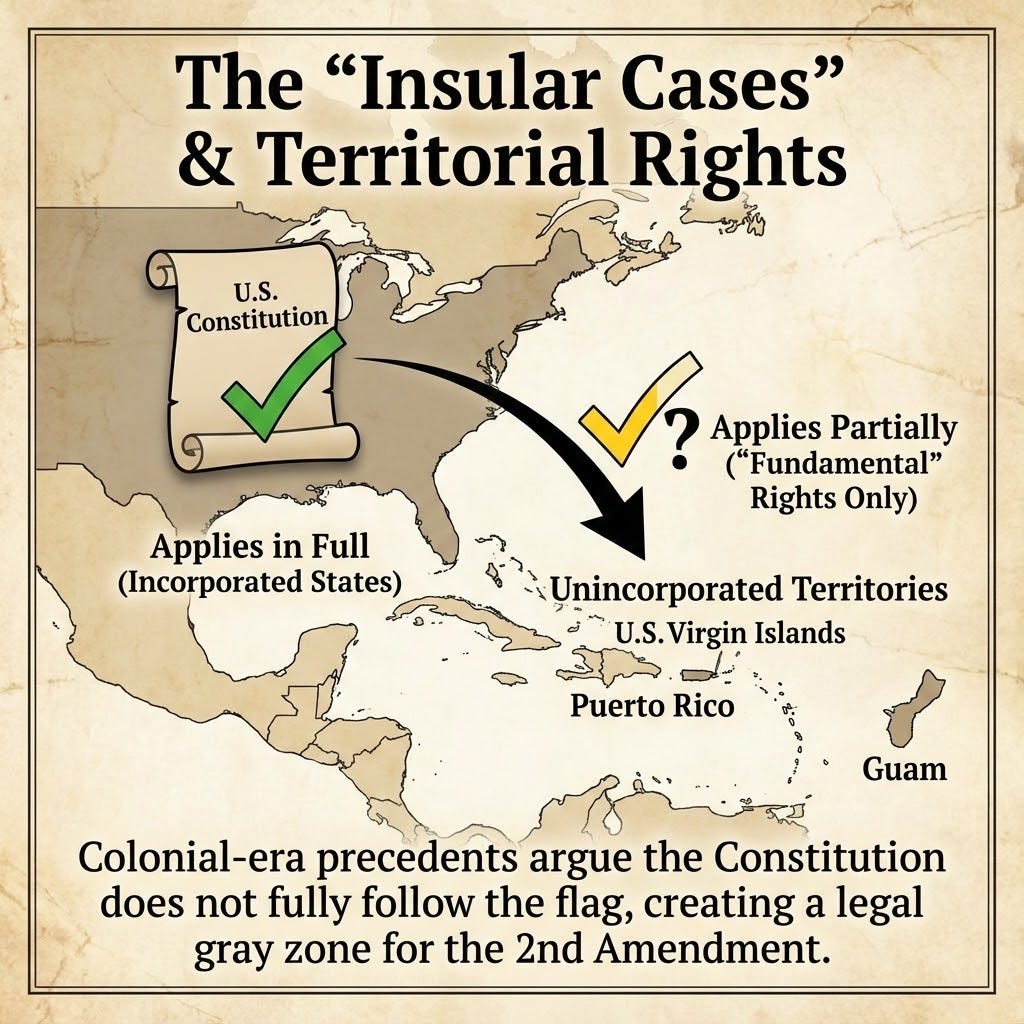
These cases established the doctrine of “territorial incorporation”, holding that the Constitution applies “in full” only to incorporated territories destined for statehood (like the Arizona or New Mexico territories of the past). For “unincorporated” territories like the Virgin Islands, Puerto Rico, and Guam, only “fundamental” rights apply.
Historically, the Insular Cases were justified by explicit racial reasoning, with the Court arguing that “alien races” in the new territories were incapable of understanding Anglo-Saxon legal principles.
In a dark irony, the Virgin Islands government may be forced to rely on these imperialist precedents to defend its gun laws.
The defense could argue that the Second Amendment’s strict prohibition against “interest balancing” — the idea that courts cannot weigh public safety benefits against the burden on rights — should not apply in an unincorporated territory with a unique legal history.
They may posit that the “Constitution does not follow the flag” in its entirety, and therefore, the territory retains the police power to regulate weapons more strictly than a state like Ohio or Florida.
This creates a high-stakes gamble for the administration.
A victory would solidify the universality of the Second Amendment, effectively erasing the distinction between state and territory regarding the Bill of Rights.
A loss, however, would validate the Insular Cases, reinforcing the second-class citizenship of territorial residents and creating a permanent constitutional carve-out where rights are conditional based on geography.
Bruen test and the problem of history
The lawsuit will inevitably turn on the application of the Bruen “history and tradition” test.
Under this standard, the government must demonstrate that a modern gun regulation is consistent with the nation’s historical tradition of firearm regulation, specifically looking at the periods around 1791 (ratification of Second Amendment) and 1868 (ratification of Fourteenth Amendment).
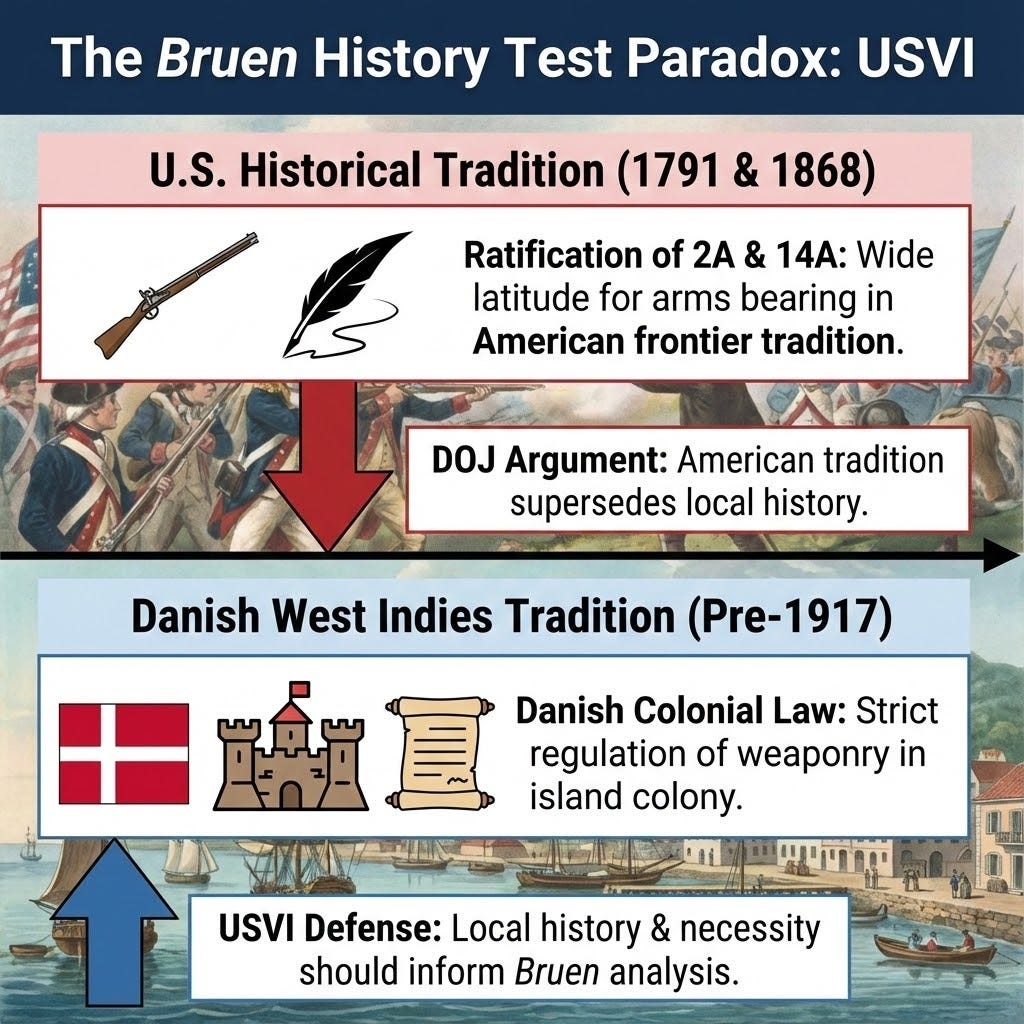
This test presents a unique intellectual conundrum when applied to the Virgin Islands. In 1791 and 1868, the islands were the Danish West Indies, governed by Danish colonial law, not the U.S. Constitution.
The territory did not come under American jurisdiction until its purchase in 1917.
The DOJ will argue that the relevant history is the American tradition, which supersedes local custom upon the transfer of sovereignty.
The Virgin Islands, however, may argue that imposing 18th-century American frontier standards on an island culture with a distinct legal lineage constitutes a form of “legal imperialism.”
They could contend that their “history and tradition” involves strict regulation of weaponry — a necessity in a small island environment — and that Bruen should respect the local historical context.
The theme of Civilizational Erasure comes into full view.
If the court rules that the specific history of the Danish West Indies is irrelevant, and that only the history of the continental United States matters, it effectively declares the local history legally null and void.
It asserts that to be American is to inherit a specific 1791 English common law tradition, regardless of the actual history of the land in question.
Administrative state as defendant
Beyond the constitutional questions, the lawsuit is a direct assault on the administrative state — the layer of bureaucracy that manages governance through discretion and regulation.
The specific targets of the suit are the mechanisms of bureaucracy: the processing times, the undefined character references and the scheduling of home inspections.
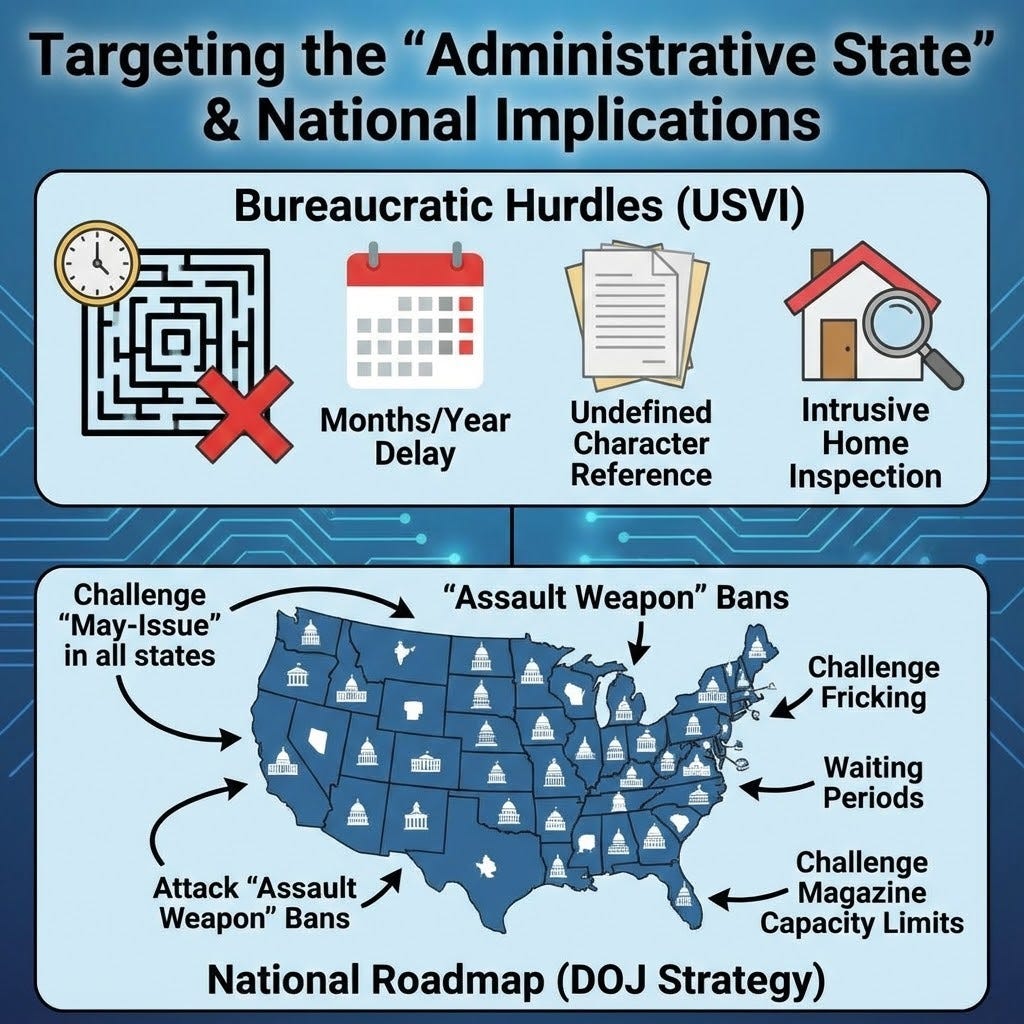
The complaint alleges that the Virgin Islands police department uses bureaucratic friction as a weapon.
By making the process take “several months to a year to schedule and complete,” the territory engages in a “pocket veto” of rights.
The DOJ’s argument frames delay as denial.
This aligns with a broader judicial movement to curtail the power of administrative agencies.
By attacking the lack of “specific standards” for the moral character clause, the DOJ is pushing for a system where the law is binary and automated: if you meet criteria A, B and C — you get the permit.
There is no room for the “expert judgment” of a police commissioner to decide that a specific individual is “improper.”
This shift has profound implications for governance beyond gun rights.
It suggests a move toward a legal order where administrative discretion is viewed as inherently suspect, and where “arbitrary and capricious” standards are applied rigorously to dismantle local regulations.
Implications for national reciprocity
While the lawsuit addresses possession and carrying within the Virgin Islands, legal scholars view it as a foundational step toward national concealed carry reciprocity.
If the federal courts establish that the discretionary aspects of the Virgin Islands’ permitting system are unconstitutional, the logic applies equally to the remaining “May-Issue” states on the mainland.
Furthermore, by establishing that the federal government has an affirmative duty to sue jurisdictions that obstruct Second Amendment, the administration is creating a roadmap for future interventions.
This could lead to a scenario where the administration systematically challenges state laws on magazine capacity bans, assault weapon prohibitions and waiting periods, — arguing that they, like the Virgin Islands’ laws, lack a historical analogue and infringe on a fundamental right.
What's next?
The lawsuit against the U.S. Virgin Islands is a bellwether.
It signifies the end of the post-Bruen adjustment period and the beginning of an aggressive enforcement phase.
The administration is no longer content to let private citizens litigate these issues; it is deploying the resources of the United States government to accelerate the expansion of gun rights.
For the residents of the Virgin Islands, the case represents a challenge to their self-governance and their ability to define public safety within their own borders.
For the United States, it represents a testing of the waters — a probe into how far the judiciary is willing to go in applying the “text, history and tradition” standard to the furthest reaches of American jurisdiction.
As the case moves to the District Court, it will serve as a stress test for the competing philosophies of the American experiment: the universality of rights versus the particularity of local rule; the rigid mandates of the Constitution versus the flexible necessities of the administrative state.
The outcome will likely reverberate far beyond the Caribbean, shaping the boundaries of Second Amendment for the coming generation.