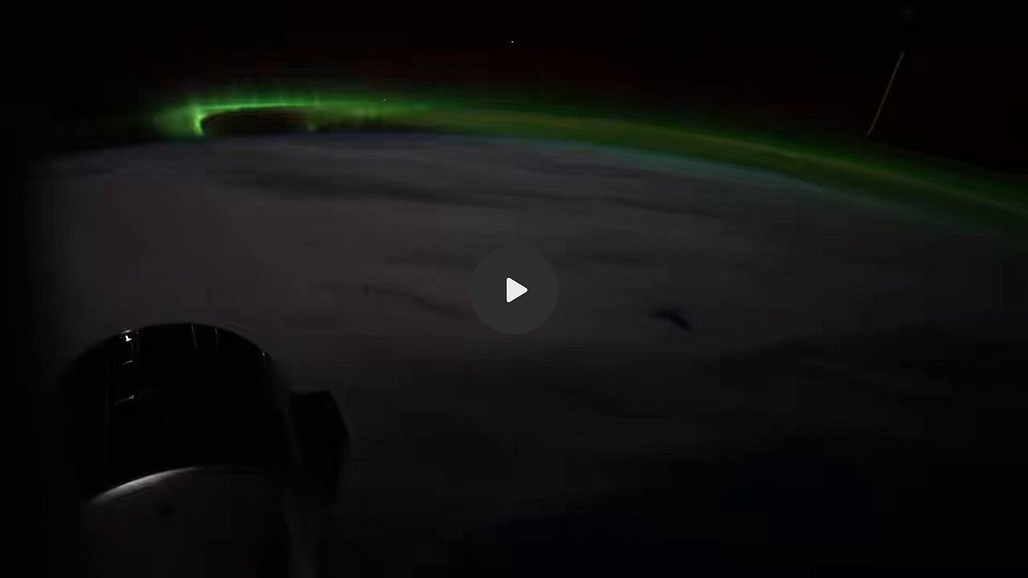

A recent solar event produces a spectacular southern aurora, captured in a mesmerizing timelapse video by astronaut Jessica Meir from the vantage point of a SpaceX Dragon capsule. The rare celestial display, which snakes and dances directly beneath the orbiting spacecraft, offers viewers a unique, top-down perspective of the aurora australis as it illuminates the Earth’s upper atmosphere.
Meir shares the breathtaking footage on the social media platform X on June 7, describing the orbital experience as an “ethereal and emotionally evocative phenomenon.” The timelapse reveals vibrant green ribbons of light undulating across the planet, providing a stark, luminous contrast to the dark void of space and the distinct curvature of the Earth visible in the frame.
“As opposed to the previous aurora I’ve seen, this one danced and snaked its way directly below us, putting on quite a show,” Meir writes in her post, which quickly garners hundreds of thousands of views and thousands of likes across various platforms. The footage not only captivates the public but also provides valuable visual data for scientists studying space weather and its ongoing interactions with Earth’s magnetic field.
Auroras, encompassing both the northern lights and the southern lights, occur when charged particles from the sun collide with gases in Earth’s atmosphere. These particles, primarily electrons and protons, are often released during intense solar events such as coronal mass ejections or solar flares. When they reach Earth, the planet’s magnetic field funnels them toward the poles, where they interact with oxygen and nitrogen molecules.
The collisions excite these gases, causing them to emit photons of light. Oxygen typically produces the green and red hues seen in the video, while nitrogen contributes blue and purple tones.
The predominantly green color visible in Meir’s timelapse indicates collisions with oxygen molecules at altitudes of roughly 60 to 190 miles above the surface.
The current level of solar activity aligns closely with the peak of Solar Cycle 25. The sun operates on an approximate 11-year cycle, transitioning from periods of quiet, known as solar minimum, to periods of intense activity, known as solar maximum.
During the maximum phase, the sun’s magnetic field becomes highly complex and unstable, leading to a significant increase in sunspots, solar flares, and coronal mass ejections.
This heightened solar activity translates directly to more frequent and intense geomagnetic storms on Earth, which serve as the primary drivers of spectacular auroral displays like the one captured by the SpaceX crew.
Space weather tracking agencies continuously monitor the sun for these violent eruptions, issuing watches and warnings when significant geomagnetic storms approach Earth.
These storms are categorized on a scale from minor to extreme. The recent solar event responsible for the southern aurora likely ranks high on this tracking scale, given the visual intensity and widespread nature of the orbital light show.
While these storms create beautiful visuals for astronauts and ground observers, they also carry the potential to disrupt satellite operations, interfere with global GPS navigation systems, and cause dangerous fluctuations in terrestrial power grids.
Viewing an aurora from space offers a distinctly different experience compared to observing it from the ground. Earth-bound observers typically look up into the night sky, seeing the lights as towering curtains or shimmering pillars overhead.
Astronauts aboard orbiting platforms fly through or directly above these glowing atmospheric layers. This orbital perspective allows them to see the true three-dimensional structure of the aurora as it forms a ring around the planet’s magnetic poles.
The timelapse video perfectly illustrates this structural reality, showing the green bands of light hugging the curvature of the Earth.
The SpaceX Dragon spacecraft serves as an ideal observation deck for such high-altitude events. Designed to ferry crew and cargo to low-Earth orbit, the capsule features windows that allow astronauts to monitor their immediate surroundings and document their journey. The high-definition cameras utilized by modern astronauts capture details and nuances that transform a highly technical scientific occurrence into a universally shared human experience.
Meir’s characterization of the aurora as “emotionally evocative” highlights the profound psychological impact of space travel, a phenomenon researchers often refer to as the “overview effect.” Astronauts frequently report a cognitive shift upon seeing the Earth from orbit, characterized by a deep sense of awe and a structural understanding of the planet’s fragility. Witnessing a violent solar storm manifest as a delicate, dancing ribbon of light against the darkness of space serves as a potent reminder of the dynamic forces that continuously shape the environment of the solar system.
The visual data from this SpaceX mission is currently being formatted for publication across independent media platforms, highlighting a growing trend where primary source material from space is directly integrated into digital newsletters and podcast feeds.
As Solar Cycle 25 continues its active phase, scientists and space enthusiasts anticipate further displays of both the northern and southern lights. For those orbiting Earth, the ongoing solar maximum guarantees more front-row seats to nature’s most spectacular light shows.
X:
“A timelapse view from our @SpaceX Dragon of the spectacular southern aurora seen in yesterday’s post, a result of a recent solar event. As opposed to the previous aurora I’ve seen, this one danced and snaked its way directly below us, putting on quite a show. I am in awe of this ethereal and emotionally evocative phenomenon. “ Jessica Meir ( @astro_Jessica )