

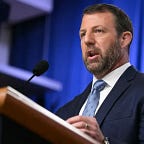

WASHINGTON — Homeland Security Secretary Markwayne Mullin’s long-standing history of promoting claims that the 2020 election was stolen is fueling widespread concern among state and local election officials as the midterm season approaches.
Critics point to Mullin’s record as a senator from Oklahoma, where he joined 147 congressional Republicans in voting against certifying the 2020 election results hours after the Jan. 6, 2021, attack on the U.S. Capitol.
During his recent Senate confirmation hearing, Mullin declined to explicitly state that President Joe Biden won the 2020 election, opting instead to note that Biden was sworn into office.
This rhetoric has prompted skepticism from nonpartisan and Republican election administrators alike. Matt Crane, a former Republican county clerk who now leads an organization for local election officials in Colorado, stated he is actively advising jurisdictions to withhold data from the Department of Homeland Security.
“I don’t trust how the administration is using that data,” Crane said. “I don’t trust that they’re going to keep it confidential.”
The friction centers on the federal government’s role in election security.
In 2020, the Cybersecurity and Infrastructure Security Agency, an arm of DHS, declared the election the most secure in American history.
Current administration officials, however, have signaled a more aggressive approach. Border czar Tom Homan recently discussed the possibility of Immigration and Customs Enforcement (ICE) presence at polling places, citing election security as a core DHS responsibility.
While Mullin testified that DHS would only deploy agents to polling sites in response to specific threats, the trust between the federal government and local officials has been severely damaged.
Kathy Boockvar, Pennsylvania’s former top voting official, described the working relationship as “eradicated.”
Election security experts warn that the elevation of officials who have embraced election denialism could undo a decade of bipartisan progress.
Following Russian interference in the 2016 election, the federal government spent years building a robust network of threat monitoring and information sharing with over 10,000 local jurisdictions. Officials now report that this coordination has effectively halted.
In a statement to NPR, the Department of Homeland Security maintained that Secretary Mullin is committed to “restoring integrity to our election system.”
Despite these assurances, the divide continues to deepen, leaving local clerks to navigate a heightened threat landscape without the traditional support structures previously provided by Washington.
Source: Reporting and interview segments provided by NPR.


